
VW recalls another 22,524 ID.4 vehicles due to fire hazards
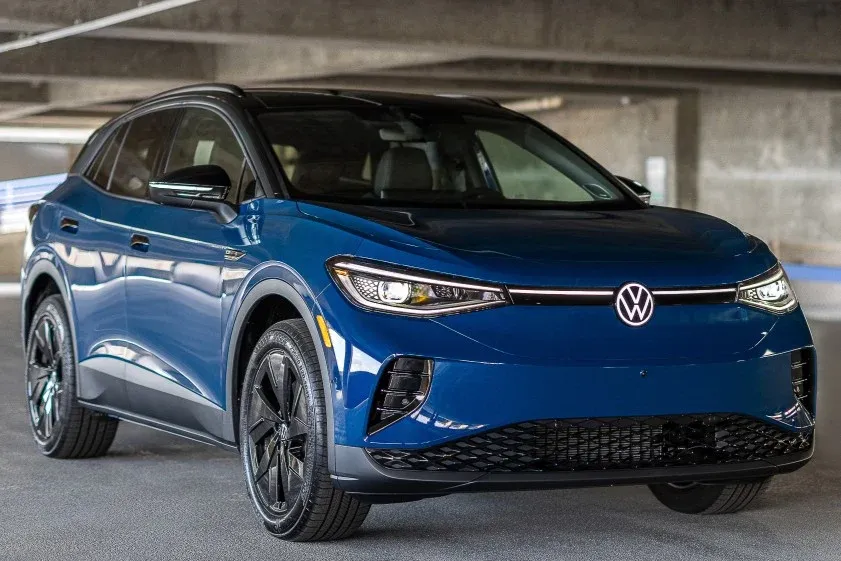
Volkswagen announces another recall in the U.S. for 22,524 ID.4 vehicles. Until a final solution is found, the affected cars should only be charged to 80 percent capacity at most.
22,524 ID.4 vehicles must be recalled in the U.S. due to a potential battery risk.
Image: VW
After Volkswagen recalled nearly 100,000 electric vehicles worldwide in the spring due to possible battery issues (including almost 44,000 ID.4s in the U.S.), another recall campaign for this electric SUV is now underway. In a statement to the U.S. National Highway Traffic Safety Administration, Volkswagen announced the recall of 22,524 ID.4 models from model years 2023 to 2026.
The exact cause has not yet been determined. According to Volkswagen, certain high-voltage batteries may experience thermal expansion within the battery when specific charging profiles are used at a charge level above 80 percent. In the worst case, this can lead to a vehicle fire.
Until a final repair solution is available, Volkswagen recommends that owners charge their vehicles to no more than 80 percent. Depending on the vehicle configuration and connectivity, the maximum charge level can technically be limited to 80 percent in some ID.4 models as well. Additionally, warning messages are included in the vehicles as a temporary measure.
Volkswagen estimates that around 0.1 percent of the recalled vehicles are actually affected by this defect. The manufacturer identifies SK Battery America as the supplier of the defective battery cells. Between January 2024 and August 2026, Volkswagen received 22 such cases or complaints in the U.S.
This latest recall follows two previous U.S. recalls launched in January for a total of 44,551 ID.4 vehicles. At that time, improperly aligned electrodes in SK Battery America’s battery cells were the issue. In the newly announced recall, the high-voltage battery also comes from SK Battery America, though Volkswagen states that the exact cause remains unclear. So far, it is only known that certain charging profiles combined with a charge level above 80 percent can trigger thermal expansion.
The investigation began in June. In September, Volkswagen Group’s Product Safety Committee concluded that a voluntary recall was necessary due to potential safety risks, even though the root cause of the issue had not yet been identified. The recall is designated as 93EX by Volkswagen and referenced as 26V630 by the NHTSA. Owner notifications are expected to be sent by November 27.
This brings the ID.4 under another battery recall campaign in a short period of time. Earlier that spring, Volkswagen recalled nearly 100,000 MEB electric vehicles worldwide due to potential battery problems. In the U.S., almost 44,000 of these were ID.4 models.
ID. Polo and Cupra Raval recalled in Germany
A separate recall, independent of this one in terms of technical reasons, is underway for several newer models from the Volkswagen Group that also affects Germany. Due to potentially improperly secured seat belts, 1,109 VW ID. Polo vehicles as well as 10,151 Cupra Raval and Terramar models worldwide need to be inspected.
In the ID. Polo, the seat belt system on the passenger side may not have been properly attached to the anchor point in the B-pillar. According to the German Federal Motor Transport Authority, this can significantly reduce the restraint effect in the event of an accident. In Germany, 239 vehicles from the production period of July 21 to September 3, 2026, are affected. Volkswagen is conducting this action under code 69G1, while the KBA’s reference number is 17099R.
In the case of Cupra, the issue relates to the fastening of the front seat belts at their lower anchor points. A total of 10,151 vehicles worldwide are affected by the recall of the Raval and Terramar models, including 1,936 in Germany. The production period spans from June 7, 2025, to September 3, 2026. The action code is 69C8, and the KBA reference number is 17072R.
The affected vehicles should be inspected at an authorized service center. If necessary, the respective seat belt will be replaced. No property or personal injuries related to these two belt recalls have been reported to the KBA to date.