
VW ID. Tiguan premiere: ID.4 successor starts at €42,695
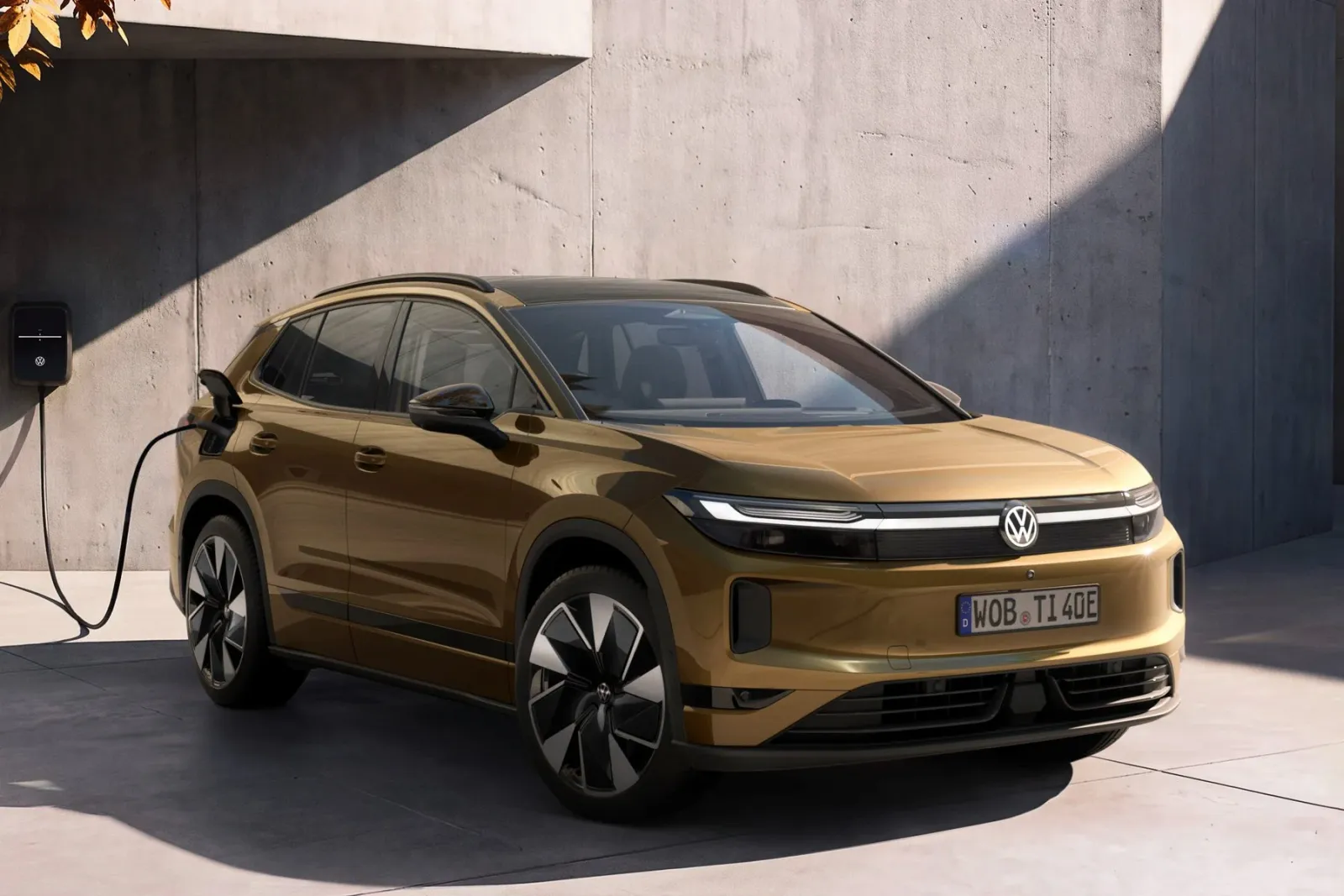
In early 2027, Volkswagen will replace its E-SUV ID.4 and its derivative ID.5 with the ID. Tiguan - emphasising its kinship with the best-selling combustion-engine Tiguan. The new VW ID. Tiguan offers drivetrains with up to 220 kW, range of up to 600 km, and towing capacities of up to two tonnes.
The new VW ID. Tiguan will launch in early 2027
Image: VW
Although the ID. Tiguan name change has been widely known since early 2026 – thanks to IG Metall Emden – the Volkswagen Group only officially confirmed it a few days ago when it simultaneously released the first camouflaged images of the VW ID. Tiguan. With today’s world premiere, the camouflage is now gone – and along with plenty of images, there comes a wealth of data about this electric SUV.
Let’s first hear what VW’s brand chief has to say about the new electric model: “The Tiguan is our best-selling model worldwide, and the ID.4 and ID.5 are among our most successful electric cars. The ID. Tiguan brings these two success stories together. A pure, confident design with the presence of a vehicle from the next class up, intuitive operation and, thanks to MEB+, a range of up to 600 kilometres: a new benchmark for our electric SUVs made in Germany. Together with the Tiguan from Wolfsburg, the ID. Tiguan from Emden is part of one of the strongest SUV duos in Europe.”
VW ID. Tiguan available for pre-order from 13 October
Volkswagen plans to launch the 4.62-metre-long, 1.86-metre-wide, and 1.62-metre-high electric SUV, with a wheelbase of 2.77 metres, in the market at the beginning of next year. Pre-orders will be possible in Germany and many other European countries starting next Tuesday, 13 October. Prices – which are not yet available in detail – will start at €42,695. For comparison: the predecessor, the VW ID.4, currently starts at €40,580.
The VW ID. Tiguan will be available in three power levels: a rear-wheel-drive model with 140 kW and a 58-kWh LFP battery; a rear-wheel-drive model with 210 kW and a 77-kWh NMC battery; and a 220 kW (299 PS) 4MOTION all-wheel-drive model, also with the 77-kWh battery. There will also be four equipment versions: ‘Trend’, ‘Life’, ‘Style’, and ‘R-Line’.
Up to 600 km range and 165 kW charging power
Homologation of the three variants is not yet complete, but Volkswagen expects its electric Tiguan to achieve WLTP ranges of up to 600 km, depending on the drivetrain and battery size. However, the charging power is not exactly state-of-the-art, as the following table shows:
| Feature | 58-kWh Battery (LFP) | 77-kWh Battery (NMC) |
| --- | --- | --- |
| AC Charging Power | max. 11 kW | max. 11 kW |
| DC Charging Power | max. 105 kW | max. 165 kW |
| DC Charging Time 10–80% | approx. 26 min | approx. 29 min |
Even if the charging power, fast-charging times, and ranges may seem underwhelming compared to other models presented in 2025 or 2026, such as the BMW iX3 or the all-electric Mercedes-Benz GLC, it must be noted that this is not a premium vehicle. At the same time, Volkswagen emphasises that the VW ID. Tiguan supports a variety of charging features. These include Plug & Charge, Smart Charging, and bidirectional charging options: Vehicle-to-Load (V2L) for powering external devices using energy from the vehicle battery, Vehicle-to-Home (V2H) for integrating the vehicle into home energy management, and Vehicle-to-Grid (V2G) for feeding electricity back into the public grid.
VW ID. Tiguan can tow a caravan on holiday
The VW ID. Tiguan is designed as a fully electric family car that can also tow a caravan on holiday – the towing capacity is up to 1,800 kg with the 58-kWh battery and a maximum of 2,000 kg with the 77-kWh battery. Inside, the electric SUV offers a spacious interior for five people, as well as optional massage and ventilation functions for the seats and a Harman Kardon sound system. For luggage, the boot provides up to 534 litres of space, and there is also a frunk under the bonnet with 32 litres of storage.
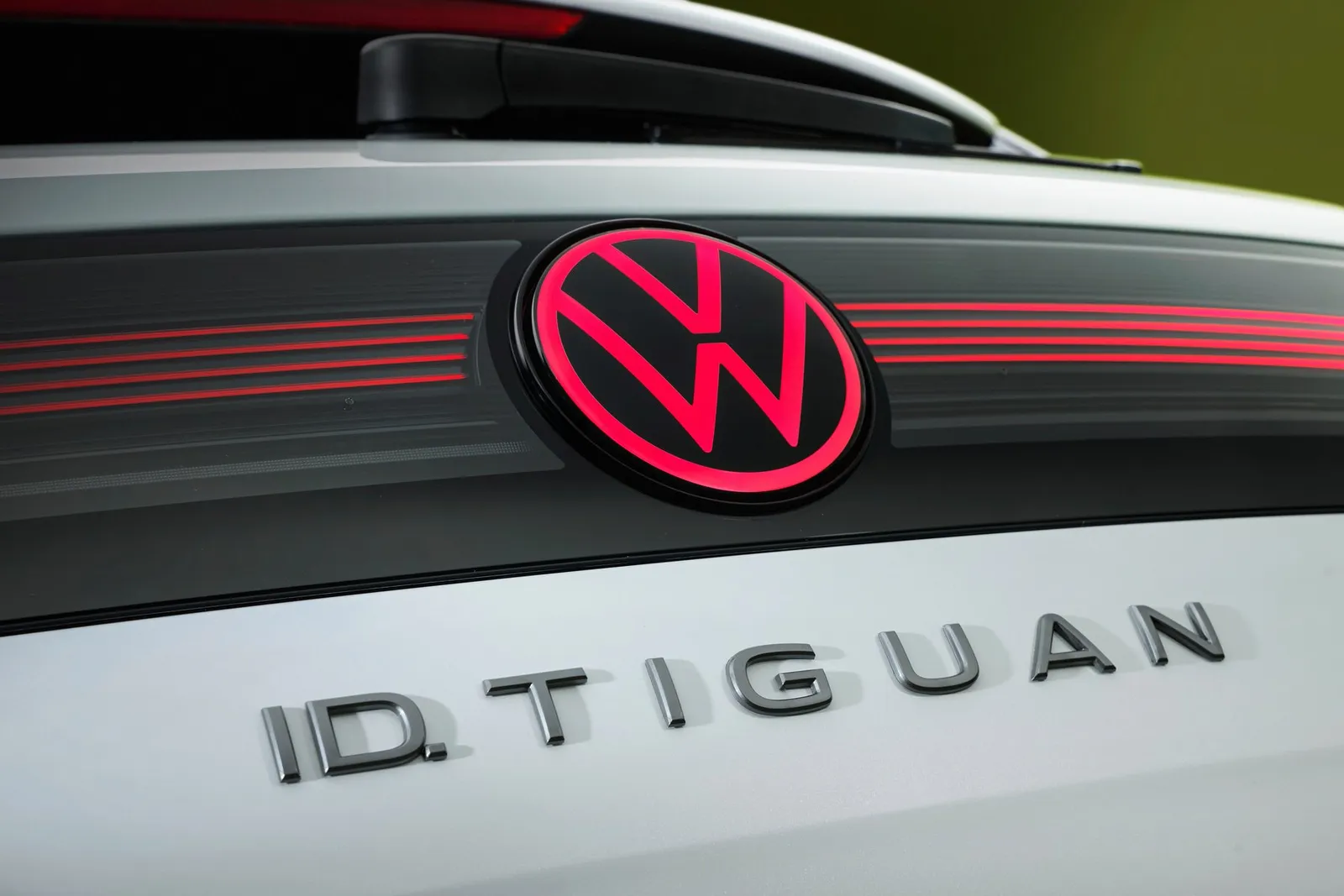
Image: VW
- 1/15
- 2/15
- 3/15
- 4/15
- 5/15
- 6/15
- 7/15
- 8/15
- 9/15
- 10/15
- 11/15
- 12/15
- 13/15
- 14/15
- 15/15
Let’s take a look at the cockpit: For the first time in a European model, VW is offering a passenger display (12 inches, 30.5 cm diagonal), similar to the one in the Chinese model ID.UNYX 08. This display “opens up a new world, especially for the front passenger – one where they can immerse themselves in their own world of infotainment, information, and gaming without distracting the driver,” according to Volkswagen. Similar to a laptop privacy screen, the passenger display is not visible to the driver (Privacy Mode). In private mode, the passenger can receive audio via their paired Bluetooth headphones. Also new are the 10-inch driver display (‘Digital Cockpit’, 25.4 cm diagonal) and the central 15-inch infotainment display (38.1 cm diagonal).
At the same time, the operating logic has been revised compared to the ID.4. Important functions are once again accessible via physical buttons, placed where they are intuitively expected. For example, the air conditioning system’s basic functions are now controlled via a button panel in the centre console. Another example is the audio volume and station/track selection, which are primarily handled using a tactile dial in the centre console. In front of this are two inductive charging points based on the Qi2 standard for the driver’s and passenger’s smartphones. Additionally, an old acquaintance from the combustion engine world returns to the cockpit: the multifunction steering wheel with physical buttons instead of touch surfaces.
| Feature | ID. Tiguan 140 kW | ID. Tiguan 210 kW | ID. Tiguan 220 kW |
| --- | --- | --- | --- |
| Power Output | 140 kW | 210 kW | 220 kW |
| Drivetrain | Rear-wheel drive | Rear-wheel drive | All-wheel drive |
| Battery (net) | 58 kWh | 77 kWh | 77 kWh |
| Battery Type | LFP | NMC | NMC |
| WLTP Range, max. | 450 km | 600 km | 560 km |
| 0–100 km/h | 8.5 s | 6.6 s | 6.3 s |
| Top Speed | 160 km/h | 180 km/h | 180 km/h |
What else? Volkswagen mentions the new design language, ‘Pure Positive’, which has had a major influence on the exterior design of the electric Tiguan: “The softer crossover design of the predecessors has given way to a powerful SUV design with a strong visual presence. Precise lines and tightly sculpted surfaces lend it additional stability and quality,” said the manufacturer. This is intended to make the VW ID. Tiguan appear like a premium-segment vehicle. At the same time, Volkswagen is returning to classic loop door handles with the ID. Tiguan.