
Volkswagen ID.Tiguan 2027: All official details on the successor to the ID.4
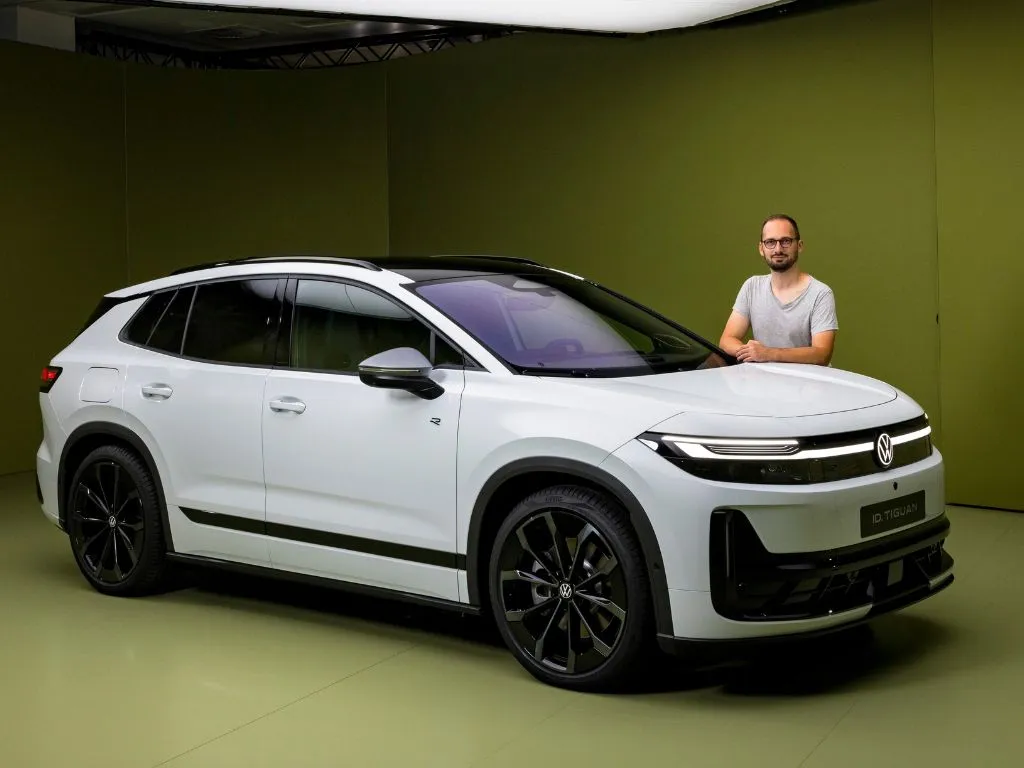
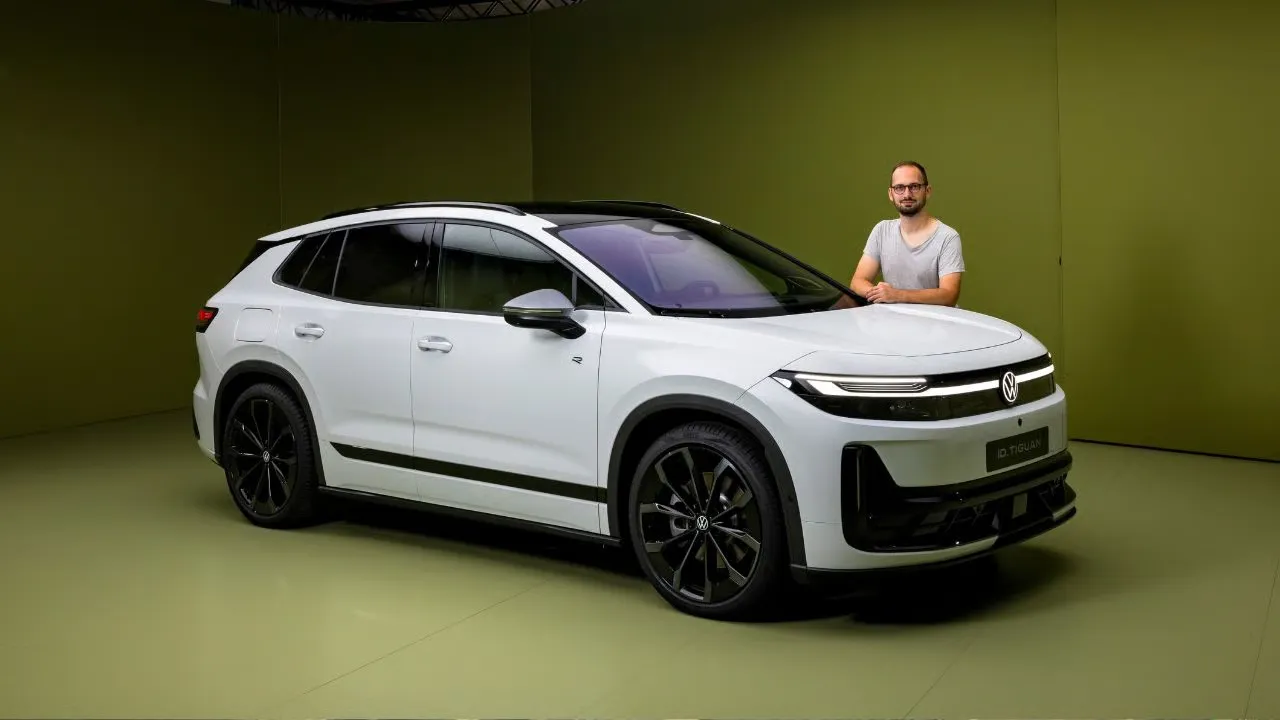
The Volkswagen ID.4 and ID.5 are being replaced by the ID.Tiguan. While the base structure remains the same, the exterior design has been significantly revised and the technical specifications have seen slight improvements. These are our initial impressions from the studio, looking at the R-Line trim.
According to several widely broadcasted automotive programs, a new look can bring a vehicle back to life. It follows that by adding a new name to a transformed design, a complete 180-degree shift can be achieved. Here’s the explanation behind the upcoming arrival of the ID.Tiguan, replacing the Volkswagen ID.4 launched five years ago. The name refers to the “mid-size” SUV that has been part of VW’s lineup for nearly 20 years.
In short:
The Volkswagen ID.4 and ID.5 are being replaced by the ID.Tiguan
Aesthetics and interior have changed significantly
A new engine and LFP batteries in the entry level
3 versions (190, 286, and 299 hp) / 2 battery capacities (58 and 77 kWh)
Range: 450 to 600 km WLTP / Charging speed: 105 to 165 kW
Also read
Volkswagen ID.Tiguan 2027: We’ve already tested the successor to the ID.4!
What’s changed in terms of design?
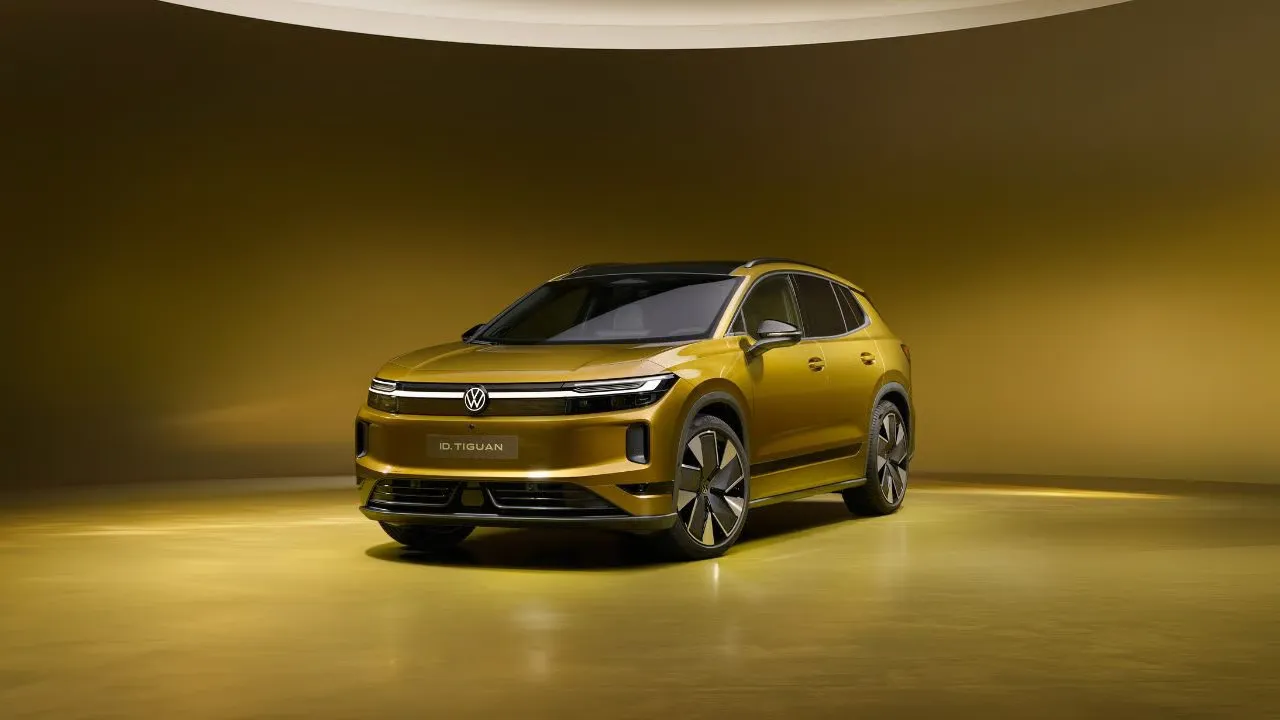
A lot. Until now, the ID.4 and ID.5 featured rounded designs. To give it a more Tiguan-like appearance, designers have opted for much more geometric shapes.
The entire front end has been redesigned. The horizontal grille extends from one headlight to the other. It features what VW calls an “aquarium,” which is a smoked and transparent surface above and below the illuminated white line as well as around the logo. A similar design can already be seen on the Opel Grandland. Below that, the technical area (cooling vents, cameras, etc.) takes on the shape of a sharp hook, with elements in the car’s body color used on the R-Line version shown in our photoshoot. The lines are straight or angled at 90 or 45 degrees.
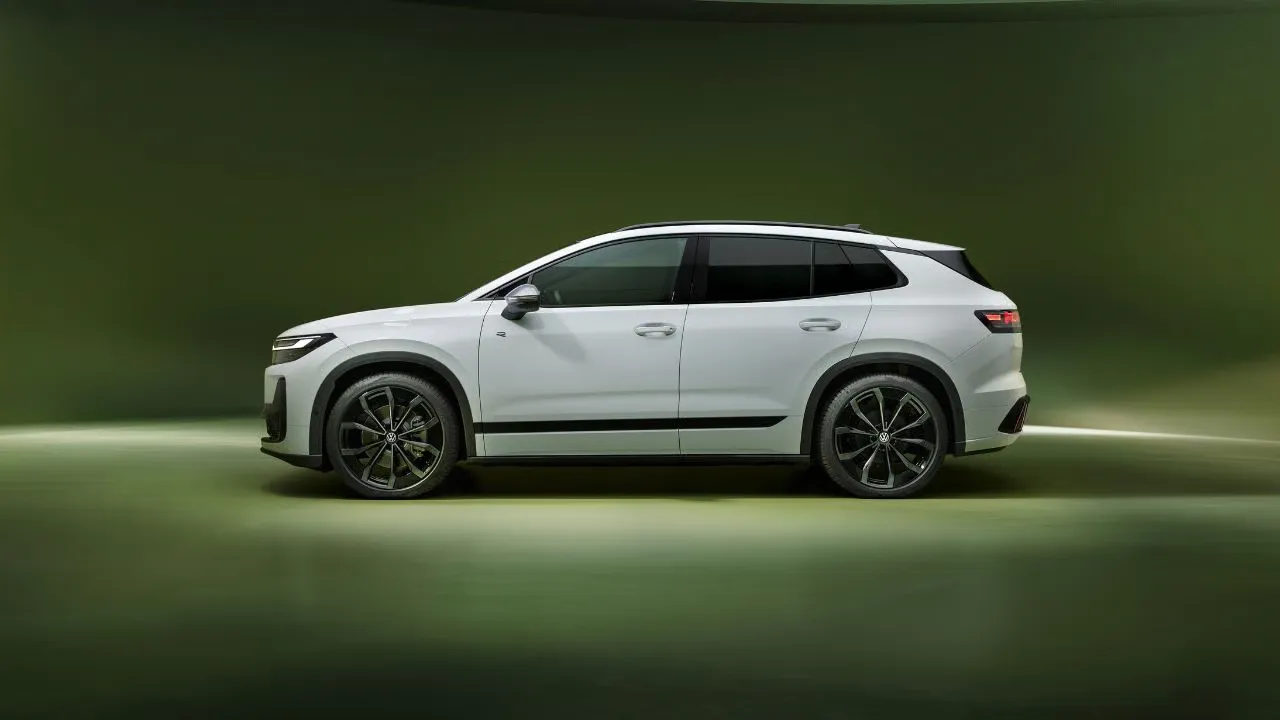
Let’s move on to the sides. VW has slightly widened the wheel arches to give it a more 4×4 vibe. The same applies to the matte plastic inserts. Interestingly, the conventional or hybrid Tiguan does without this trick. We also note the return of large door handles that are easy to grip with any hand. A black line helps slim down the large doors. Looking at the rear, there are significant changes around the C-pillar, located between the trunk lid and the window frame. There, VW has created a clean shoulder line and redesigned the trunk lid. On the ID.4, the body panel followed the curve of the windows in a wide arc. The aluminum-colored arch that ran along the hood is gone.
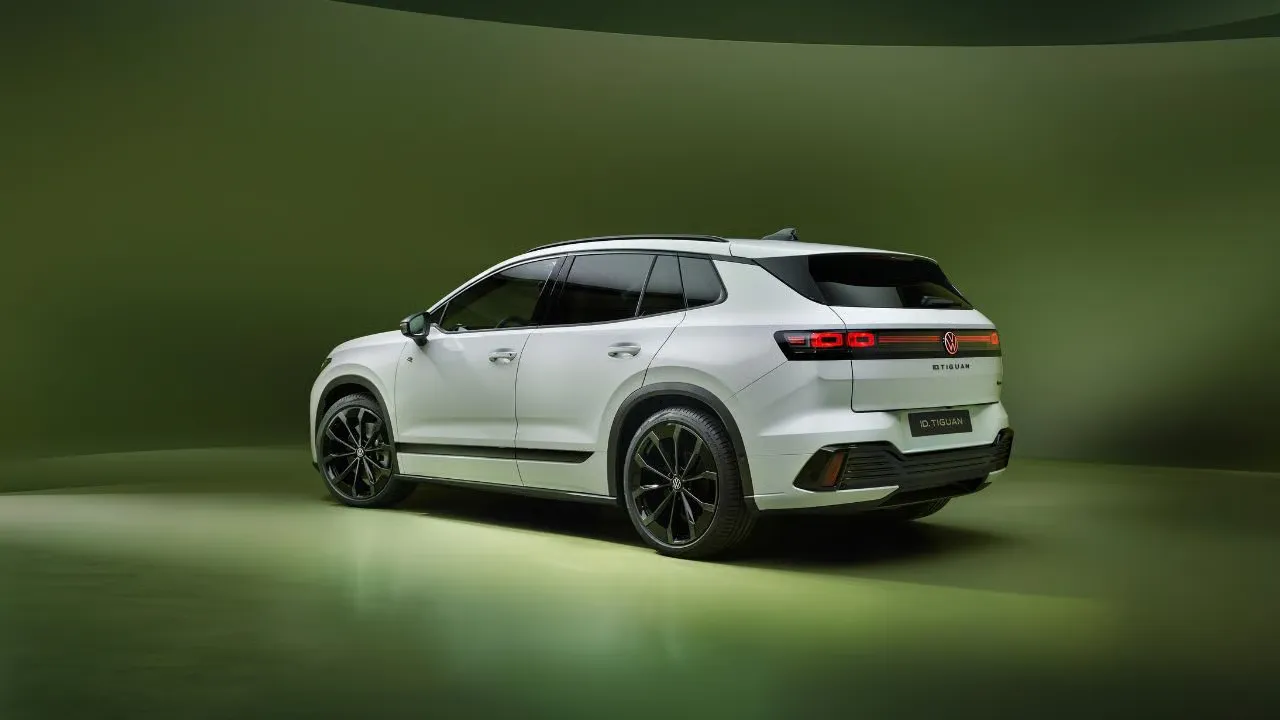
The rear design, more conventional in style, features the smoke-colored horizontal strip and red LED line that are characteristic of current Volkswagen models. It also includes rectangular taillights with a whisky glass finish, already present on the ID.Polo and ID.Cross.
Dimensions:
Length: 4.62 m
Width: 1.89 m
Height: 1.62 m
Wheelbase: 2.77 m
An observant eye will still recognize the sharply angled front pillars or the hood design from earlier models, but this update goes far beyond a simple facelift. VW has invested heavily in its electric SUV.
We should also note that Wolfsburg claims improved aerodynamics. The drag coefficient has dropped from 0.27 to 0.26. It would have been useful to have the third digit after the decimal point for a more precise idea of the improvement.
What about the interior?
There was also investment in this area. The dashboard is entirely new, standing out with its symmetrical design and greater emphasis on screens.
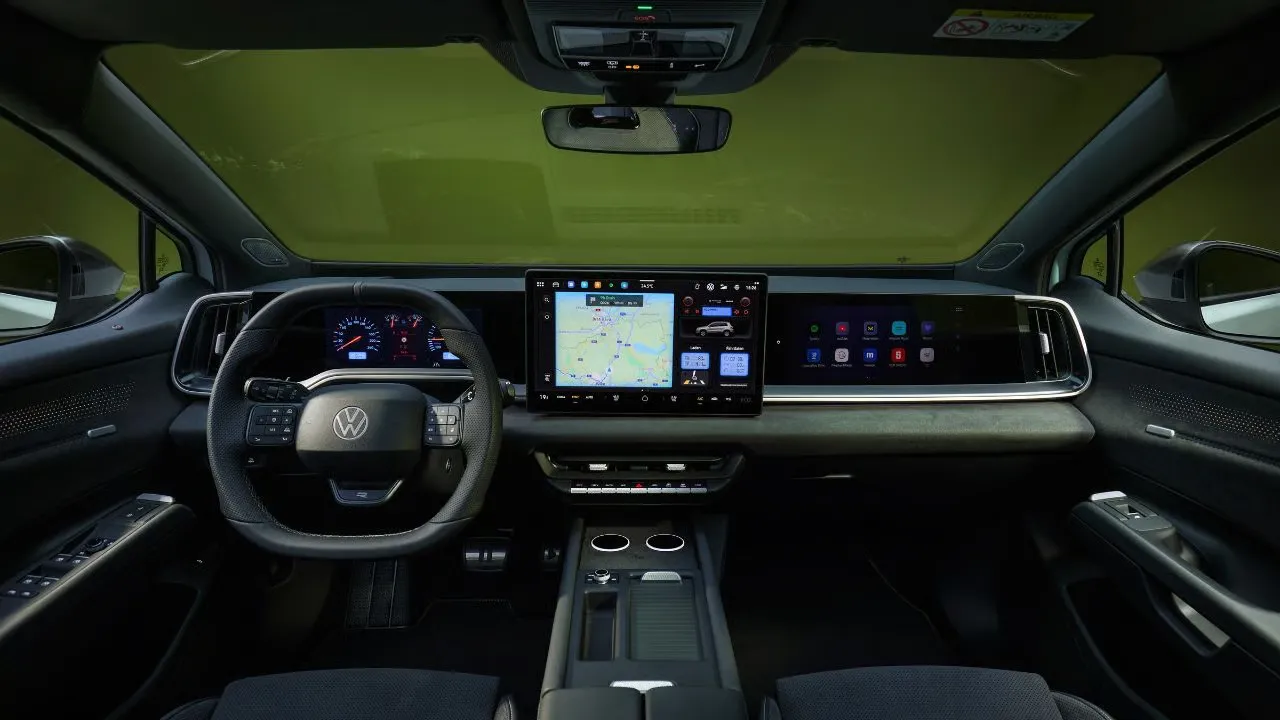
Let’s start with the screens, beginning on the right side. For the first time in Europe, a VW model is equipped with a third screen dedicated to entertaining the passenger. From the driver’s seat, it will not be possible to watch the latest episodes of Inoxtag or the return of L’Heure de Vérité: this 12-inch screen is designed so it cannot be read from beyond a certain angle. Passengers who wish to avoid disturbance can listen to their content through Bluetooth headphones.
In the center, the 15-inch diagonal infotainment screen uses the same design as that found in the ID.3 or ID.7. A brief test drive confirms it: it’s still far from being the best in terms of smoothness and response speed. But it’s already much neater than before. At 12 o’clock, the small instrument cluster is replaced by a 10-inch tablet. Various display views can be selected using a button on the steering wheel. The information can also be shown on the windshield via a head-up display (optional).
Dashboards in the style of Golf IV
VW continues down the nostalgic path. The ID.3 Neo has recently been equipped with square-shaped gauges reminiscent of the Golf I. Here, it’s the Golf IV that is symbolized. One of the available displays features round gauges on a blue background, evoking the compact car sold in Europe from 1997 to 2004. Like on the ID.3 Neo or ID.Polo, this “view” can be selected using a button on the steering wheel. One can also choose a navigation background or a simplified, more modern display. On the central screen, a vintage home screen is also available. In a designated area, one can place their favorite Volkswagen model, from the Beetle to the diesel Touareg used in the Dakar race (evoking memories of Carlos Sainz or Jutta Kleinschmidt). It’s trivial, but pleasant.
The very horizontal layout of the dashboard is interrupted by the central console, which features two inductive charging ports for phones. There is storage space at the bottom as well as a tray covered by a butterfly-style folding armrest.
Similar to the recent ID.Polo and ID.3 Neo, VW has also opted to revert to its proven ergonomic designs. The air conditioning is controlled via buttons, the radio through a dial, and there’s no need to press an additional button to open the rear windows. Good. Our right hand will thank us.
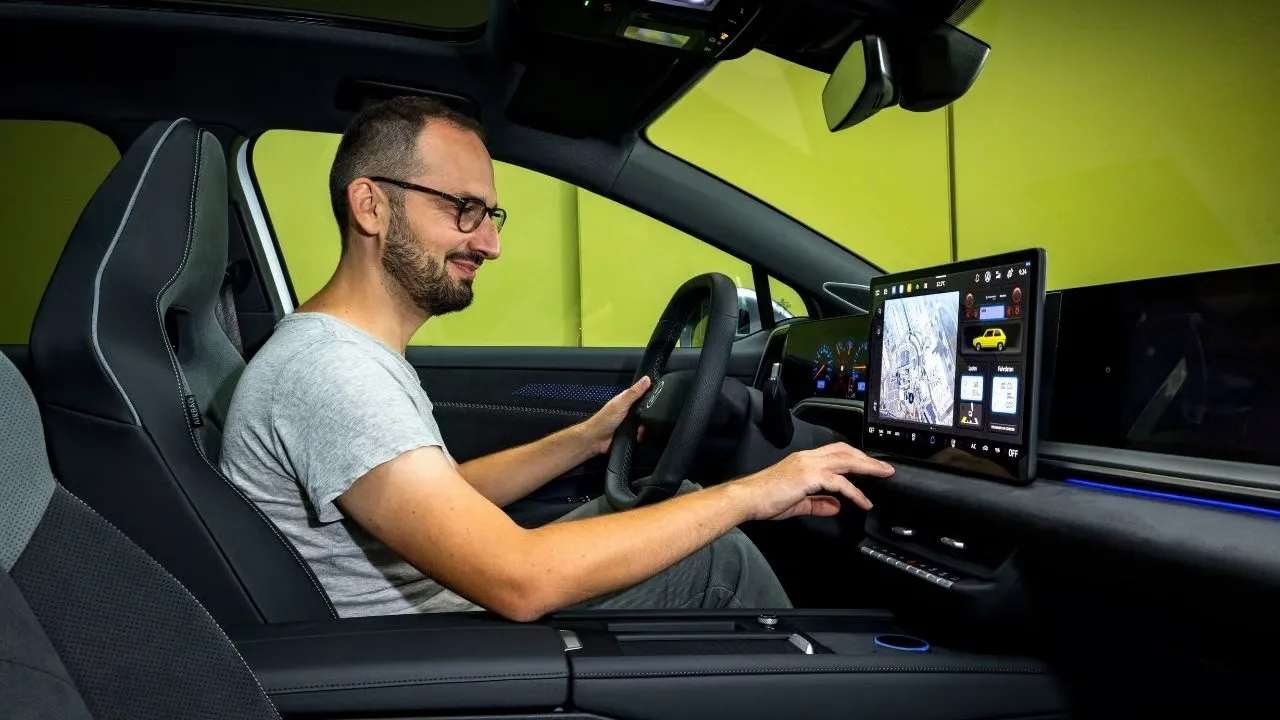
Our R-Line version adopts a sporty look with markings under the steering wheel hub, additional padding, and spacious semi-bucket seats. The overall quality of the materials is good, with a focus on using light effects and R-Line inserts.
Otherwise, the interior space and dimensions remain similar to those of the ID.4. There’s ample knee room in the rear seats. The trunk capacity ranges from 534 to 1,577 liters. The seat back can be divided in a 40/60 ratio, and the ski trunk allows you to store… skis.
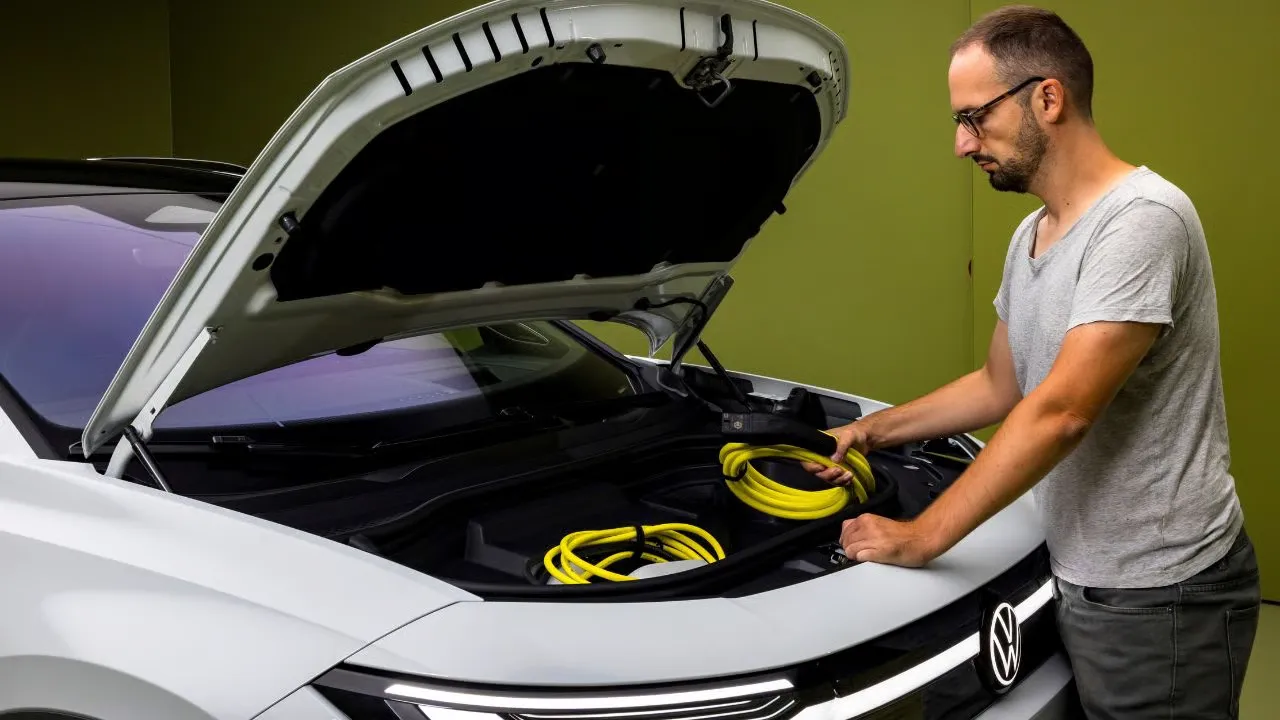
Hello, frunk
The Volkswagen ID.4 was part of that odd group of rear-wheel-drive SUVs without a frunk. The brand has corrected this oversight. But be warned—it’s quite minimal; with about 30 liters, you can store cables, not hiking gear.
What’s changing technically?
A fair number of things. The German group’s MEB platform has undergone several upgrades, and it is now called MEB+. The first novelty is the new APP350 engine introduced recently on the ID.4, as well as on the ID.3 Neo and Audi A2 e-tron, which serves as the entry-level model (190 hp). It joins another engine, the APP550, which has been available for several model years. This new APP350 engine is paired with an inverter that uses silicon carbide (SiC) semiconductors. The theoretical fuel consumption figures are very promising.
The second innovation is the introduction of cheaper lithium-iron-phosphate (LFP) batteries in 58 kWh versions. The “long-range” versions still use nickel-manganese-cobalt (NMC) batteries with 77 kWh capacity. Range varies from 450 to 600 km according to WLTP standards, while charging speeds reach 105 to 170 kW at fast chargers.
Other elements of the MEB platform remain unchanged. For example, the front motor is used in four-wheel-drive versions, there’s an option for adaptive suspension, and the voltage remains at 400 volts.
What versions are available?
Propulsion, 190 hp, 58 kWh
Propulsion, 286 hp, 77 kWh
4-wheel drive, 299 hp, 77 kWh
Trims:
Trend, Life, Style, R-Line
What range? What charging requirements?
The technical improvements offer a slight improvement in fuel efficiency, although Volkswagen has not yet provided final figures. Thus, the ID.4 with 286 hp and a 77 kWh battery previously had an announced WLTP range of 569 km. With the ID.Tiguan equipped with the same powertrain, the range is expected to approach 600 km. It should therefore have lower fuel consumption than the previous model’s 16.5 kWh/100 km figure.
Provisional maximum ranges on WLTP cycle (source: Volkswagen)
Electric/190 hp: 450 km
Electric/286 hp: 600 km
4WD/299 hp: 560 km
Similarly, the entry-level model is improving. Until now, it was equipped with a 58 kWh battery and claimed “up to 433 km” range in the latest brochure from July for the 2027 model year ID.4. With the new APP350 engine (and its SiC inverter) and revised aerodynamics, the range could potentially reach much higher levels, around 450 km. Of course, these figures should be viewed with caution depending on the wheels and additional equipment.
Also read
Volkswagen ID.Polo review: A versatile city car… really?
In terms of charging capacity, it remains competitive for a “400 volts” vehicle. The ID.Tiguan’s charging peaks are set at 105 kW (58 kWh) and 165 kW (77 kWh). These figures have slightly decreased in recent months with the introduction of new powertrains (they were 135 and 175 kW in 2024). Should we be concerned? Not really, as the charging times to reach 80% from 10% at a fast charger are 26 minutes for the smaller battery and 29 minutes for the larger one. Similar brands previously achieved times just under half an hour. This is also reasonable for a 400 volts model.
What will the prices be?
The ID.Tiguan will be produced at the historic Emden plant in northern Germany. It should therefore qualify for EU subsidies, reducing the price based on your income and the number of tax residents in your household. The previous ID.4 was priced between 42,000 and 56,000 euros. As of now, VW has not yet announced the prices for the new ID.Tiguan. The perceived improvement in quality is unlikely to significantly change things. However, the French subsidiary is currently offering substantial discounts on its ID.Polo, ID.3, and ID.7 models... We will keep you updated.
When is it coming out?
Prescriptions will open on October 13. The first units will arrive at dealerships in France in early March 2027.
That’s encouraging... The development is progressing nicely.
It’s disappointing... The platform remains heavy.
Farewell, dear ID.5
VW confirms it: the arrival of the ID.Tiguan means the end of the road for the Volkswagen ID.5. The “coupe” version did not achieve — to put it mildly — the expected success. Last year, 12,000 ID.5s were sold in Europe compared to nearly 80,000 ID.4s with a more conventional design. That’s a ratio of over one to six. Volkswagen Group, which is pursuing a strategy to reduce the number of models, had little interest in continuing with this design. For comparison, on the same MEB platform, the ratio for the Ford Explorer/Capri pair was less than three.
Technical specs
Volkswagen ID.Tiguan 190 hp/58 kWh
Engine: rear-mounted (APP350)
Transmission: front-wheel drive, 1 gear + reverse
Range: up to 450 km
Battery: lithium-iron-phosphate (LFP)
Wallbox charging: 11 kW
Rapid charging (peak): 105 kW
Charging from 10-80%: 26 minutes
Weight: starting at 2,073 kg
0 to 100 km/h: 8.5 seconds.
Top speed: 160 km/h
Volkswagen ID.Tiguan 286 hp/77 kWh
Engine: rear-mounted (APP550)
Transmission: front-wheel drive, 1 gear + reverse
Range: up to 600 km
Battery: nickel-manganese-cobalt (NMC)
Wallbox charging: 11 kW
Rapid charging (peak): 165 kW
Charging from 10-80%: 29 minutes
Weight: starting at 2,155 kg
0 to 100 km/h: 6.6 seconds.
Top speed: 180 km/h
Volkswagen ID.Tiguan 299 hp/77 kWh
Engine: rear + front-mounted (AKA150)
Transmission: all-wheel drive, 1 gear + reverse
Range: up to 560 km
Battery: nickel-manganese-cobalt (NMC)
Wallbox charging: 11 kW
Rapid charging (peak): 165 kW
Charging 10-80 %: 29 minutes
Weight: over 2,200 kg (AP estimate)
0 to 100 km/h: 6.3 s.
Top speed: 180 km/h