
The Volkswagen ID. Tiguan will replace the ID.4 in 2027. It finally comes with buttons and a front trunk.
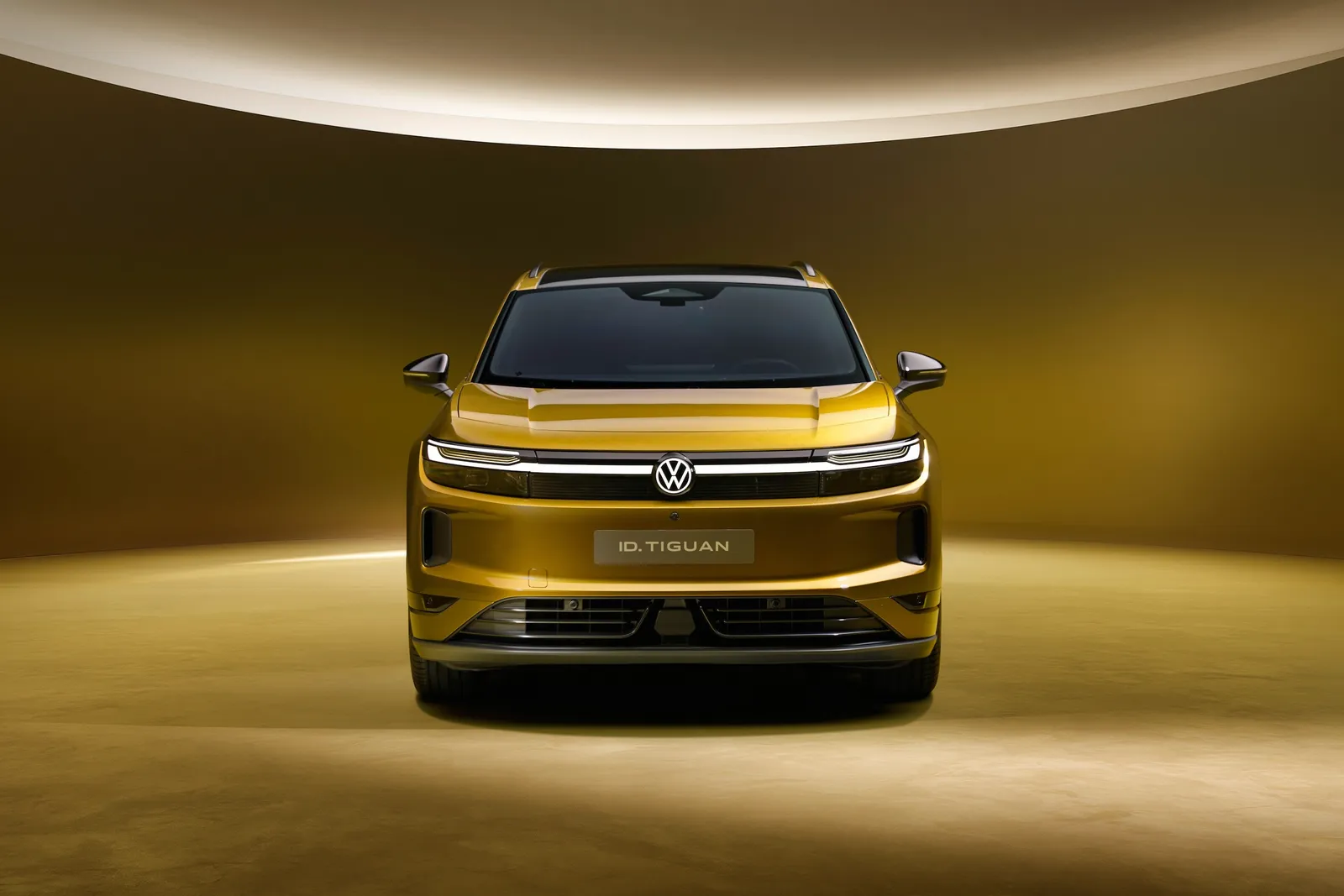
Volkswagen unveiled the ID. Tiguana on October 9, 2026, an electric SUV that will replace the ID.4 and ID.5 models. The vehicle is expected to achieve up to 600 km of WLTP range, come in two battery capacities, offer rear-wheel or all-wheel drive, and go on sale in Europe at the beginning of 2027.
Table of Contents
Show
Hide
The ID. Tiguana isn’t just a simple name change. Volkswagen has improved several aspects that frustrated users since the launch of the ID.4. Physical buttons have returned, a single-pedal driving mode was added, there’s a small front trunk, and a V2L function is included.
The ID. Tiguana replaces two models and focuses on a familiar design
The ID.4 debuted in 2021 and turned out to be a spacious, fairly competent electric car. However, it wasn’t free from criticism. The most common complaints related to the software, the touch controls on the steering wheel, the unlit sliders under the screen, and controlling the rear windows using two buttons and an additional switch.
In the ID. Tiguan, Volkswagen clearly moves away from these designs. The car still uses the MEB+ architecture but looks more like a conventional SUV from the brand. It features a higher and visually longer front bumper, a more sharply defined side profile, and light strips on both the front and rear. The Volkswagen emblem is also illuminated.
This is a deliberate move toward drivers who are not seeking a futuristic experiment. The Tiguan name is well-known, and the car no longer tries at all costs to show that it has a battery under its floor. In terms of size, it remains similar to the ID.4, so one should not expect an electric version of the larger Tayron.
The new model will also replace the ID.5, which is a more streamlined version with a sharply sloping roof. In this way, Volkswagen simplifies its lineup and focuses on one traditionally designed SUV.
Two batteries, up to 600 km WLTP range and 2 tons of towing capacity
The base ID. Tiguan will come equipped with a 58 kWh battery, rear-wheel drive, and an engine producing 187 horsepower. Volkswagen has not specified the battery chemistry nor confirmed whether it refers to net capacity.
The version above is the rear-wheel-drive model with a 77 kWh battery and 282 HP of power. The same battery will be used in the 4Motion all-wheel-drive variant, which will deliver around 295 HP.
Version
Battery
Drive Type
Power
Maximum Towing Capacity
ID. Tiguan 58 kWh
58 kWh
rear-wheel drive
187 HP
1800 kg
ID. Tiguan 77 kWh
77 kWh
rear-wheel drive
282 HP
2000 kg
ID. Tiguan 77 kWh 4Motion
77 kWh
all-wheel drive
around 295 HP
2000 kg
The declared maximum range is 600 km WLTP. This likely applies to the rear-wheel-drive version with a 77 kWh battery, although Volkswagen has not yet officially assigned this value to a specific configuration. This is 26 km more than the comparable ID.4.
The manufacturer has not specified the DC charging power, the time it takes to charge from 10 to 80 percent, or the performance metrics. As a result, we don’t know whether MEB+ will bring significant improvements for long trips or if the main changes will be limited to software, equipment, and efficiency.
A new feature is V2L, which allows external devices to be powered by the car’s battery. Access to this power is provided through an adapter connected to the charging port. The ID. Tiguan will also feature one-pedal driving, enabling deceleration until the vehicle stops primarily using the accelerator pedal.
There is a frunk under the front bumper. It has only about 31 liters of space, so it’s hard to consider it a second full-sized trunk. However, it should be able to hold the charging cables that usually end up under the floor of the rear trunk in the ID.4.
Physical buttons return to Volkswagen
The biggest change is visible in the cabin. Traditional buttons for controlling the cruise control and multimedia have been reinstated on the steering wheel. A separate keypad is located beneath the central screen, and the volume knob has returned to the center console.
Volkswagen has also abandoned the controversial window control. The driver will get four regular switches instead of two buttons that alternate between controlling the front and rear windows. It’s a minor detail, but such cost-cutting measures greatly damaged the reception of the first generation of ID electric vehicles.
The digital gauge cluster is larger and integrated into the dashboard. The central screen has also grown in size, though the manufacturer hasn’t specified its diagonal dimension. Optionally, a third display for apps and entertainment will appear in front of the passenger.
The new software offers a Retro mode, in which digital clocks mimic the classic dials of older Volkswagen models. The brand has already shown a similar feature in the ID. Polo. In the R-Line version, the interior can be finished with Alcantara or a material similar to leather.
The European price list is expected to start at around 42,695 euros, which is similar to the current ID.4 in some markets. A price list for Poland has not been released yet. The ID. Tiguan will arrive in Europe at the beginning of 2027, with a release in North America following later.
On paper, Volkswagen has improved the most annoying aspects of the ID.4, but data on charging and energy consumption is still missing. It will be these figures that determine whether the ID. Tiguan is a true technical successor or merely a much better refined version of the existing car.
LovEV Newsletter
Want more content like this?
Sign up — we’ll send you a weekly summary once the newsletter starts.