
A study warns of the problem for low-income households with electric cars: "They will pay more and more for gasoline and diesel.
06/10/2026 13:00
Updated to
06/10/2026 13:00
The transition to electric cars will not have the same economic impact on all households. A new study by Öko-Institut warns that lower-income families may face a proportionally greater burden in the coming years.
The problem lies not only in the purchase price of an electric vehicle. The report also highlights the importance of access to private charging, annual mileage, and each household’s financial capacity to replace their current car. According to the analysis, households with higher incomes and those who own company cars are likely to be the first to electrify their transportation. At the opposite end of the spectrum are many families with monthly net incomes below 2,000 euros.
Families with lower incomes will switch cars later
The study warns that this gap could become particularly evident around 2035. By then, low-income households that need to travel long distances will still rely more heavily on gasoline-powered vehicles. This creates a double problem: on one hand, they will face greater difficulties affording the upfront cost of an electric car, and on the other hand, they may be affected by increasingly expensive fossil fuels.
Thomas Losse-Müller, director of Stiftung Klimaneutralität, summarizes the risk very directly: “Those who cannot make the switch pay more each year for gasoline and diesel.”
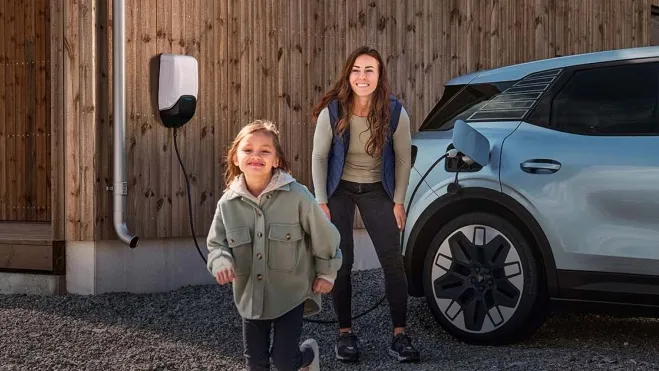
Being able to charge at home completely changes the decision
Access to a private charging station appears to be another key factor. According to the data from the study, only 14% of respondents would consider buying an electric car if they didn’t have access to a private charging option. The situation changes drastically when there is a charging station at home or at work. In that case, the willingness to purchase an electric car rises to 51%.
However, 70% of participants claim that they currently cannot charge at either their home or workplace. This situation particularly affects those who live in rentals or do not have their own garage space.
The difference is significant because home charging is usually considerably cheaper than relying solely on public chargers. As a result, the actual cost of using an electric vehicle can vary greatly between two households, even if they drive exactly the same model.
The authors believe that public policies should take these economic differences into account. Their proposals include maintaining specific subsidies for low-income households beyond 2028. They also recommend expanding schemes such as social leasing, improving access to charging points in rental homes, and reducing the price gap between home charging and public charging.
The goal would be to prevent the transition to electric vehicles from ultimately harming those with the least financial means to switch cars. The study thus raises an issue that will become increasingly important as electrification advances: it is not enough to have more efficient or cheaper electric vehicles; it is also necessary to ensure that a large portion of the population can afford to buy them and charge them at competitive prices.
