
UK electric car registrations hit record as almost 100,000 new EVs join roads
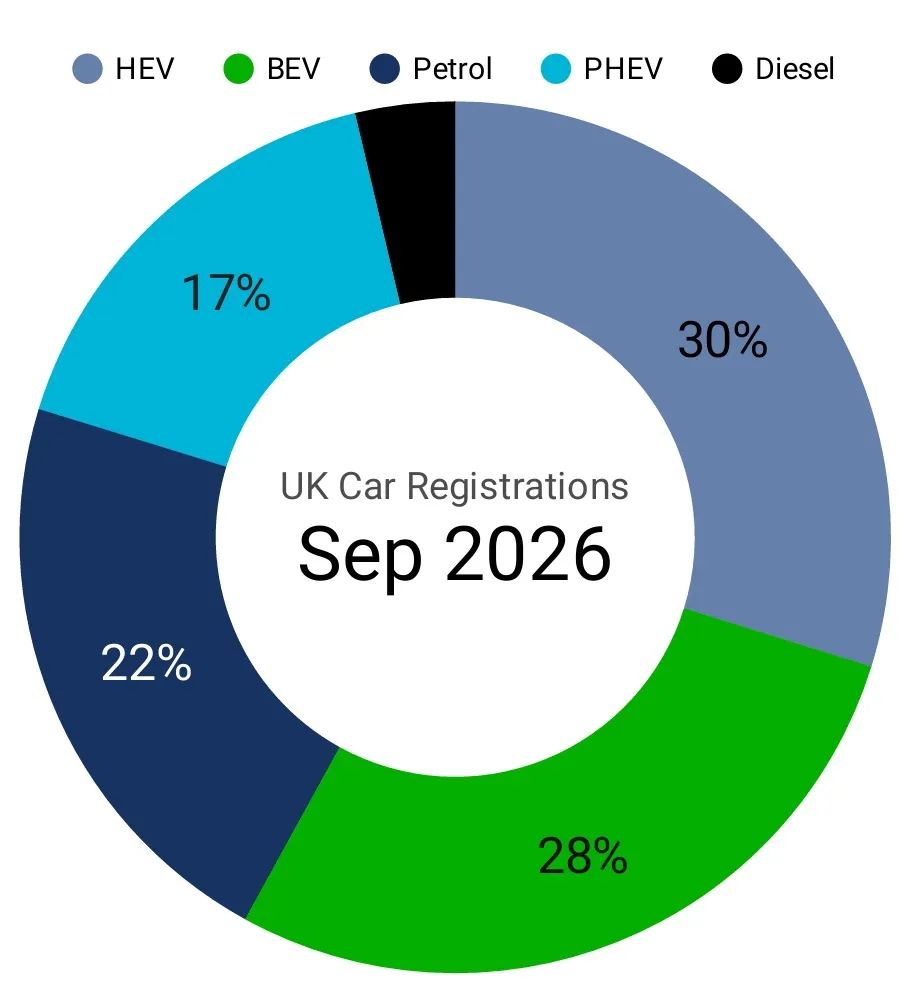
Almost 100,000 new electric cars were registered in the UK in September, setting a monthly record as battery electric vehicles increased their share of a growing car market, according to New AutoMotive.
The transport research organisation recorded 99,827 battery electric car registrations, up 37.5% compared with September 2025. Fully electric models accounted for 28.2% of new cars registered during the plate-change month, while electric vans also achieved their highest monthly total.
The results prompted calls from charging operators and EV industry representatives for ministers to maintain support for electrification. New AutoMotive, which campaigns for the transition to clean transport, said the market was already exceeding its estimate of the electric car share needed under the Zero Emission Vehicle mandate once compliance flexibilities were considered.
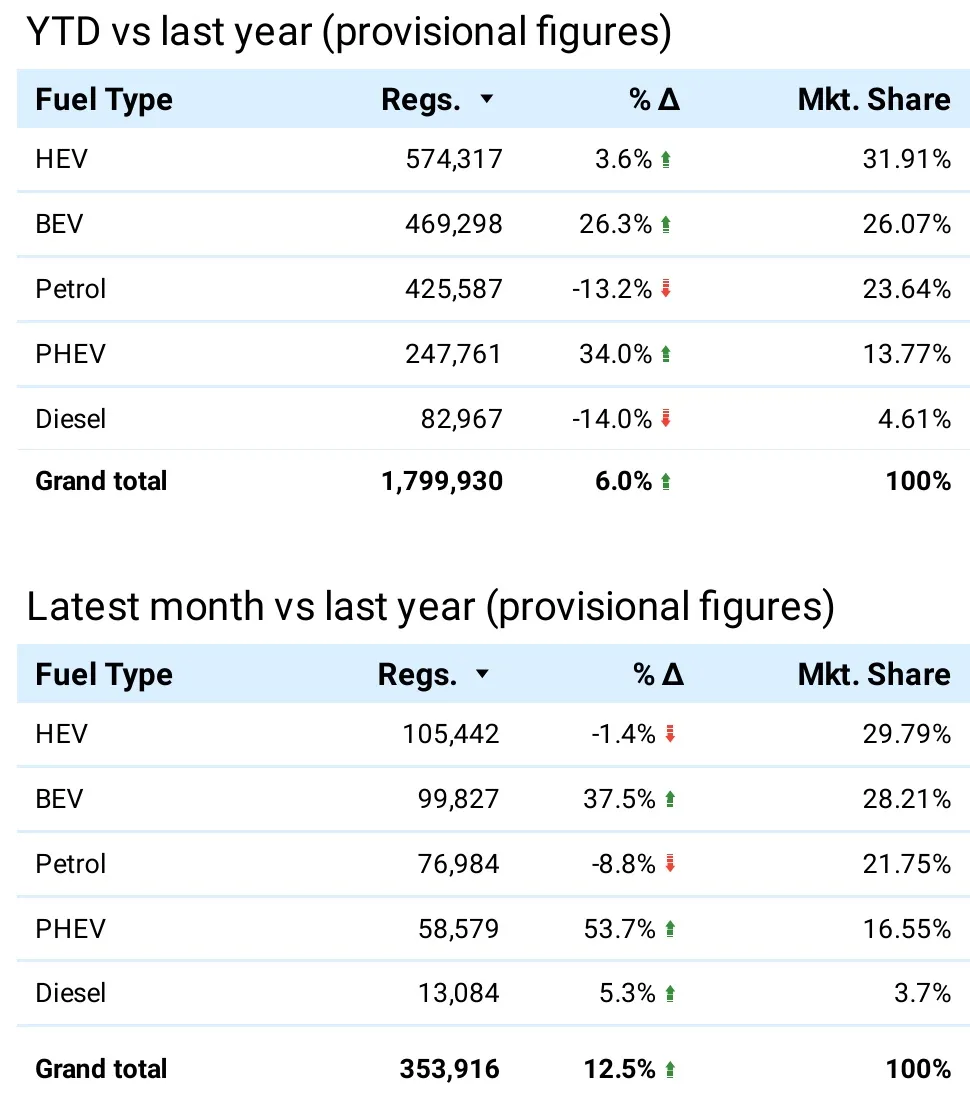
September’s performance took battery electric car registrations to 469,298 for the first nine months of 2026, an increase of 26.3% on the same period last year. That gave BEVs a 26.1% share of the new car market so far this year.
Electric car growth comfortably outpaced the wider market. Total registrations across all fuel types rose 12.5% in September to 353,916, meaning the BEV record reflected both a busier month for dealers and a shift towards fully electric models.
Ben Nelmes, chief executive of New AutoMotive, said: “With fuel prices at £2 a litre, drivers are voting with their wallets. Every one of those cars means a household spending less on running costs and a country less exposed to the next oil price shock.”
The organisation linked the figures to diesel prices reaching £2 a litre. However, the registration data does not establish why buyers chose particular vehicles, or distinguish in the published tables between private customers and fleet registrations.
Nelmes urged the government to retain the policy framework encouraging manufacturers to supply electric cars.
“The ZEV mandate is working. With the cost of living at the top of the political agenda, ministers would be ill-advised to weaken a policy that is putting cheaper motoring within reach of millions of households,” he said.
New AutoMotive’s press release puts the effective market-wide electric car target for 2026 at 24.9%, after accounting for the scheme’s flexibilities. It said 18 manufacturers exceeded that proportion in September alone.
That estimate should be distinguished from the headline mandate target, which the accompanying report lists as 33% for cars. The organisation calculates a lower effective requirement by estimating credits manufacturers can generate through lower CO₂ emissions from their remaining combustion-engined vehicles.
The distinction matters because a market-wide surplus does not mean every manufacturer has met its obligations. New AutoMotive’s tracker shows an uneven distribution of credits, with some groups ahead of their estimated requirements and others still facing shortfalls.
Its analysis identifies Tesla, BYD, Geely, SAIC and Renault among the groups generating surpluses. Volkswagen, Stellantis, Toyota, Nissan and Ford are among those shown with deficits. Manufacturers have the remaining quarter to improve their position, while access to credits also affects compliance.
Tesla led September’s electric car market with around 16,000 registrations, representing approximately 16% of BEVs. New AutoMotive described it as the company’s second-best UK month on record.
BYD followed with around 9,000 electric car registrations and roughly 9% of the BEV market, its strongest UK month to date. Kia took third place, accounting for 7.7% of September’s fully electric registrations.
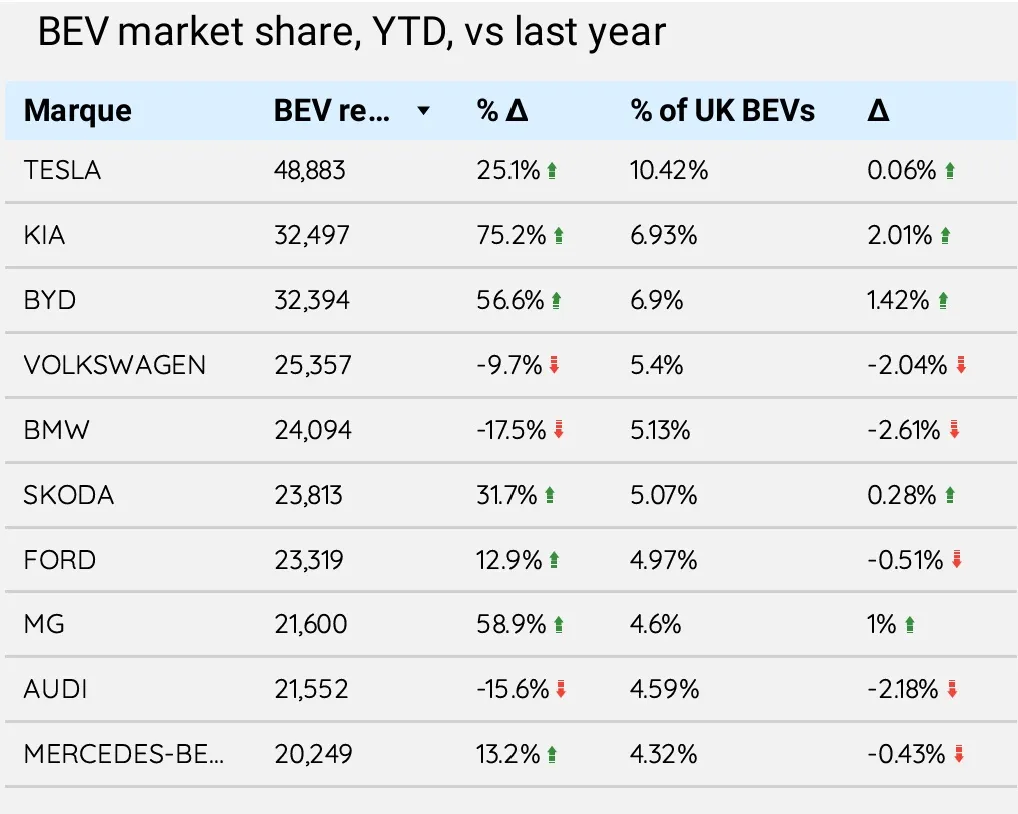
Across the first nine months, Tesla remained the largest BEV brand with 48,883 registrations and a 10.4% share of the electric car market. Kia and BYD were separated by just 103 cars: Kia registered 32,497 BEVs against BYD’s 32,394.
Kia’s electric registrations were up 75.2% year on year, while BYD recorded growth of 56.6%. Volkswagen remained fourth in the year-to-date BEV ranking with 25,357 registrations, although that represented a 9.7% decline against the equivalent period of 2025.
For buyers, the brand rankings show that rising overall electric demand is being shared unevenly between competing manufacturers.
The wider fuel-type breakdown showed that battery electric cars were not the only plug-in vehicles gaining ground. Plug-in hybrid registrations rose 53.7% in September to 58,579, accounting for 16.6% of the market.
Together, BEVs and plug-in hybrids represented almost 45% of September’s new car registrations. Conventional hybrids remained the largest individual category in the report, with 105,442 registrations and a 29.8% share, despite volumes falling 1.4% year on year.
Petrol car registrations dropped 8.8% to 76,984, while diesel registrations increased 5.3% to 13,084. Over the first nine months, however, both categories remained below their 2025 totals: petrol was down 13.2% and diesel down 14%.
Charging companies said the growing number of electric cars increased the urgency of infrastructure investment. Delvin Lane, chief executive of InstaVolt, said the figures made it harder to argue that drivers were not ready to switch.
“Every one of these new EV drivers needs confidence that there is reliable, easy-to-use infrastructure, not just today but for the decade ahead. The cars are arriving at scale, and the charging network has to be ready for them,” he said.
Melanie Lane, chief executive of Pod, also pointed to the financial case for electrification, arguing that higher diesel prices strengthened the appeal of more predictable motoring costs. She called on the government to accelerate the transition rather than dilute the mandate.
Commercial vehicles delivered another record, with 4,826 battery electric vans registered in September, an increase of 8.7% compared with a year earlier. They accounted for 9.7% of the month’s van market.
Year-to-date electric van registrations reached 27,692, equivalent to 10.9% of the market. Diesel remained dominant, accounting for 205,262 registrations and approximately 81% of vans registered over the same period.
Volkswagen led electric van volumes so far this year with 7,428 registrations, followed by Ford on 6,637 and Kia on 4,724. The figures also illustrated how differently electrification is progressing across manufacturers: BEVs represented around a quarter of Volkswagen’s van registrations, compared with 8.9% of Ford’s.
New AutoMotive said charging access remained a barrier for businesses unable to rely on overnight depot charging. That makes the practical availability of suitable infrastructure particularly relevant as more operators consider replacing diesel vehicles.
The record car and van figures were not repeated across every vehicle category. September registrations of electric motorbikes fell 39% year on year to 277, while battery electric heavy goods vehicle registrations dropped 72.3% to 31, according to the report.
New AutoMotive labels its car figures provisional. Its registration analysis uses a snapshot of the DVLA vehicle licensing database taken in the first few days of each month, supported by information from the DVSA’s MOT database. The figures describe newly registered vehicles, rather than the electric share of all vehicles already on UK roads.
