
Toyota unveils new hydrogen bus for Japan
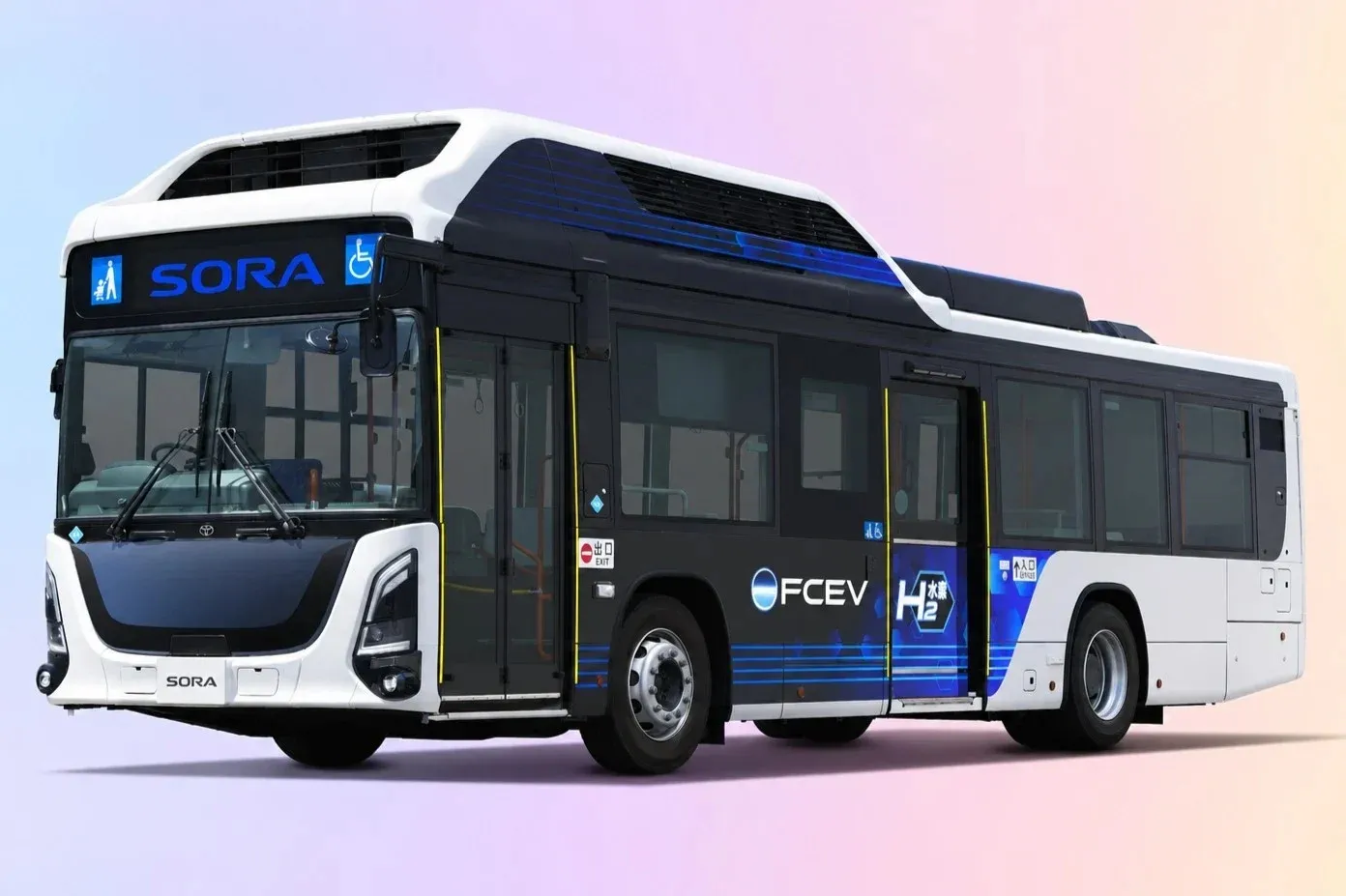
Toyota has unveiled the second generation of its fuel cell-powered bus named Sora in Japan. The company developed this completely new model in collaboration with Isuzu.
Image: Toyota
The second-generation Sora is based on Isuzu’s low-floor platform for battery-electric city buses and is equipped with a fuel cell stack developed by Toyota. The stack remains mounted on the roof but has been moved from the rear to the front area; the hydrogen tanks have been shifted slightly further back to make room for it.
While the first-generation Sora had over ten hydrogen tanks with a pressure of 70 MPa, the new model uses three tanks with larger capacity. Refueling currently takes about ten minutes; however, the tanks are designed to reduce this time by half once more powerful hydrogen fueling stations become available. Instead of adopting the previous staggered layout with diagonally positioned tanks, Toyota arranged the new tanks horizontally in a single row. Although the tank volume decreased by 129 liters (or 21.5 percent) to 471 liters, Toyota was still able to increase the range by around 100 kilometers to over 300 kilometers.
Toyota with a more efficient fuel cell stack
Toyota attributes the significant increase in range to more efficient use of the fuel cell stack and a high-capacity battery. The company replaced the nickel-metal hydride battery with a lithium-ion unit but did not specify its capacity. Two AC asynchronous motors provide power, each delivering 110 kW of output and 485 Nm of torque. Although they generate 3 kW less power per unit compared to the AC synchronous motors in the previous model, they offer 150 Nm more torque.
The second-generation Sora is 10.5 meters long, 2.5 meters wide, and 3.4 meters high. It features a completely flat interior floor, eliminating the steps of the previous model; this improves accessibility, especially for passengers with limited mobility or those traveling with strollers. Toyota has designed the all-new Sora in four variants: two for urban use and two for suburban areas. For one of the urban variants, the company states a maximum capacity of 69 passengers (19 seats and 50 standing spaces). For comparison, the previous model can accommodate up to 78 passengers (22 seats and 56 standing spaces).
To enhance safety, Toyota equips the second-generation Sora with the EDSS (Emergency Driver Stop System), which works in conjunction with the DSM (Driver Status Monitor). If the system detects a problem with the driver, it slows down the vehicle, brings it to a stop, and automatically activates the parking brake. Additionally, the latest model features a system to monitor the blind spot in front of the bus, which detects pedestrians and cyclists and alerts the driver.
Toyota has not announced prices or detailed plans for introducing the new Sora in Japan. No information has been provided either regarding possible export plans. In Europe, however, Toyota relies on its Portuguese partner Caetano for hydrogen buses. H2 buses with co-branding from both companies are in operation in cities such as Vienna, the capital of Austria.
