
Tesla is introducing fans instead of a spoiler. Will this innovative patent make it to production?
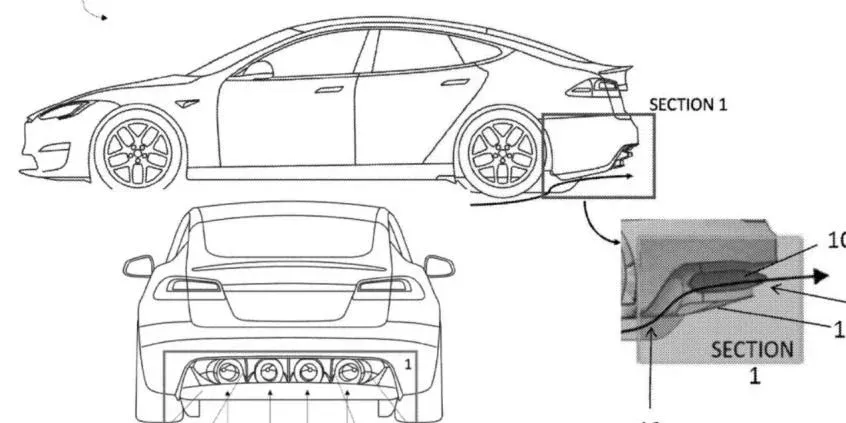
Tesla has patented an innovative active diffuser that uses electric channel fans to draw air from under the chassis and increase the car’s grip on the road surface. The system is designed to improve traction not only during high-speed driving but also while braking and slowing down, without the need for bulky spoilers. For now, this solution remains a patent, and its potential series production depends on balancing energy consumption, design complexity, and costs.
In short:
Tesla filed a patent with the U.S. Patent Office for an active diffuser system with electric fans.
The device forces air flow under the chassis, creating a vacuum and boosting grip on the road.
The system can generate downforce even at low speeds and during braking, outperforming traditional aerodynamic wings in this regard.
Although the drawings show a Tesla Model S, the sports Roadster remains a possible candidate for market debut as well.
The implementation of this technology is in doubt due to power consumption, the system’s weight, and the risk of clogging the rotors.
How does Tesla’s active diffuser work?
Traditional aerodynamics in vehicles rely on the shape of the body, splitters, and spoilers. These create downforce as speed increases but also generate additional air resistance. The American manufacturer decided to approach this issue from a completely different angle by combining chassis geometry with forced air flow.
In the patented solution, air is introduced from the front of the vehicle and directed through special channels running under the floor to the rear diffuser. There, between vertical guide strips, engineers placed electric channel fans. The installed ventilators draw air out from under the car at high speed, creating a zone of significant low pressure. As a result, atmospheric pressure acting from above on the vehicle’s body presses it against the surface.
Importantly, the effectiveness of such a system does not depend solely on the speed at which the car is moving. A traditional spoiler provides the most downforce during very fast straightaways, whereas fans can operate at full speed even when accelerating into a tight corner or starting from a stop. Increased traction during deceleration helps stabilize the driving path and transfer braking forces more effectively to the asphalt.
Active downforce is not new. Others have implemented it before Tesla.
Although the idea sounds futuristic, using fans to generate underpressure beneath a car has a long history in motorsports and supercars. The pioneer of this solution was the racing model Chaparral 2J from the late 1960s, in which an additional engine powered fans that drew air out of the tightly enclosed chassis.
The renowned designer Gordon Murray built upon this same concept in his road-going supercar, the GMA T.50. It features a rear-mounted fan with a diameter of about 40 cm that works in close coordination with active aerodynamic flaps. An even more extreme example is the track-focused electric McMurtry Speirling, whose fan system can generate such immense downforce regardless of the vehicle’s speed that it could theoretically keep the car hovering above the surface.
The difference lies in how Tesla plans to integrate this technology into a civilian vehicle body. Instead of installing large exhausts or externally visible turbines, the American company concealed the entire system inside the rear diffuser. This allows the car to maintain a smooth, elegant silhouette and refined aerodynamics without significantly increasing drag during normal driving conditions.
The editorial team of electromobilni.pl