
Testimony: Thierry drove his Peugeot e-208 all the way to Estonia at 6.40 € per 100 km
Home
Articles
Testimonial: Thierry drove his Peugeot e-208 all the way to Estonia for 6.40 € / 100 km
More content after this ad
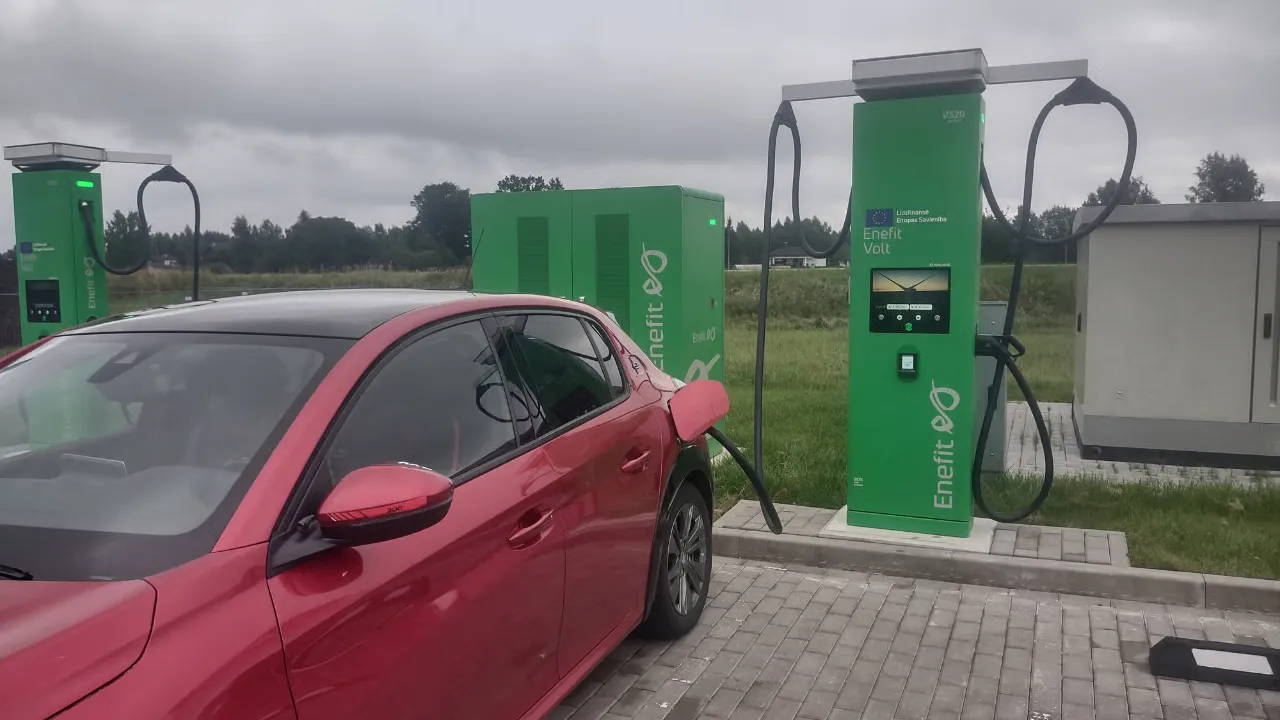
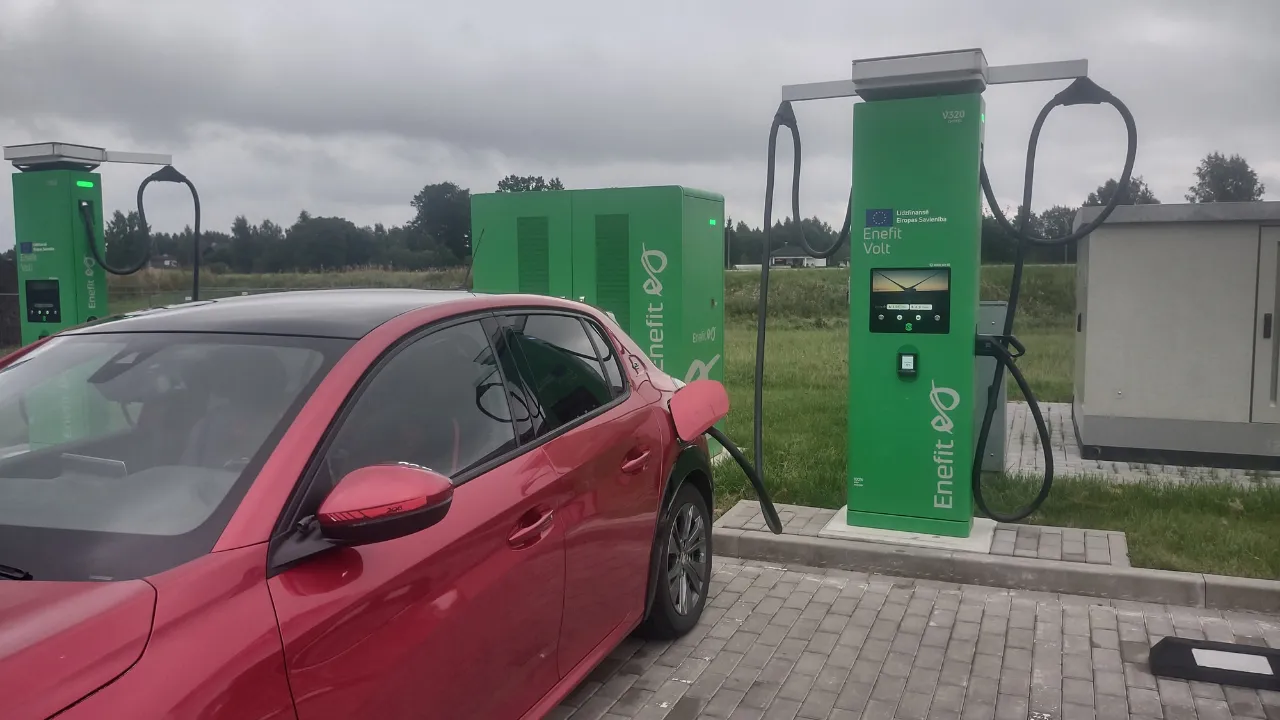
Having been an electric vehicle enthusiast since 2019, Thierry took advantage of his retirement to fulfill a childhood dream: traveling across Europe in his electric car. Along with his 9-year-old son, he drove his 2020 Peugeot e-208 from Loiret to Estonia without paying tolls, booking hotels, or using a planner. With charging records as proof, he shows that his city car with a “small” battery can cover 1,000 km per day at a cost of only 6.40 € per 100 km.
From the forklift to the red “speeder”
Thierry lives in Saint-Père-sur-Loire in Loiret, between Gien and Orléans. Before retiring, he was a high-rise forklift operator at a pharmaceutical company, handling pallets up to 14 meters high. “It comes from my adolescence playing video games; I developed good agility. I liked driving all kinds of machinery,” he smiled.
For 16 years, he drove a conventional Peugeot 307 before switching to electric vehicles in 2019 with a peculiar car: an old Bluecar he bought for 5,000 euros and still owns today. These urban vehicles, originally part of the Autolib’ service, were sold at reduced prices after the end of Paris’s car-sharing program. “It’s full of flaws, but you know, very rock’n’roll,” he summarizes, referring to its pedestrian alarm called “Cigales” and its “City” assisted steering system that allows parking with just one finger.
Convinced by its performance, he switched a year later to a new 2020 Peugeot e-208 to cover his 74 km daily commute. Why this model? “It was one of the first to offer fast charging,” he explains. Thanks to tax incentives and subsidies, the cost dropped to 23,000 euros for a red city car with a panoramic roof. It’s now sold! Thierry calls it Luke Skywalker’s “speeder,” though he admits the wheels still touch the ground. Combined with installing a heat pump at his home, this switch from an internal combustion engine to electric reduced his annual energy bill for heating and fuel from 5,000 euros to about 2,000 euros. When he can’t use the few free charging stations nearby, he usually charges at home.
A childhood dream, two people, and no planner
Thierry is well acquainted with the Baltic countries, where he has spent vacations in the past. But until now, he traveled there by plane: “It’s a one-day trip, it’s tiring, and you need to rent a car on site... Now that I have time, I thought I’d try going there by road. That way, you have your own car on location.” The train, which he loves, doesn’t go everywhere. And gliding didn’t appeal to him for such a long distance: “Long gliding trips, after 600 kilometers, are exhausting. I found that electric flying is more comfortable.”
Also read
Testimonial – Never again! Laurent was turned off by electric cars after his Tesla experience
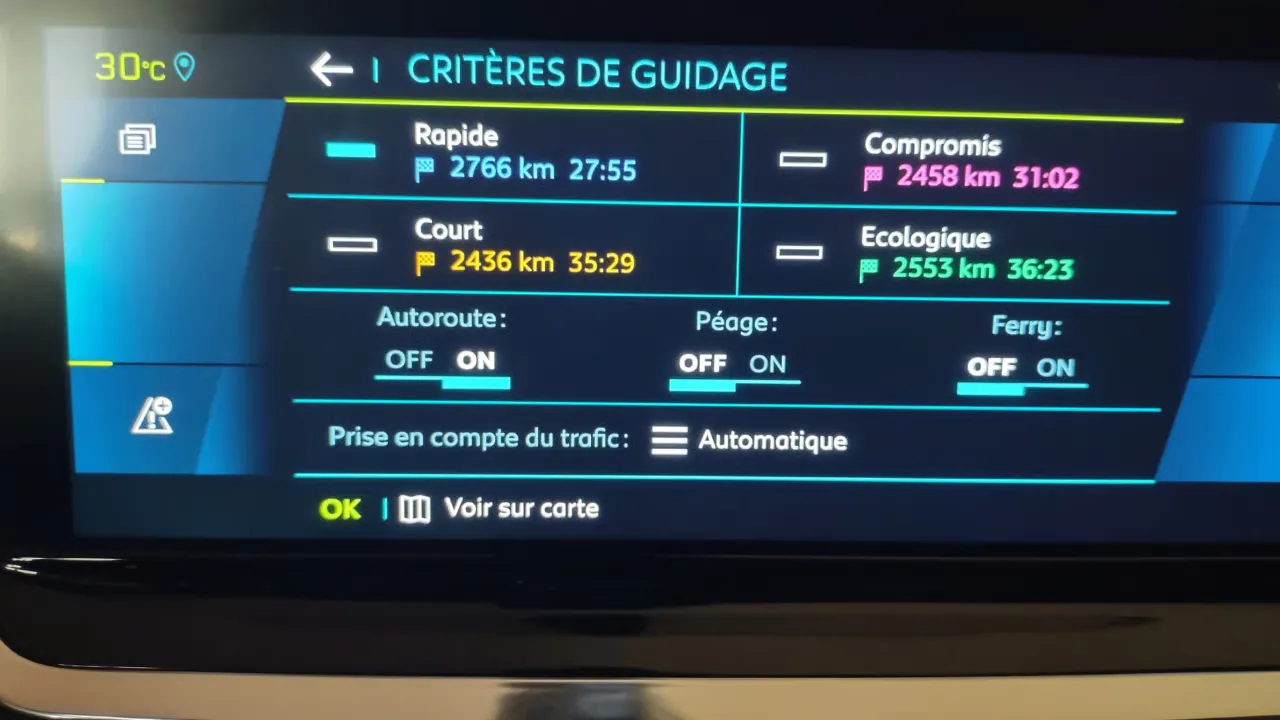
On July 17, 2026, he entered his final destination into the GPS TomTom in his 208. The route remained unchanged until Estonia, passing through Germany, Poland, Lithuania, and Latvia. The rule he set for himself was simple: no tolls, no hotels booked, and no planning tools. “Total adventure,” he joked. The planning apps kept telling him the destination was too far away. It seems they were trying hard enough to discourage our reader, who has grown accustomed to finding the next charging station at every stop, using his phone as a secondary GPS.
Aboard, his 9-year-old son served as an excellent co-pilot. “He handled things very well with his tablet. There are periods of sleep, and since we stop to recharge, we can check out two or three shops around, have a meal... For him,
The most exhausting part was his child seat," says the father, regretting not having chosen a booster seat.
The first night is spent at a B&B in Germany, before departing at 5 a.m. toward Poland. Upon arriving in Zielonka that evening, the manager of their small hotel gives them an unforgettable welcome. She offers them dinner and breakfast, then hands them a bag of food for the road. According to Thierry, she was “clearly very happy to see us on this trip.”
Also read
Testimonial – Kevin’s vacation: a 3,400 km road trip with his MG 4!
1,000 km per day with a 300 km range
On paper, Thierry’s E-208 isn’t exactly a long-distance vehicle. Its 50 kWh gross battery capacity (46.3 kWh usable) provides around 300 km of range in real-world conditions. But this doesn’t discourage our traveler, who has a well-established routine: charging every three hours or so, taking time to eat and stretch his legs. “My strategy is to ensure I have over 250 kilometers of range before continuing. Sometimes I charged it to 80%, other times higher. I only charged it to 100% when I was eating,” he explains. It generally took him 25 to 35 minutes to reach the desired charge level.
The charging curve never let him down, even after several quick sessions in the same day. “I didn’t notice any drop in power. In Germany and Poland, I managed to reach 85 kW,” he explains. Yet his car doesn’t have any battery preconditioning features.
To preserve range, Thierry doesn’t exceed 110 km/h, even on the long sections in Germany with no speed limit. He describes these concrete roads as “a disaster,” where he “felt like I was imitating that famous dog in the back seat.” The numerous construction sites he encountered often forced him to slow down. By the time he reached Estonia, his dashboard showed an excellent average of 13.6 kWh/100 km.
On the last day, there were still 1,000 km left to cover from Poland to Sillamäe. In total, it took him about thirty hours of driving to cover the 2,900 km round trip. “1,000 km per day — that’s impressive, but with an electric car, without the vibrations of an engine, it’s easy and not tiring. I didn’t even doze off behind the wheel,” he says. He also praises the cruise control, “staying in lane like a Jedi,” and the comfort of the seats.
Charging outside France: the end of the competition game
This is the key lesson from traveling. “In France, encouraging competition is like a game. Since we have the necessary networks in place, it’s great. Elsewhere, it’s different—you’re forced to take what’s available,” notes Thierry. In France, his 5 euro monthly Electra subscription guarantees him a rate of 0.29 euros per kilowatt-hour. In Germany and Poland, prices generally exceed 0.60 euros, and looking for a lower rate doesn’t help much: “It varies by only 2 to 3 cents. It seems like everyone adjusts their prices based on those around them.”
The two countries are not identical despite this. In Germany, charging stations are easy to find right at the exits of major highways. In Poland, one often has to go into a small town, to a business parking lot. “It’s like France in 2021,” says Thierry, who also regrets the large distances between Tesla stations further east. Yet the Superchargers, now open to other brands, have saved him several times. Only one station disappointed him: a cheap Lidl fast charger in Poland that was so slow he preferred to switch stations after charging less than 4 kWh.
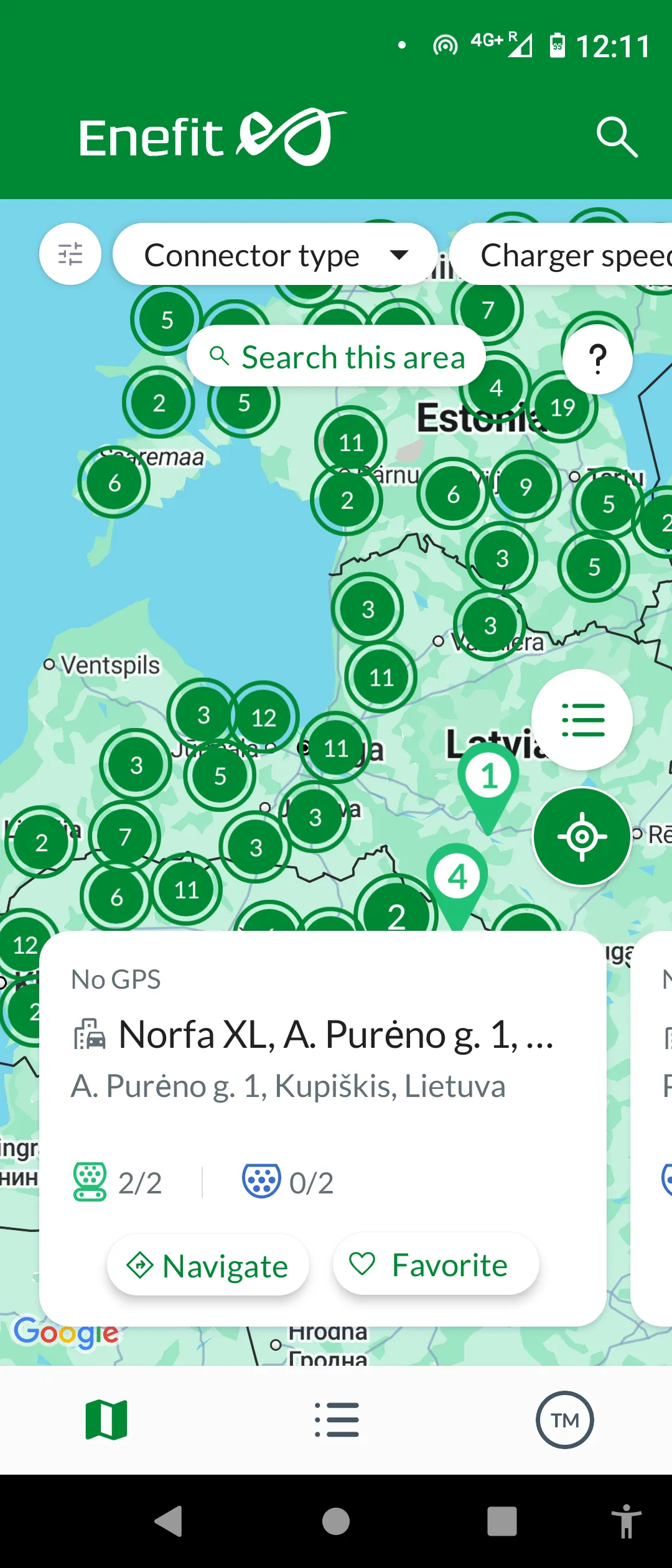
The Baltic countries, on the other hand, impressed him with their excellent roads and signposts at gas stations and shops. In Estonia, the card from the local provider Enefit reduced the cost per kilowatt-hour to 0.27 euros. His first card from that provider, obtained during a previous trip, was no longer valid. So he created a new account in English through the app on site by providing his address, and received the card two days later. A small surprise there was the Peugeot app, which requires an update every time in France, but displayed the battery percentage in real time in Estonia.
This Enefit card explains why the return trip was cheaper than the outbound one. “On the way there, I had to stop at Tesla. On the return, I used more local charging stations,” he explains. Here is Thierry’s detailed charging log, which he agreed to share with our readers.
Outbound trip, July 17–19, 2026 (about 2,900 km)
Date
Operator and location
Country
kWh
Price (€)
€/kWh
17/07
Electra Saint-Dizier
France
37,70
10,92
0,29
17/07
Electra Chemnitz
Germany
39,60
13,46
0,33
17/07
Tesla Wörrstadt
Germany
22,48
15,00
0,66
17/07
Tesla Kirchheim
Germany
26,82
17,20
0,64
17/07
SWK Kaiserslautern (Electra charger offline)
Germany
7.73
5.98
0.77
17/07
SWK Kaiserslautern
Germany
14.24
11.01
0.77
18/07
Tesla Legnica
Poland
40.93
18.67
0.45
18/07
Tesla Wrocław
Poland
9.48
4.56
0.48
18/07
Biedronka
Poland
40.01
29.66
0.74
19/07
Biedronka
Poland
20.68
15.19
0.73
19/07
Biedronka Powerdot
Poland
31.80
21.00
0.66
19/07
Tesla Kaunas
Lithuania
26.59
16.83
0.46
19/07
Eleport Riga
Latvia
35.71
17.25
0.48
19/07
Tesla Tartu
Estonia
32.39
17.16
0.53
Total
395.44
213.89
0.54
7.37 € per 100 km for this first section of 2,900 km.
In Estonia from July 22 to August 18, 2026 (1,264 km)
Date
Location
kWh
Price (€)
€/kWh
22/07
Sillamäe
17.17
4.68
0.27
22/07
Tallinn
16.36
4.42
0.27
27/07
Sillamäe
14.83
4.00
0.27
29/07
Sillamäe
7.56
2.49
0.33
29/07
Sillamäe
31.50
8.51
0.27
31/07
Tallinn
26.08
8.61
0.33
31/07
Sillamäe
29.81
8.05
0.27
02/08
Sillamäe
2.57
0.69
0.27
02/08
Sillamäe
28.25
7.63
0.27
06/08
Tartu
26.06
8.78
0.33
06/08
Sillamäe
28.50
7,70
0,27
12/08
Sillamäe
30,46
8,22
0,27
18/08
Sillamäe
9,76
2,64
0,27
Total
264,91
76,45
0,28
Which is 3,10 € per 100 km. The Enefit card has a significant impact.
Return, from August 20 to 22, 2026 (about 2,900 km)
Date
Operator and location
Country
kWh
Price (€)
€/kWh
20/08
Enefit Tartu
Estonia
28,00
7,56
0,27
20/08
Enefit Ragana
Latvia
33,00
15,51
0,47
20/08
Enefit (Lithuania)
Lithuania
27,71
8,31
0,30
20/08
Enefit Kreivukė
Lithuania
31,57
11,05
0,35
20/08
Kisielnica
Poland
27,29
17,05
0,62
21/08
Tesla Warsaw
Poland
32.19
10.66
0.33
21/08
Lidl Elocity Zduńska Wola (too slow)
Poland
3.93
2.63
0.66
21/08
Eleport Sieradz
Poland
18.75
10.40
0.55
21/08
Tesla Wrocław
Poland
37.10
23.56
0.63
21/08
Tesla Dresden
Germany
37.09
24.75
0.66
22/08
Tesla Weimar
Germany
32.62
21.77
0.66
22/08
Ionity Alsfeld
Germany
10.41
6.66
0.63
22/08
Tesla Alsfeld
Germany
20.03
12.84
0.64
22/08
Electra Kaiserslautern
Germany
35.71
12.14
0.33
22/08
Saint-Dizier
France
38.58
11.19
0.29
Total
413.98
196.08
0.47
That’s 6.76 € per 100 km. The journey through the Baltic countries was cheaper before returning to the higher costs in Germany and Poland.
In total, Thierry spent 486.42 euros on charging for his vacation, which amounts to 6.40 € per 100 km according to his calculations. In addition to Electra and Enefit, he used Electroverse, Chargemap, the Tesla app, and Google Maps to find charging stations. This cost is very similar to that of Armand’s 4,300 km road trip across Central Europe, despite him using a Tesla Model 3 with Superchargers.
With his experience, he recommends obtaining the recharge card for the destination country in advance, if available, as he couldn’t find one for Poland. He also advises checking Chargemap for local providers to avoid relying solely on Tesla stations. “My trip was cheaper on the way back, because experience pays off!” he concludes.
170,000 km and a battery that holds up
Thierry’s E-208 has now accumulated nearly 170,000 km, at a rate of about 30,000 km per year. Although his owner has never had the battery’s health status (SoH) checked, he relies on the range displayed after a full charge. “When it was brand new, I could go 320 km. Now it’s around 302 or 308 km. Well, it’s still fine,” he says modestly. This moderate loss of about 5% aligns with studies on used electric vehicle batteries, which show generally slight degradation.
For those who are still hesitating due to budget concerns, Thierry reminds them of an often-overlooked expense: the maintenance of a conventional car. “People only think about fuel, but they always forget about maintenance,” he insists. He experienced this firsthand for 16 years with his Peugeot 307. With his e-208, the costs remain low. He spends between 200 and 250 euros every 25,000 kilometers (roughly once a year) for maintenance done at an official dealership. After nearly 170,000 kilometers, only the brake fluid and cabin filters have needed replacing. The original Michelin tires were replaced twice for the same model, and they “last easily 90,000 kilometers.” He reports no breakdowns, and the system continues to receive GPS updates. “I trust the tires, I trust TomTom, I trust Peugeot,” he summarizes.
“Beyond 400 km of range, it doesn’t serve much purpose.”
In Estonia, Thierry met a Frenchman who had come to explore the country in a camper van. “I told him I came here in a small car,” he says, amused. Along the way, several people were surprised to see his French license plate: “You’re from France? That’s very far!”
Also read
Testimonial – Nicolas loves his Mercedes EQS but here’s why he’s leaving the brand
To those who firmly believe that a large battery is essential for traveling long distances, he responds with a hint of irony. “It’s people who know nothing about electric vehicles who keep looking for excuses. Highway rest areas are full of people who never stop!” His opinion is clear: “For comfort, 400 km is better, but beyond that, it doesn’t serve much purpose. It takes longer to charge, and anyway, people with a 500 km battery will stop after two and a half to three hours. When you drive 600 or 700 kilometers on vacation, you don’t need such a large range.”
It’s obvious that Thierry’s testimony dispels two persistent misconceptions:
First, a six-year-old electric compact car with 170,000 km on the odometer and a range of about 300 km can cross a continent at a pace of 1,000 km per day.
Second, traveling long distances electrically doesn’t cost a fortune: even at 0.60 to 0.77 euros per kilowatt-hour in Germany and Poland, he spent an average of 6.40 euros per 100 km.
His account also highlights that France remains relatively well-served in terms of prices and charging infrastructure, while Eastern Europe is progressing at very different speeds depending on the country. The Baltic states are among the best performers, while Poland still has a long way to go.
And you? Have you ever crossed distant borders with your electric car? Which country surprised you the most regarding charging options? Share your experience in the comments and/or post your story on the Automobile Propre forum.
Automobile Propre and I would like to express our sincere thanks to Thierry for sharing his experience with us.
To prevent discouraging our readers from contributing in the future, any offensive comments directed at our interviewees, their lives, choices, and/or opinions will be removed. Thank you for your understanding.
Angstromil 7 hours ago
Thank you for this interesting testimony. I also own an e-208 from the same generation, purchased used (2021 model, 16-inch wheels, 50,000 km driven).
I notice both similarities and differences compared to Thierry’s experience:
- The car is comfortable and pleasant to drive
In addition:
- The engine and/or transmission have always made noise (resonance?) between 105 and 115 km/h (I noticed this on another car as well).
- The MyPeugeot app sometimes works :-D. It’s not reliable for tracking remote charging.
- I bought it without much thought due to its fairly criticized reliability. I’ve encountered two major breakdowns: a stuck gear selector lever in 2025 (impossible to shift out of P), fixed under warranty as a used car, and a 12V battery issue in 2026. I’m still hoping for the best regarding the air conditioning compressor.
- My experience with my Peugeot dealership is highly improvable and falls short compared to Renault and Toyota
In summary: I often consider replacing it
1
Albertoil 10 hours ago
The same route without a smartphone?
1
Jerem974 8 hours ago
In the summer, my partner and I traveled from Toulouse to Copenhagen in a 2020 electric Corsa (it had only 50,000 km on the odometer). On the way there, we made many stops, passing through Switzerland, Germany, Belgium, the Netherlands, Denmark, and finally Sweden. For the return trip, we left Copenhagen on Sunday morning, took a ferry between Sweden and Germany, and arrived in Toulouse around 10:30 p.m. on Tuesday. The following day, Wednesday, was a solar eclipse, so we drove down to Tarragona to see it in totality. It was a really great trip.
The total cost for electricity was 450€; we charged the battery every 200 km or about every 2 hours.
Our guides
