
Testimonial – Donovan drives 30,000 kilometers per year with his Nissan Leaf purchased for 17,000 euros
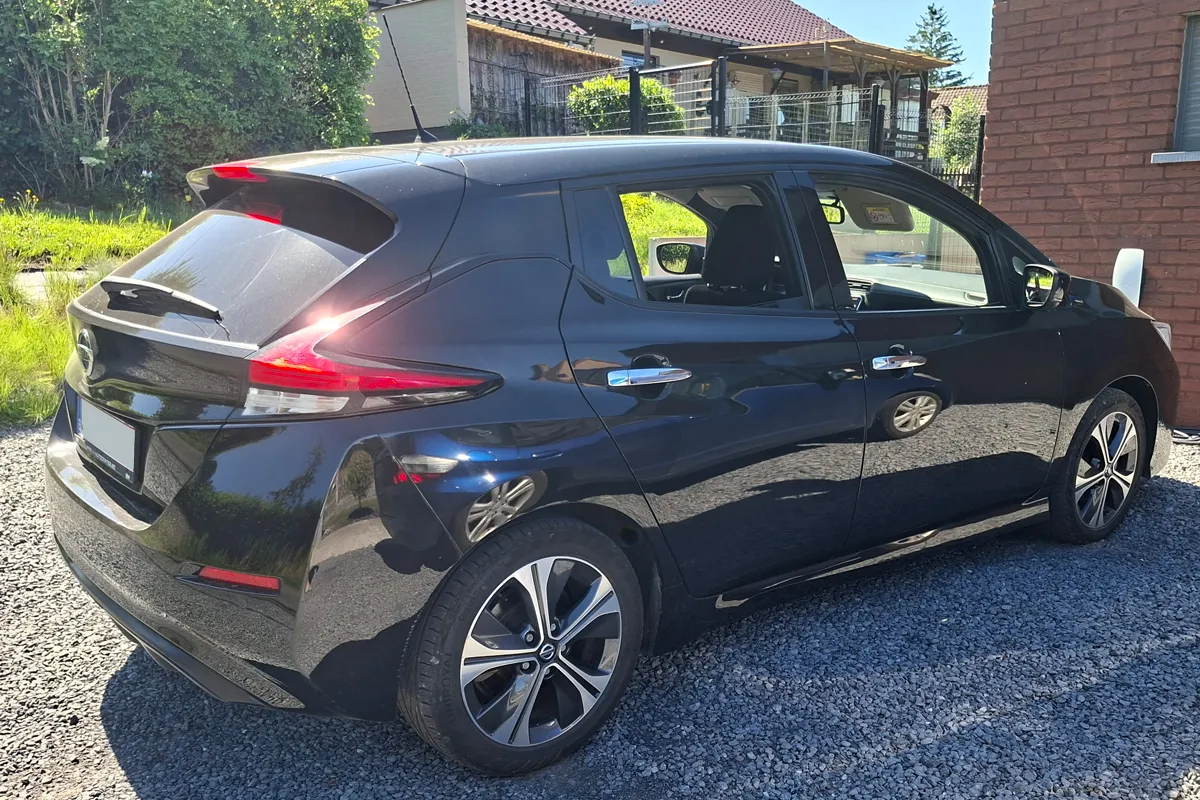
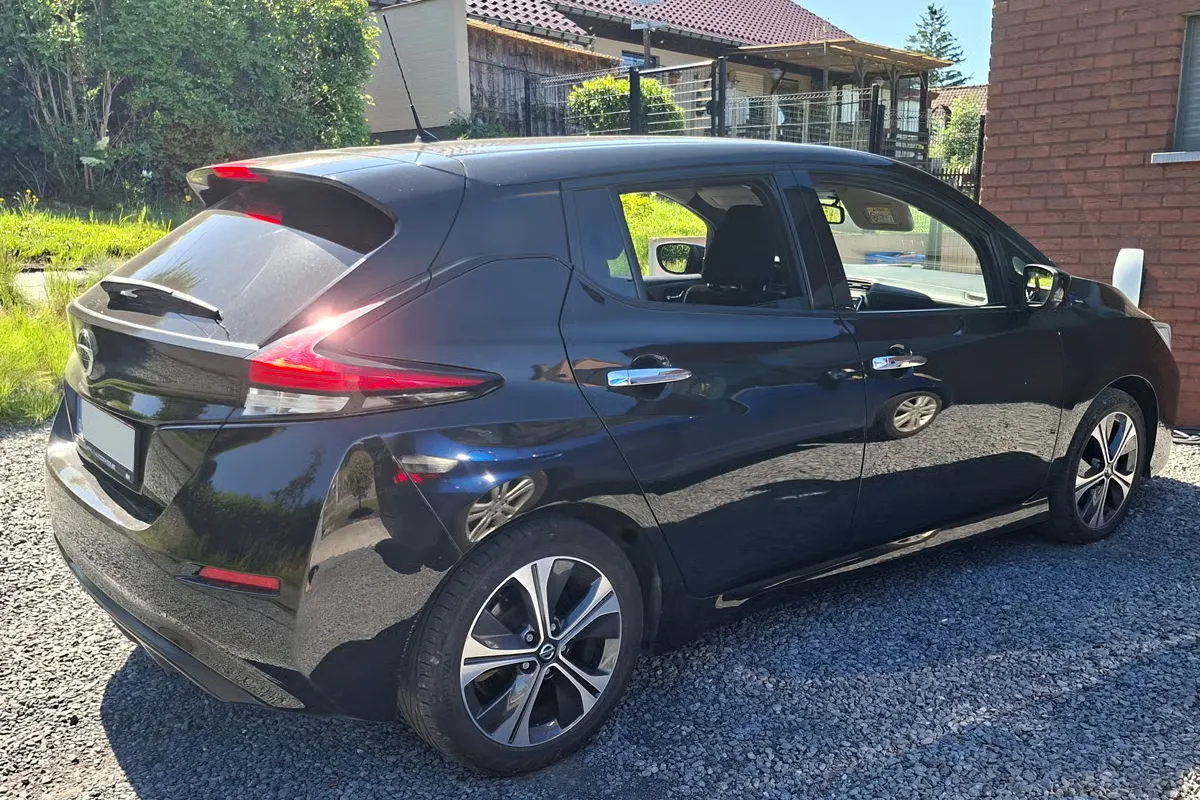
Living in a home equipped with solar panels and a charging station, Donovan is well aware that he has an advantageous situation for driving an electric vehicle. He doesn’t want a model burdened by a highly capacity battery: 40 kWh allows for lower consumption while still providing enough energy for all daily trips.
A compact electric sedan for 3
Living in Tournai, Belgium, Donovan adopted an electric vehicle in 2023: “With solar panels and the option to charge at home, I was in an ideal situation to switch to electric as fuel prices rose. I drive about 30,000 kilometers per year, so I’m a heavy driver. Choosing the Nissan Leaf 2 also allowed me to reduce my annual road tax to 100 euros, compared to 400 for a conventional vehicle with similar power of around 150 horsepower. There’s almost no maintenance needed either. I quickly did the math: choosing an electric vehicle was a cost-effective decision for me.”
At the time, a father for just a few months, the thirty-year-old set a budget of 15,000 euros for a used electric car: “The choices were limited to a few models such as the Renault Zoé and Dacia Spring, which I ruled out to have more space for the three of us. The Nissan Leaf 2 was much more suitable. By slightly exceeding the initial budget, we found a 2018 model with a 40 kWh battery, in black, featuring the N-Connecta trim, and it had 50,000 kilometers on the odometer for 17,000 euros.”
Also read
Testimonial – Never again! Laurent was turned off by electric cars after his Tesla experience
Our reader was aware of his main shortcomings: “The rapidgate? It doesn’t apply to me, as I’ve never had to do two quick charges in a row. My daily driving distance has never exceeded 230 km—the Netherlands isn’t that big a country. The CHAdeMO connector? I use it at most five times a year, for example during a weekend in Flanders. I’ve seen these charging stations disappear as newer ones were installed, but for my longer trips, I know where to plug in. For a few instances per year, I’m not going to spend 1,500 euros on a CHAdeMO/CCS converter.”
A model suited to Donovan’s daily routine
Donovan uses his Nissan Leaf very regularly: “My daily commutes to work are about 80 km. If I also go to my parents’ house for lunch or make other short trips, I drive up to 160 km in a day, returning home with still 20% of battery energy left. That shows its energy capacity is suitable for my needs. There’s no need for a larger one that would weigh down the car and lead to higher consumption.”
This doesn’t mean our reviewer is against better specifications: “For a salesperson who drives 300 or 400 km per day, a battery of 90 or 100 kWh would be more suitable. But not for someone who only drives 80 km per day. However, I’m also aware that with technological advancements, the efficiency of electric vehicles has improved. My Leaf consumes between 12 and 15 kWh per 100 km in summer and 15–17 in winter. A modern Peugeot e-208, for example, will have similar figures but with a larger-capacity battery.”
The Walloon electric vehicle enthusiast looks even further ahead: “Technology is advancing so rapidly these days in the field of electric cars. I’m thinking, for example, of the Denza Z9 GT, which can already recharge very quickly, as well as BYD’s Flash Charging that aims for powers of up to 1.5 MW. In a few years, when everyone is using electric cars and such fast charging becomes standard, people will laugh at my experience!”
1,500 to 2,500 euros saved per year
Donovan’s Nissan Leaf is mostly charged at his home: “My house is a new construction that was equipped from the start with three-phase electricity, anticipating the upcoming arrival of an electric vehicle. I use a Tesla 22 kW AC charger for charging, but since the car is only equipped with a 6.6 kW charger, the charging power is limited to about 4.4 kW. The stove, heating, etc.—everything in the house is electric, but the installation was carefully planned in advance to ensure everything runs smoothly.”
Solar energy helps reduce the operating cost of this car: “On the roof, my installation has a peak power of 10 kW. At its best, I’ve managed to produce up to 8,800 kWh in a year, falling short of the estimated 10,000. From September 2025 to now, my panels have produced exactly 7,482 kWh in a year, while my household consumption, including daily charging to 100% capacity for the Leaf, was 10,102 kWh. Given today’s fuel prices, this is also the car that is generally used on weekends.”
With such a setup and the use of his electric vehicle, our reader estimates saving a significant amount each year: “Compared to an equivalent gasoline model, the savings are between 1,500 and 2,500 euros. This is mainly thanks to the photovoltaic installation. The calculations would be very different for a driver living in an apartment in Brussels. Ever since we got our Leaf, everything has gone very smoothly regarding home charging.”
“Keep it until death do us part.”
After about three years of use, Donovan’s Nissan Leaf 2’s mileage meter has risen significantly: “It’s at 151,000 km now. This car isn’t exactly sexy — it’s worth almost nothing in the used car market and costs us nothing to keep. That’s why I plan to keep it until death do us part, hoping to reach 300,000 km. Its purchase will then have been a great investment. I didn’t pay much attention to the battery’s SoH when I bought it three years ago. It was rated at 86% around 120,000 km. Battery aging is always a risk with unknown outcomes.”
The stylish Japanese compact car has proven to be highly reliable: “I only had to have the original 12 V battery and the four tires replaced. The brake discs and pads have never been changed. I plan to change the fluid in the reducer—it can only do good for it. As a test technician at Aisin Europe, I’m used to doing as much of the maintenance on my cars myself as possible. If I had any issues with the traction battery or engine in the Leaf, I’d have a dealership diagnose the problem, but I’d try to fix it myself. This is made easier by the fact that there’s no coolant circuit for the lithium cells.”
Our reader isn’t too concerned about potential difficulties in finding the necessary parts: “It’s true that you don’t see many Nissan Leaf 2 models in Belgium or France. But in other European countries, it’s much more common, such as in the United Kingdom for example. Additionally, there are plenty of tips and guides online on how to work on it. I was able to fix a problem with the charging connector myself by 3D printing the small gears that were broken and preventing the cable from being unplugged. It didn’t cost me anything.”
“They don’t think about the financial savings that can be achieved.”
In his circle, Donovan observes changing attitudes: “When people around me want to switch to electric vehicles, they ask for my opinion, especially regarding the technical choices they don’t understand. Two colleagues who used to laugh at me three years ago because I drove a zero-emission vehicle now have adopted electric models. One of them, who drives about 140 kilometers per day, bought a BMW xDrive25e hybrid vehicle with a rechargeable battery, while the other got a Renault Scenic e-Tech with an 87 kWh battery.”
Our reader doesn’t want to imply that electric vehicles are infallible: “For example, with the Nissan Leaf 2, I know there are some users who ended up with a dead battery module. It’s still like playing the lottery, and that’s what I explain to all my colleagues. I sometimes check a Facebook page for users where there are constant negative reviews. It’s to the point where one might think they didn’t choose the right electric vehicle model. That’s why I was very pleased to one day find a message saying that a 200 km drive in a Nissan Leaf went smoothly.”
Also read
Testimonial – Nicolas loves his Mercedes EQS but here’s why he’s leaving the brand
A dedicated electric vehicle advocate remains surprised by an attitude that persists among car owners: “Many wonder how one can be satisfied with an electric vehicle that doesn’t have very long range or fast charging capabilities. It’s strange to be so fixated on that. I tell them we don’t care about it for daily use, that my car recharges quietly while I sleep, and that it helps me save money. Generally, they don’t consider the financial savings involved.”
An EV for a Lady?
What about long trips? “In that case, we can take the TGV or my wife’s gasoline car. She has a 2009 Honda Jazz 1300 with an engine. It only gets about 7,000 kilometers per year. This vehicle could be replaced with an electric one, but as I like to say, ‘The less credit I have, the better off I am.’ No leasing, no monthly financial burdens, because I want the car to be ours. We’ll wait until we have the necessary money for such an expense.”
That doesn’t stop Donovan from thinking of a specific model for his wife: “I look at many used car listings. I’m interested in the 2018 to 2020 Tesla Model 3 in the Long Range version. It’s the ideal car, with good range, sturdy, and versatile. I’m waiting for its price to drop further. My threshold price would be 20,000 euros.”
Automobile Propre et moi-même thank Donovan greatly for his excellent hospitality, his very high responsiveness, and his interesting testimony provided after our request for feedback from our readers.
For your reference, any offensive comments directed at our interviewees, their lives, choices, and/or ideas will be removed. Thank you for your understanding.
Author’s Note
Some electric vehicles have been labeled as “not very interesting” a bit too quickly. But once one understands their strengths and limitations, they can also satisfy many city dwellers looking for a car that is easy to use in daily driving with short distances. This is the case with the Leaf featuring a 40 kWh battery, which has improved significantly compared to earlier models.
Donovan is right to compare electric vehicles around him to a lottery. Just like with traditional cars, an electric vehicle can also suffer from major breakdowns or recurring problems. Promising the moon might end up drawing back dissatisfied family members who will expect explanations. Personally, I avoid recommending specific models these days, preferring to provide a short list so that potential electric vehicle owners can make their own choice.
Our Tournai correspondent is also correct when he says that, ultimately, many drivers don’t consider electric vehicles seriously enough as a potential option—provided they can charge at home or at work—to achieve significant annual savings. For long trips, these vehicles can also provide an opportunity to find a pleasant place for meals or accommodation.
Philippe SCHWOERER