
Solaris unveils Urbino 40 electric for North America
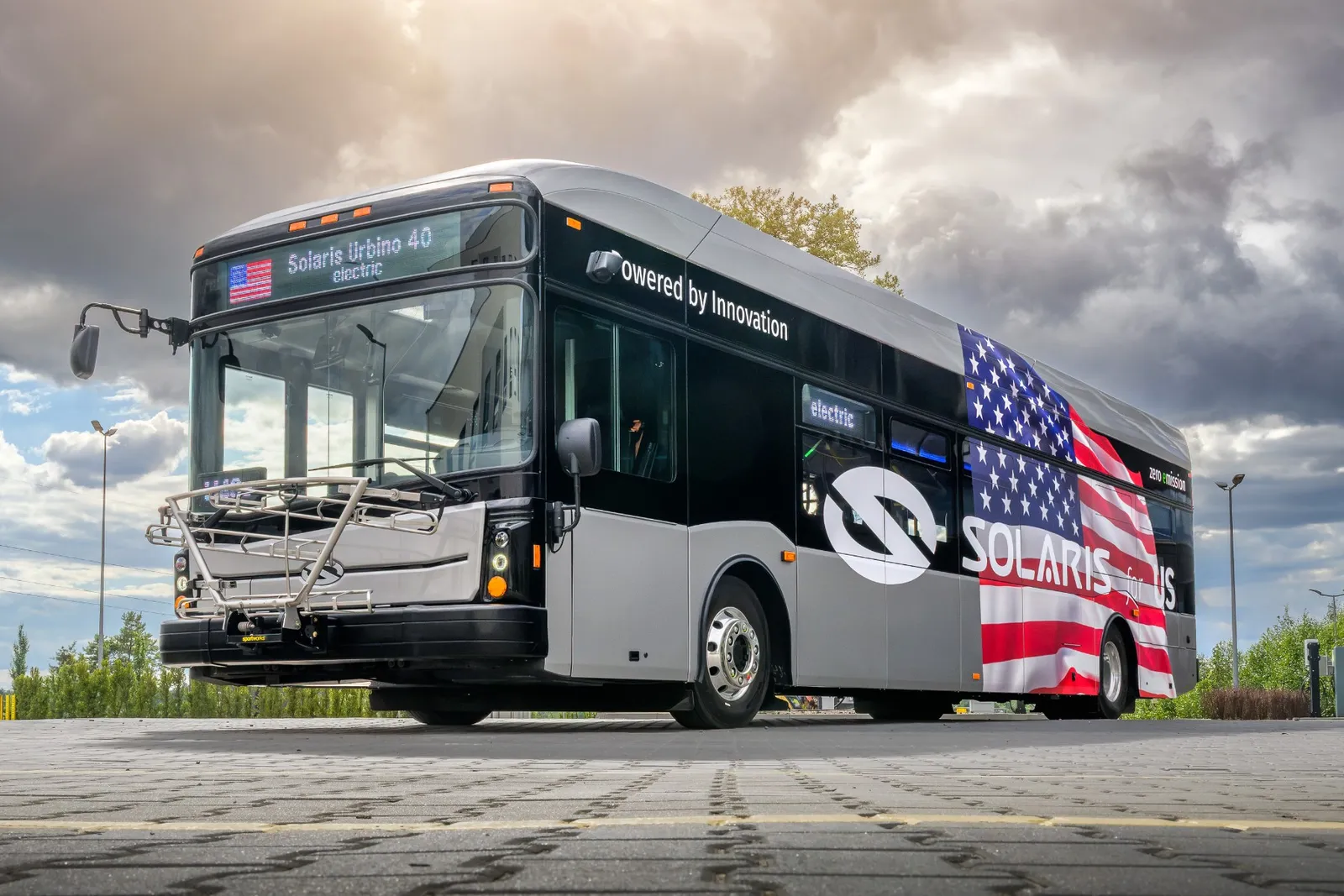
Solaris celebrates the world premiere of the Urbino 40 electric, an electric bus specifically developed for the North American market. The model name refers to the length of just over 40 feet - approximately 12.4 meters. A articulated bus variant called the Urbino 60 electric is set to follow soon.
Image: Solaris
Solaris presented its first product for the North American market at the APTA TRANSform & EXPO in Chicago: the battery-electric Urbino 40. Based on a platform specifically developed for the North American market, it is intended to pave the way for the Polish manufacturer to enter its first overseas market. Solaris has now been receiving orders from the first North American bus operators since the start of last year.
The expansion into North America bears the signature of Javier Iriarte, who became the new CEO of Solaris at the beginning of 2023. He stated shortly after his appointment that Solaris should leverage the existing sales and production structure of its parent company, CAF, in the USA to enter the North American electric bus market. Even then, Iriarte targeted 2026 as the entry year.
To put this into context: the Polish bus brand has been part of the CAF Group since 2018, and management has since sought synergies between the bus and rail businesses. With Solaris’ entry into the US market, a central strategic pillar is now being realised. In its current statement, Solaris itself writes that its parent company CAF “has decades of experience” supplying customers “across the USA with rail solutions.” Solaris aims to leverage this in order to serve “transit agencies across North America” from the outset.
“Local manufacturing” on the cards for Solaris
In Europe, the Polish bus brand is one of the major manufacturers of urban and intercity buses. The company states that it has already delivered 30,000 vehicles to 34 countries and is increasingly focusing on zero-emission vehicles – primarily battery-electric buses, hydrogen fuel cell buses, and trolleybuses. In the USA, Solaris aims to build on this experience, but not only that: the company promises “proven technology, local manufacturing, and dedicated customer support”. However, management does not specify in its statement where the buses will actually be built.
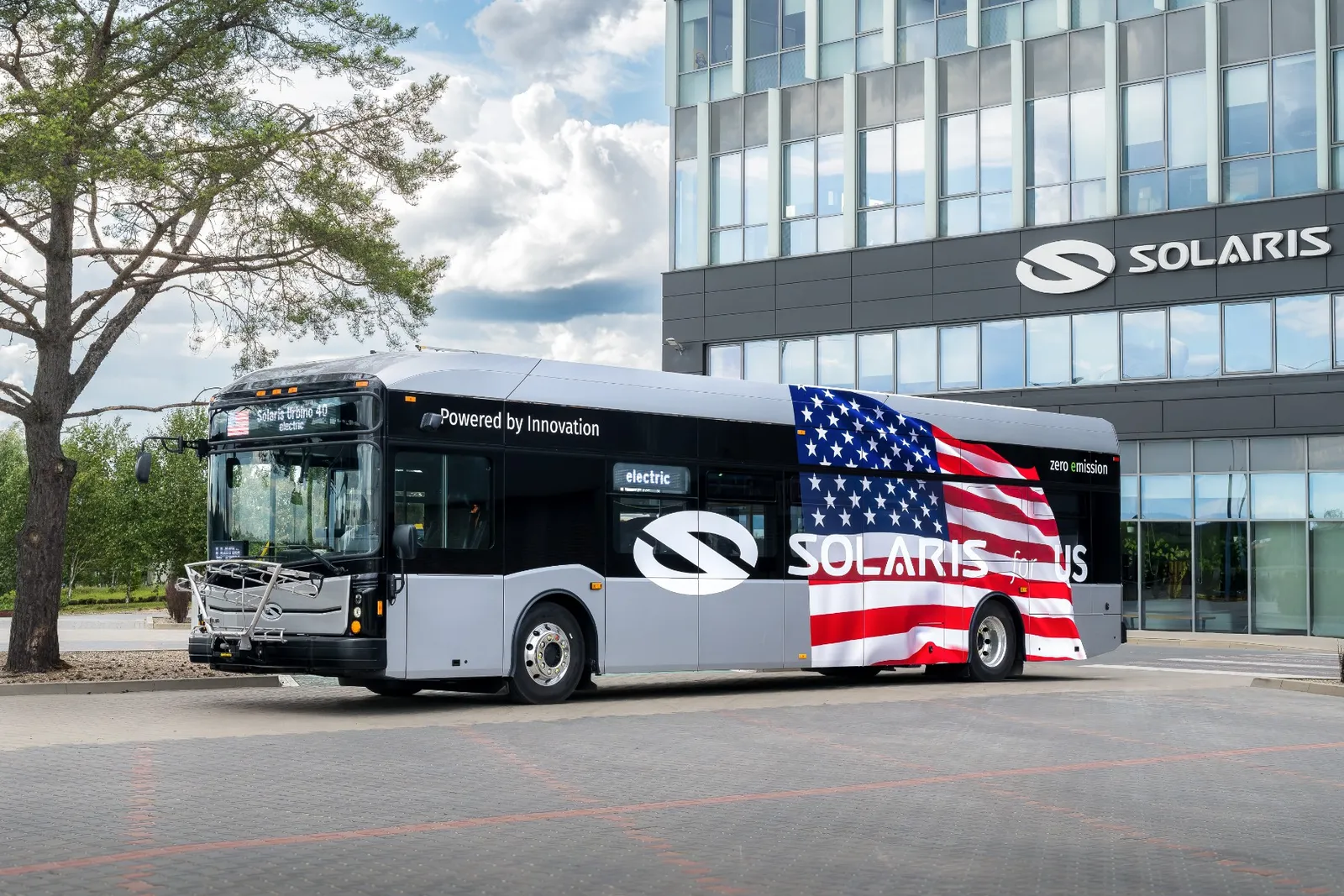
Image: Solaris
- 1/10
- 2/10
- 3/10
- 4/10
- 5/10
- 6/10
- 7/10
- 8/10
- 9/10
- 10/10
Solaris has now published the complete data sheet for the Solaris Urbino 40 and the upcoming longer variant, the Urbino 60, ahead of its world premiere. The Urbino 40 has two axles, while the Urbino 60 has three. The bus lengths are 12.44 and 18.59 metres, respectively, with the original data provided in feet and inches. This is how the model designations 40 and 60 are derived. In Europe, Solaris also names its buses after their length. The equivalents to the two new North American models are the Urbino 12 electric and the Urbino 18 electric, with lengths of 12 and 18 metres, respectively.
Battery capacity reaches 528 and 704 kWh
According to Solaris, the new platform for the 40 and 60 models was necessary to meet all US regulations. The technically permissible gross vehicle weight is stated as 20.3 and 32.1 tonnes, respectively. The solo bus offers drive options of 230 or 300 kW, while the articulated bus always comes with two 230 kW motors as standard. As usual, Solaris installs the battery on the roof, with a capacity of 528 kWh for the Urbino 40 and 704 kWh for the Urbino 60. A summary of the data is provided in the table below.
Solaris does not specify the size of the individual battery packs. However, assuming identical blocks are installed, a simple calculation suggests that each pack likely has a capacity of 88 kWh. In this case, the solo bus would have six units, and the articulated bus would have eight. This would also align with the design of the European models: the Urbino 12 electric also features six packs, though with a total capacity of ‘over 600 kWh’ – Solaris does not provide more precise details in its official communications.
While the Urbino 12 electric in Europe is said to achieve over 600 km (according to the SORT 2 test), the manufacturer has not yet specified a range for its North American models. The statement only mentions that the Urbino 40 “designed to facilitate demanding daily operations and meet transit agencies’ range requirements”. The manufacturer also emphasises a range of advanced technologies on board, including in-house solutions for battery integration and vehicle monitoring, an efficient HVAC system (Heating, Ventilation, Air Conditioning), an integrated battery temperature management system, and multiple driver assistance systems.
| | Urbino 40 electric | Urbino 60 electric |
| --- | --- | --- |
| Axles | Two-axle | Three-axle |
| Power | 230 or 300 kW | 2 x 230 kW |
| Battery | 528 kWh | 704 kWh |
| Length | 12.44 m | 18.59 m |
| Width | 2.59 m | 2.59 m |
| Height | 3.43 m | 3.43 m |
| Technically permissible gross vehicle weight | 20.3 tonnes | 32.1 tonnes |
| Maximum seating capacity | 41 | 50 |
| Maximum passenger capacity | 65 | 123 |
First customers, but still low volumes
According to Solaris, the development focused primarily on the safety and comfort of the driving personnel. The bus therefore features an ergonomic cockpit, a fully shielded driver’s workspace, and optional external cameras as a replacement for rear-view mirrors. The passenger area offers wide aisles and barrier-free zones. Solaris specifies a maximum seating capacity of 41 or 50 seats, depending on the bus length, with a total passenger capacity of up to 65 or 123 people, including standing passengers.
The first deliveries of electric Solaris buses to the US market will soon be made to King County Metro in Seattle and the San Francisco Municipal Transportation Agency. Solaris is also delivering trolleybuses to TransLink in Vancouver, Canada. While the latter order involves a substantial 107 vehicles, the other two orders are relatively small: King County Metro has ordered four buses but secured an option for 12 more. The San Francisco operator is initially taking six vehicles. Both customers have ordered solo buses as well as articulated buses.
