
Solaris reveals the Urbino 40 electric for North America
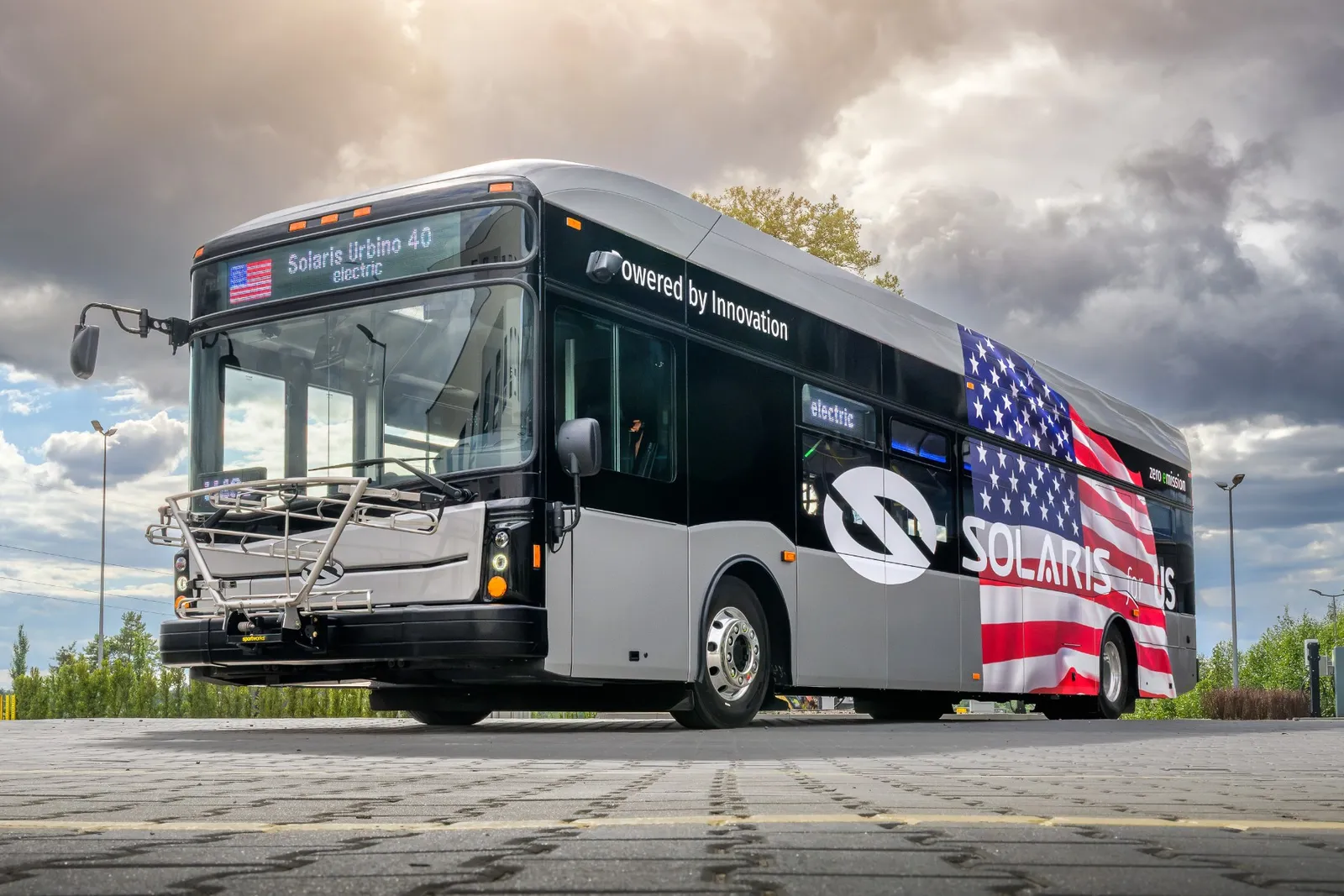
Solaris is holding the world premiere of the Urbino 40 electric, an electric bus developed specifically for the North American market. The model name refers to its length of just over 40 feet, which is approximately 12.4 meters. A articulated bus version named the Urbino 60 electric is set to follow soon.
Image: Solaris
Solaris unveiled its first product for the North American market at the APTA Transform & EXPO in Chicago: the battery-electric Urbino 40, which is built on a platform developed specifically for this market and aims to help Polish manufacturers gain access to their first overseas market. Orders from North American bus operators have been received by Solaris since early last year.
Solaris’ expansion strategy is shaped by Javier Iriarte, who became the company’s new CEO in early 2023. Shortly after taking office, he stated that Solaris should leverage the existing distribution and production network of its parent company CAF in the U.S. to enter the North American electric bus market. Iriarte set 2026 as the target year for entry into this market.
The following is an overview: The Polish bus brand has been part of the CAF Group since 2018, and management has since sought synergies between its bus and rail businesses. With Solaris’s entry into the U.S. market, a key element of this strategy is now taking shape. In its latest announcement, Solaris states that its parent company CAF “has decades of experience supplying transportation agencies across the United States with rail solutions.” Solaris aims to build on this foundation and serve “transportation agencies throughout North America” from the start.
Solaris also mentions “local manufacturing”
In Europe, the Polish bus brand is among the major manufacturers of urban and intercity buses. The company claims to have delivered 30,000 vehicles to 34 countries, with an increasing focus on zero-emission vehicles — primarily battery-electric buses, fuel cell buses, and trolleybuses. In the U.S., Solaris aims to build on this experience, but not stop there: the company promises “proven technology, local manufacturing, and dedicated customer service.” However, the management does not specify where the buses will be manufactured in its statement.
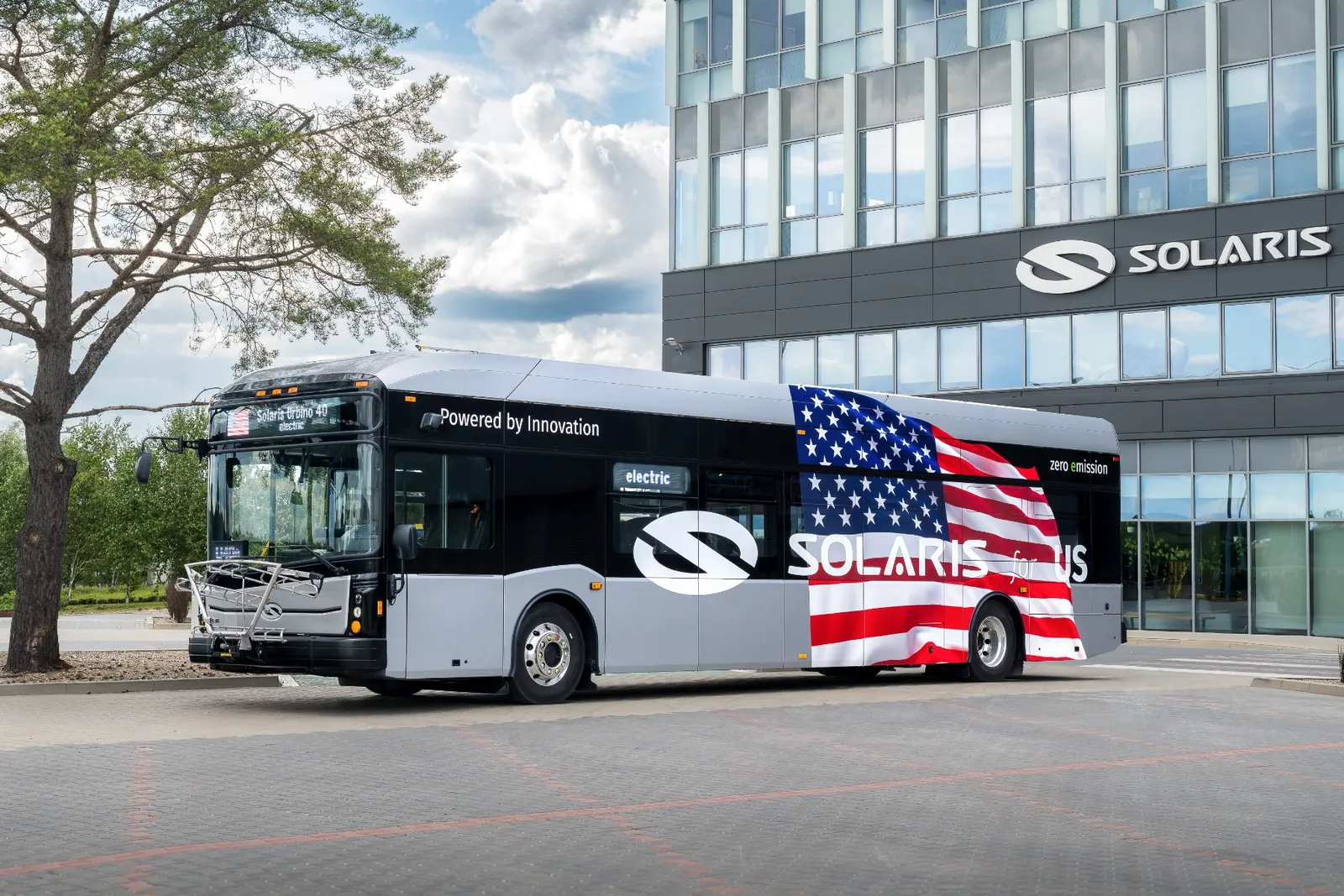
Image: Solaris
- 1/10
- 2/10
- 3/10
- 4/10
To mark the world premiere of the Solaris Urbino 40 and its longer counterpart, the Urbino 60, Solaris has released the complete specifications sheet. The Urbino 40 is equipped with two axles, while the Urbino 60 has three. The bus lengths are 12.44 meters and 18.59 meters respectively, with the original figures given in feet and inches. This is how the model names 40 and 60 were derived. In Europe, Solaris also names its buses after their length. The equivalents to these two new North American models are the Urbino 12 electric and the Urbino 18 electric, with lengths of 12 meters and 18 meters respectively.
The battery capacity is 528 kWh and 704 kWh respectively.
Solaris states that a new platform for the 40er and 60er models is necessary to comply with all U.S. regulations. The technical maximum allowable weight is estimated by Solaris at 20.3 and 32.1 tons respectively. The Solobus is available with either 230 or 300 kW of power output. The articulated bus comes standard with two 230-kW engines. As usual, Solaris installs the battery on the roof, specifying a capacity of 528 kWh for the Urbino 40 and 704 kWh for the Urbino 60. The following table provides a summary of the specifications:
Solaris does not specify the size of each battery pack. However, since identical modules are typically used, a simple calculation shows that each pack likely holds 88 kWh. In this case, six packs would be installed on the single-axle bus and eight on the articulated bus. This also aligns with the design of the Europa models: the Urbino 12 electric has six packs as well, but with a total capacity of “over 600 kWh”; Solaris does not provide a more precise figure in its official communications.
While the Urbino 12 electric is said to have a range of over 600 kilometers in Europe (according to the SORT 2 test), the manufacturer has not yet specified a range for its North American models. The statement only says that the Urbino 40 “is designed for demanding daily operations and meets the range requirements of transit agencies.” The manufacturer also highlights a range of advanced technologies onboard, including self-developed solutions for battery integration and vehicle monitoring, an efficient HVAC system, an integrated battery temperature management system, and several driver assistance systems.
| | Urbino 40 electric | Urbino 60 electric |
| --- | --- | --- |
| Axles | Two-axle | Three-axle |
| Power | 230 or 300 kW | 2 x 230 kW |
| Battery | 528 kWh | 704 kWh |
| Length | 12.44 m | 18.59 m |
| Width | 2.59 m | 2.59 m |
| Height | 3.43 m | 3.43 m |
| Technically permitted total weight | 20.3 tons | 32.1 tons |
| Maximum seating capacity | 41 | 50 |
| Maximum passenger capacity | 65 | 123 |
First customers, but still limited production volume
Solaris stated that safety and comfort for the crew were the main priorities during development. Therefore, the bus features an ergonomic cockpit, a fully shielded driver’s area, and optional exterior cameras as substitutes for mirrors. The passenger compartment offers wide aisles and barrier-free areas. Solaris specifies a maximum seating capacity of 41 or 50 units depending on the bus length, with up to 65 or 123 people able to be transported including standing passengers.
The first deliveries of electric Solaris buses to the U.S. market are set to go to King County Metro in Seattle and the San Francisco Municipal Transportation Agency soon. Solaris is also supplying trolleybuses to TransLink in Vancouver, Canada. While the latter order involves a substantial number of 107 vehicles, the other two orders are relatively small: King County Metro has ordered four buses but secured an option for twelve more. The San Francisco operator will initially use six vehicles. Both customers have ordered both single-decker and articulated buses.
