
Alarms are ringing at Volkswagen: sales dropped by 14.3% in the third quarter, including electric vehicles
Volkswagen Group is facing an increasingly difficult situation. The German automaker has seen several quarters marked by weakness in some of its key markets, growing competition, and challenges in adapting its structure to an automotive industry that is changing rapidly. Recent results have once again raised a tricky question for Wolfsburg: whether its current strategy will be sufficient to maintain its position among the world’s top automakers.
The third-quarter figures show a significant decline, especially in China, where local manufacturers are overtaking German brands. This is compounded by pressure on electric vehicle sales and the need to cut costs within a group that includes brands with very different market positions and requirements. The problem is no longer just about selling less, but finding a way to regain competitiveness without compromising their industrial future.
Volkswagen Loses Ground in China with Falling Sales
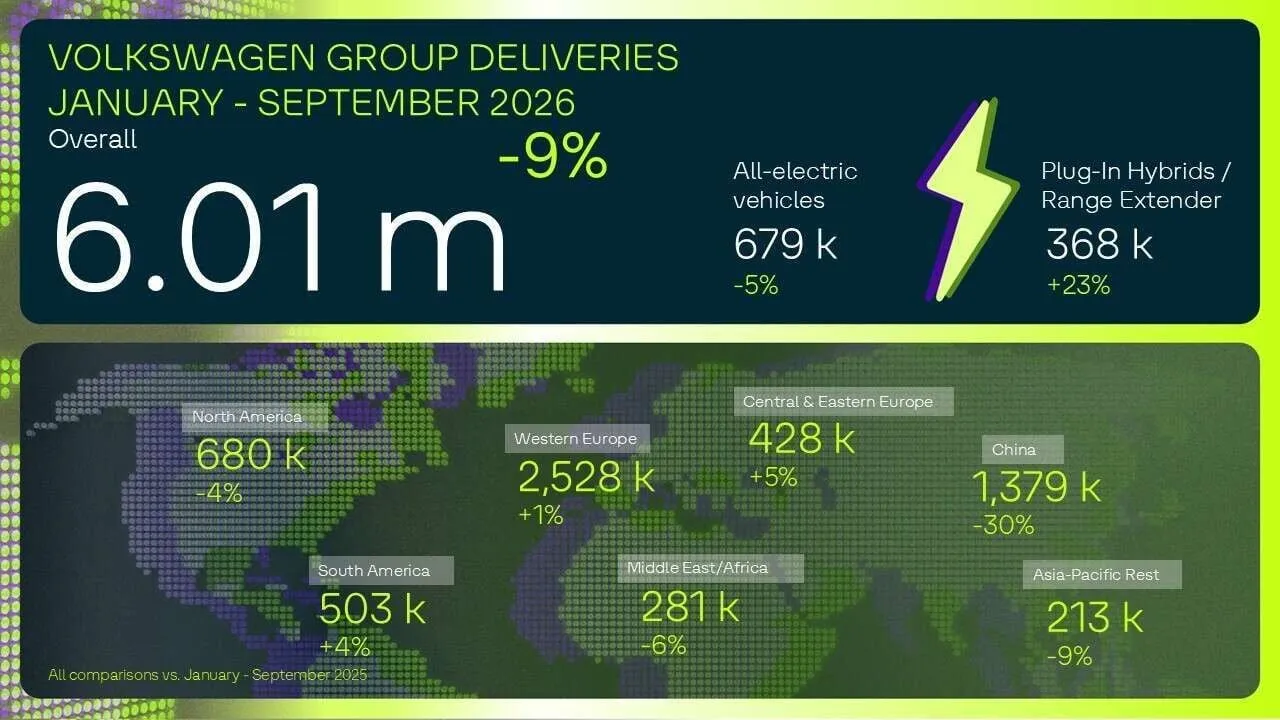
In the third quarter, Volkswagen Group delivered around 1.89 million vehicles worldwide, a 14.3% decrease from the same period last year. This decline is particularly concerning due to its scale, as well as its geographic distribution, since it affects key markets for the German automaker’s business.
China was one of the main sources of concern, with deliveries dropping by 38.5% during the quarter. The company is facing a profound transformation in that market, where domestic manufacturers have gained ground thanks to their electric vehicles, digital systems, and ability to update their models, forcing traditional automakers to respond.
Over the full year to date, from January to September, Volkswagen sold just over six million vehicles, approximately 600,000 units fewer than in the first nine months of the previous fiscal year. This represents a decline of nearly 9%. It is therefore not a problem confined to specific months, but rather a trend that is beginning to have a significant impact on the group’s overall results.
By brand, Volkswagen and Audi experienced declines of nearly 20% during the third quarter, while Skoda managed to maintain more stable sales. The commercial vehicle division, Traton, was one of the positive exceptions, with growth exceeding 10%. These differences show that the situation is not uniform across all segments of the conglomerate, although the performance of its key brands leaves little room for optimism.
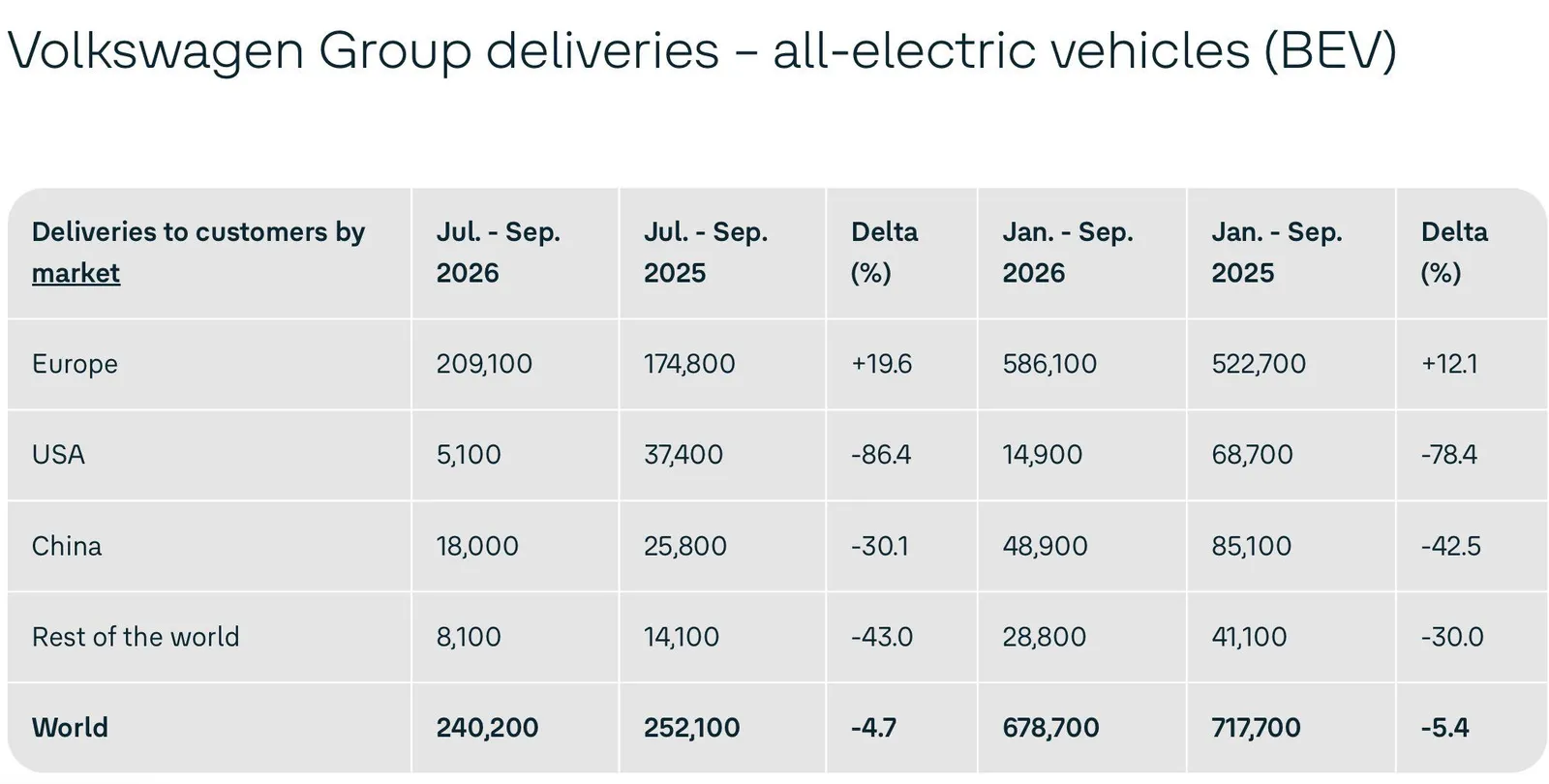
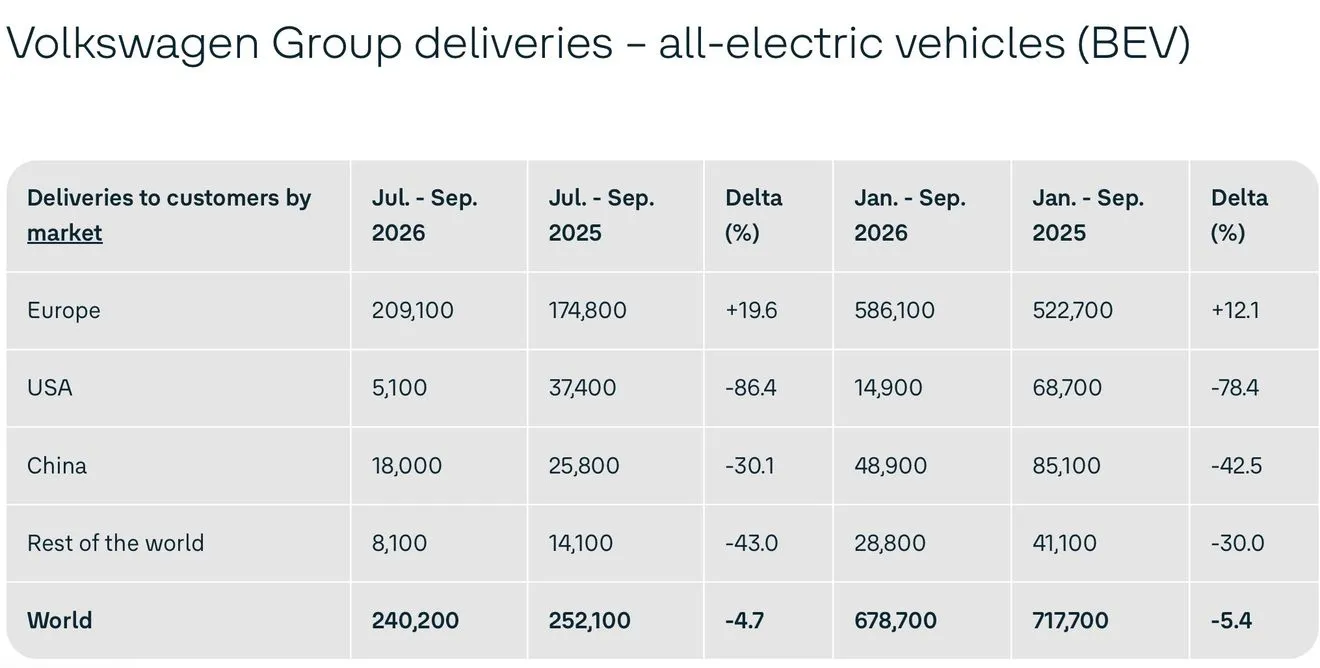
We might think that electric cars would stem the bleeding, but their development also offers no reason for optimism. Global deliveries of battery-powered electric cars from the group declined by 5% during the first three quarters of the year, according to figures in the original report. Europe stands out as the main exception, with positive growth that contrasts with difficulties in other markets.
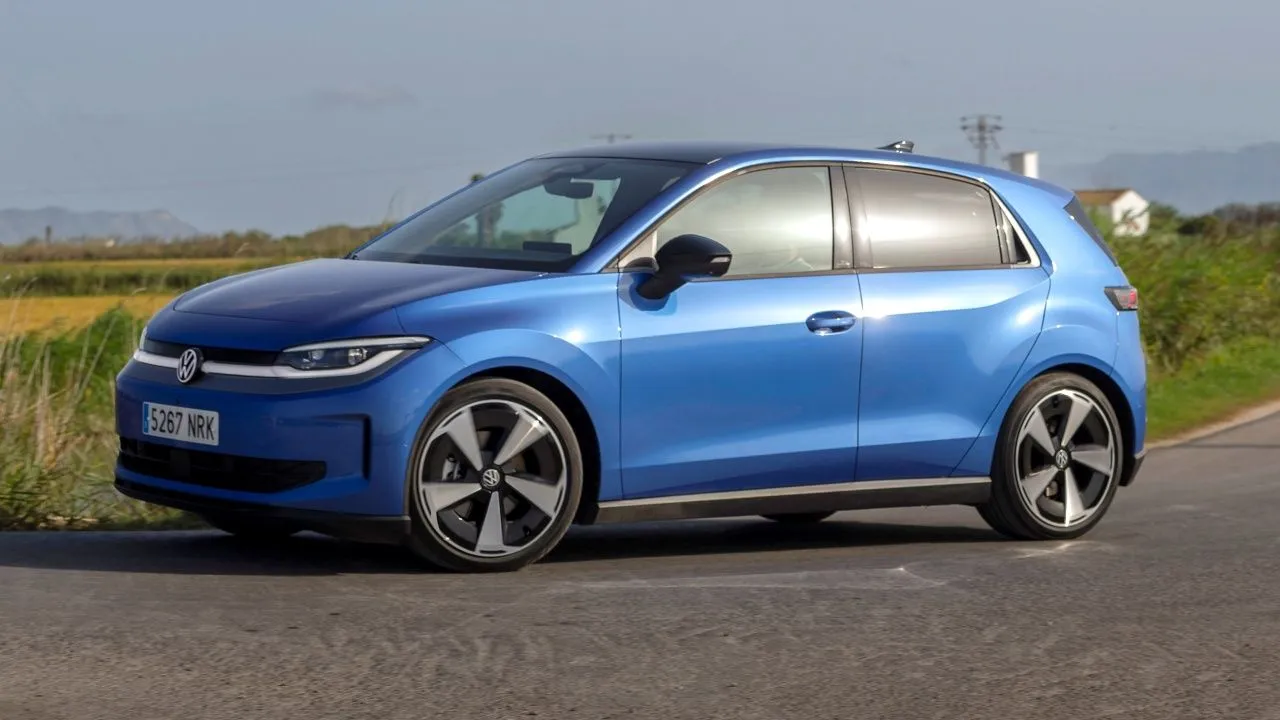
At least there is a glimmer of hope with the arrival of the new generation of electric cars, led by the ID. Polo, through which VW hopes to turn things around, at least in the electric vehicle segment.
These figures reinforce the idea that Volkswagen relies increasingly on its European market to sustain its business. The situation is particularly delicate in China, where its brands have lost some of the advantage they once had over local manufacturers, and in the United States, where trade conditions and competition make expansion difficult. However, to assess to what extent the group is losing ground in each region, it is necessary to distinguish between total deliveries and electric vehicle registrations, as well as compare equivalent periods.
The measures Volkswagen needs to avoid further deterioration
In this situation, Volkswagen’s management faces a difficult decision. The group’s CEO, Oliver Blume, has called for government support to address industry challenges, but the current difficulties also require a review of internal decisions that go far beyond public assistance. The question is whether the manufacturer is willing to transform its structure as thoroughly as the new competitive landscape demands.
Among the most radical proposals put forward to change the group’s direction is a drastic reduction of its product catalog, with up to 80% or 90% of models and versions being eliminated. This is an extreme measure, but it stems from a real problem: maintaining an excessively wide range increases industrial complexity, boosts costs, and makes it difficult to focus resources on products with the greatest commercial potential.
Technology is another area where Volkswagen needs to accelerate progress. Proposals include using larger cast components, new manufacturing processes, and greater integration of vehicle parts. The goal is to simplify production, reduce the number of components, and adopt methods that allow some competitors to build cars with more cost-competitive structures.
In terms of software, the group also needs to strengthen its capabilities, as cars with significant software functionality flaws are being launched in 2026. Of course, VW must make headway in autonomous driving—a factor that is becoming increasingly important and highly valued by customers—where Europe seems to be falling behind.
The restructuring of the experts also involves halting investments in new internal combustion engines, hybrid systems, and hydrogen propulsion, in order to focus resources on electric cars. It proposes closing underutilized engine factories, reducing staff where necessary, and renegotiating labor agreements. These are measures with enormous social and economic impact that cannot be presented as simple solutions or implemented without considering their consequences for workers and regions dependent on these facilities.
The main obstacle is that a transformation of this scale requires immediate costs to be incurred in order to achieve long-term benefits. Closing factories, simplifying product lines, and changing corporate culture can improve competitiveness, but it also entails industrial, financial, and labor risks. Therefore, rather than announcing indiscriminate cuts, Volkswagen needs to identify which activities add value, where it loses competitiveness, and what investments are essential to regain ground.
Volkswagen’s problems won’t be solved merely through government aid or a new generation of electric cars. The company needs to combine competitive products, a sustainable cost structure, and a technological strategy that keeps up with the pace of change in the industry. The third-quarter results don’t mean its business model is doomed, but they do show that sticking to the same approaches while the market evolves can be very costly. And the later it decides to act, the harder it may be to regain lost ground.