
The S7 line through Łomianki is getting closer to construction. It’s an important development.
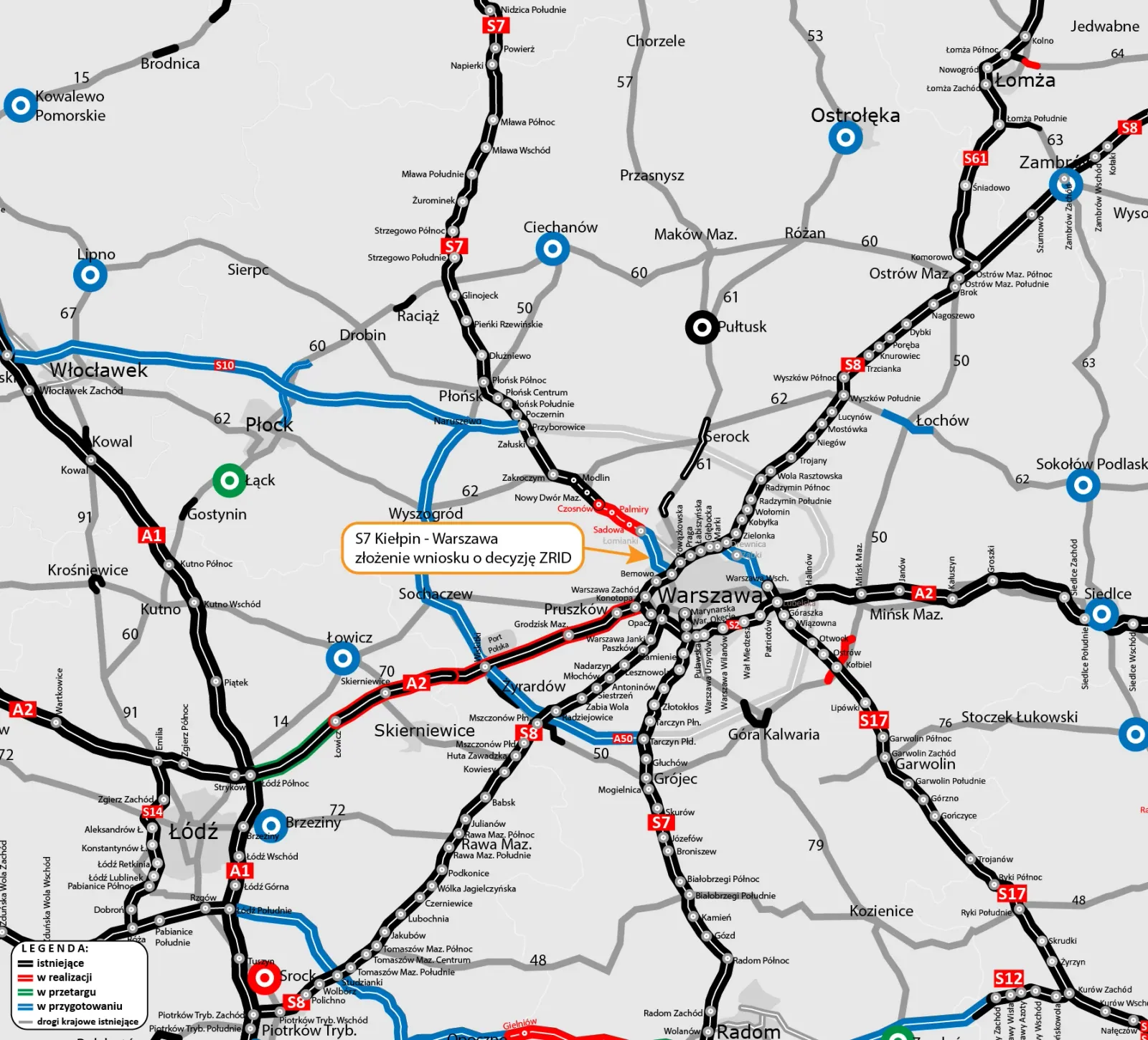
The northern exit from Warsaw remains an exception on the capital’s road network. Drivers head west and east using A2, go south via S7 and S8, while the Southern Ring Road of Warsaw is part of S2. When traveling toward Gdańsk through Łomianki, one still has to use the current, congested DK7.
Preparations to change this situation have been underway for many years. The technical, economic, and environmental study for S7 Kiełpin – Warsaw was commissioned in 2012, an application for an environmental permit was submitted in 2016, and the permit itself was issued in 2018. Now the project is much closer to the construction phase.
GDDKiA submitted an application for ZRID
On September 30, 2026, the General Directorate of National Roads and Highways submitted a request to the governor of Mazovia for an ZRID decision regarding the Kiełpin – Warsaw section. ZRID, or permission to carry out road construction, is one of the most important steps in preparing for building. It defines, among other things, the final scope of the project and allows for the acquisition of necessary properties for the state treasury. Once the decision is issued, the process of determining compensation for the current owners begins as well.
This does not yet mean that excavators will appear on the route in a few weeks. After obtaining ZRID, designers must prepare technical and organizational requirements for the construction work along with accompanying documentation. Only afterward will GDDKiA announce a tender for the contractor and project supervision. For now, there is no official date for opening the S7 Kiełpin – Warsaw route to traffic.
Almost 13 km and even four lanes
The planned section is exactly 12.9 km long. It starts in the area of Kiełpino and Dziekanów Leśny, and ends at its connection to the Armia Krajowa Route,即 Warsaw’s S8 expressway. The S7 will have two lanes. Most of the route is planned to have three lanes in each direction, but on the most heavily trafficked section near S8, the width will be increased to four lanes per lane. The traffic lanes will be 3.5 m wide, while the emergency lanes will be 2.5 m wide.
Initially, the expressway will follow the current route of Kolejowa Street in Dziekanów Leśny. Further ahead, past the Kolejowa intersection, the route will be built on an embankment heading toward the Młocińskie Canal. Then, S7 will run along the eastern edge of Kampinos National Park and reach Warsaw.
Two Tunnels Under Bielany and Bemowo
The most complex section will begin after crossing Arkuszowa Street. Due to existing buildings, the road will be buried underground there.
The first tunnel in Bielany will be about 1000 meters long. The second one in Bemowo will be around 1280 meters long. Between them will be the Generał Maczek interchange, while at the end of the entire S7 project it will connect to S8 via the Warszawa Północ interchange.
It is the tunnels, dense buildings, and the need to integrate a new expressway into the existing road network that make the final kilometers of S7 much more complex than typical highway construction outside cities.
Five Interchanges and 14 Viaducts
According to the current plan, five interchanges are planned along just under 13 km of the route: Kolejowa, Wólka Węglowa, Janickiego, Generała Maczka, and Warszawa Północ. The Janickiego and Wólka Węglowa interchanges could function as one expanded, integrated system. This system will maintain all key connections to the local road network while also being adapted to other planned transportation projects in Warsaw.
The entire project also includes 14 road overpasses, three underground passages for pedestrians and cyclists, as well as a pedestrian-cyclist footbridge. Animal crossings will also be constructed: one large and four smaller ones. GDDKiA plans to install 39 sound barriers, an ecological screen, and protective guiding fences.
The project itself costs over 54 million zł
The documentation is handled by the Transprojekt Gdańsk and Transprojekt Warszawa consortium. The contract was signed on October 2, 2024. Its value is 54.2 million zł, with a completion time of 41 months. This does not cover the cost of building the expressway itself—it includes project development and the necessary preparatory stages.
The cost of construction work will only be known after a subsequent tender. With two tunnels, large interchanges, and the urban nature of the project, this will undoubtedly be a much larger financial undertaking than the neighboring section built primarily along the existing DK7.
Construction of S7 is already underway beyond Łomianki
Meanwhile, construction of the missing section between Czosnow and Kiełpin is in progress. This 9 km stretch of road will replace the current DK7. Work here is several stages ahead. The regional governor issued the ZRID decision in March 2026, after which the main construction work began.
The current two-lane road with two traffic lanes in each direction will be expanded to an expressway standard of 2×3 lanes. Three interchanges will be built: Czosnów, Palmiry, and Sadowa, along with local roads and environmental protection infrastructure.
The contract value is 536.3 million złoty. The contractor is a consortium consisting of Fabe Polska, SP Sine Midas Stroy, and Yörük Yapi İnşaat. Initial schedules suggested an earlier completion date for the project, but recent updates from GDDKiA indicate completion by spring 2028.
The S7 road to Warsaw has been in preparation for over a decade
The final section holds disproportionately great significance given its length of just under 13 kilometers. North of Warsaw, further sections of S7 have already been opened or are under construction. The missing urban section ends precisely where traffic from the north should be directed onto the capital’s expressway network.
Once the Czosnów – Kiełpin and Kiełpin – Warsaw sections are completed, the current DK7 route through the Łomianek area will no longer be the missing link in the northern exit route. However, more time is needed for this second section. The most important development so far is that the project has reached the stage of applying for ZRID approval. Subsequent steps will include a decision by the governor, preparation of construction documents, and bidding for the project.
Piotr Sobczyk