
Cracks in the column: readers' anger and suggestions

The beating of Paride, which stemmed from the inability to charge his car at a charging station — an incident we documented a few days ago — is unfortunately not an isolated case, as our readers have confirmed. Though no fists were exchanged, it came close. Blocking a charging spot is not comparable to searching for parking: it doesn’t mean driving a few hundred extra meters; it means risking staying without a vehicle. This is a serious issue, one that does not occur in areas designated for fossil fuel refueling, where no one would think of parking for “convenience.” Paride’s experience sparked widespread and intense discussion. We heard from our readers: some criticized the lack of oversight, others shared similar experiences, and still others emphasized that charging is an urgent need, which means such tense situations are likely to increase. The overall picture
Which confirms that respecting rules — and enforcing them — is more necessary than ever today.Intimidation at the charging station
Massimo da Granarolo often shares his experiences. “It happened to me in Rimini; he told me to go to hell, left his car there, and drove away. Out of 4 spots, one was still available, so I parked my car against the flow of traffic to be able to charge, otherwise the cable wouldn’t reach. After reading Paride’s story, I felt lucky it didn’t happen to me.” On social media, Francesco Cataldi recalls, “It happened to me too 2 years ago... I pretended to be armed; he was crazy.” Although we advise avoiding such pretenses, as you never know who you’re dealing with.
Another witness is Otello Celletti: “Fortunately, there was never any physical confrontation….but I’ve received so many threats.....unfortunately, the authorities often take a bit too long to respond.” Marco Tardini had a terrible experience: “A good dash cam, and then report it to the carabinieri with the video attached. I did that once, but my car ended up completely scratched on the entire left side. The culprit was identified and reported; this shouldn’t happen.”
Roberto commented on our article skeptically on our website, but he wrote: “I have a PHEV that I charge in my garage using a 10A portable charger. Even though it takes the whole night, I wouldn’t dream of using public charging stations just to avoid all kinds of vandals.” We’re in a state of civic chaos if people are afraid to exercise a fundamental right: the right to mobility.
The illegal occupation of parking spaces is not sporadic but systemic
To go beyond the surface-level news, we collected and cataloged comments from our website and the VaiElettrico Discussioni & Consigli group. There are plenty of haters who trivialize and insult others. Here’s one example: “Basically what I predicted would happen once electric toilets became common. Next steps: removal of free blue strips and free tolls, you idiots.” These are the kinds of insults we read every day on social media. Unfortunately, regarding tolls, we should note that the exemption for 2027 does not apply to electric vehicles with less than 5 years of registration.
Blessed are the Spaniards, look how little they pay for charging / VIDEO
But let’s move on to the analysis. The discussion reveals a very clear picture; here are the key points:
The issue of occupied parking spaces is seen as systemic, not occasional.
Trust in institutions is extremely low: absent security personnel, useless complaints, and slow justice systems.
Social tension is high.
Electric vehicles exacerbate the conflict because charging is an urgent need that cannot be delayed.
Concrete and reasonable proposals emerge, along with anger and frustration.
From complaints to solutions: what can be done about free parking spaces?
Complaints are valid, but how can we mitigate this problem? We have gathered proposals from readers. The first involves physically protecting parking spaces: barriers or deterrents that lower only when charging starts, thereby preventing unauthorized occupation. However, this system requires investment and agreed-upon standards—it’s not simple.
Model 3 and Y Power Homes During Outages (But with Powerwall 3)
Another approach is surveillance. Many call for cameras installed in charging stations or the charging area, capable of automatically recording the license plates of vehicles that stay there without charging. There is also the issue of law enforcement intervention. Readers are advocating for a dedicated protocol that allows digital reporting of abuse through a municipal app or a QR code on the charging station, to reduce response times. There is also strong demand for stricter penalties. Those who occupy a charging spot without charging should face higher fines, point deductions, and, in more serious cases, charges of service disruption, as preventing charging undermines a citizen’s mobility.
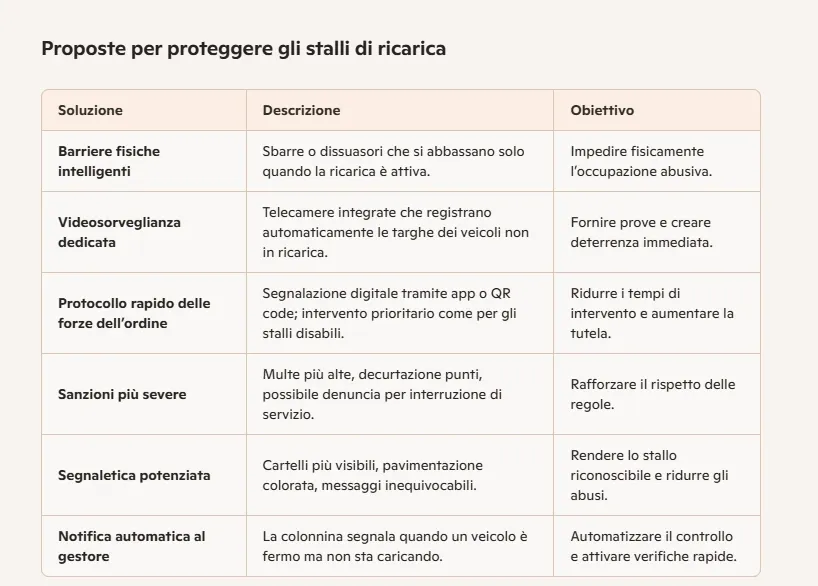
A simpler solution involves signage. More visible signs, colored pavement, and clear messages such as “Only vehicles charging – immediate penalty” could, according to proponents, reduce the excuse of “I didn’t see it” and make traffic jams immediately recognizable. Finally, some proposals focus on automation: charging stations that can alert operators when a vehicle is stationary but not charging, allowing for quick inspection or notification to the local authorities. Not all of these proposals are feasible, either economically or legally, but they provide a starting point for addressing the issue, especially if Italy reaches the levels of electrification seen in other European countries.
READ ALSO: Bonus for charging stations – there’s still hope, and watch the video – Guide to incentives
Previous Article
Is the onboard computer reliable? In my case
Next Article
Reducing bills and pollution with solar power: the guide