
The Renault E-Space revives the concept of a van from 1984. This electric model has six seats.
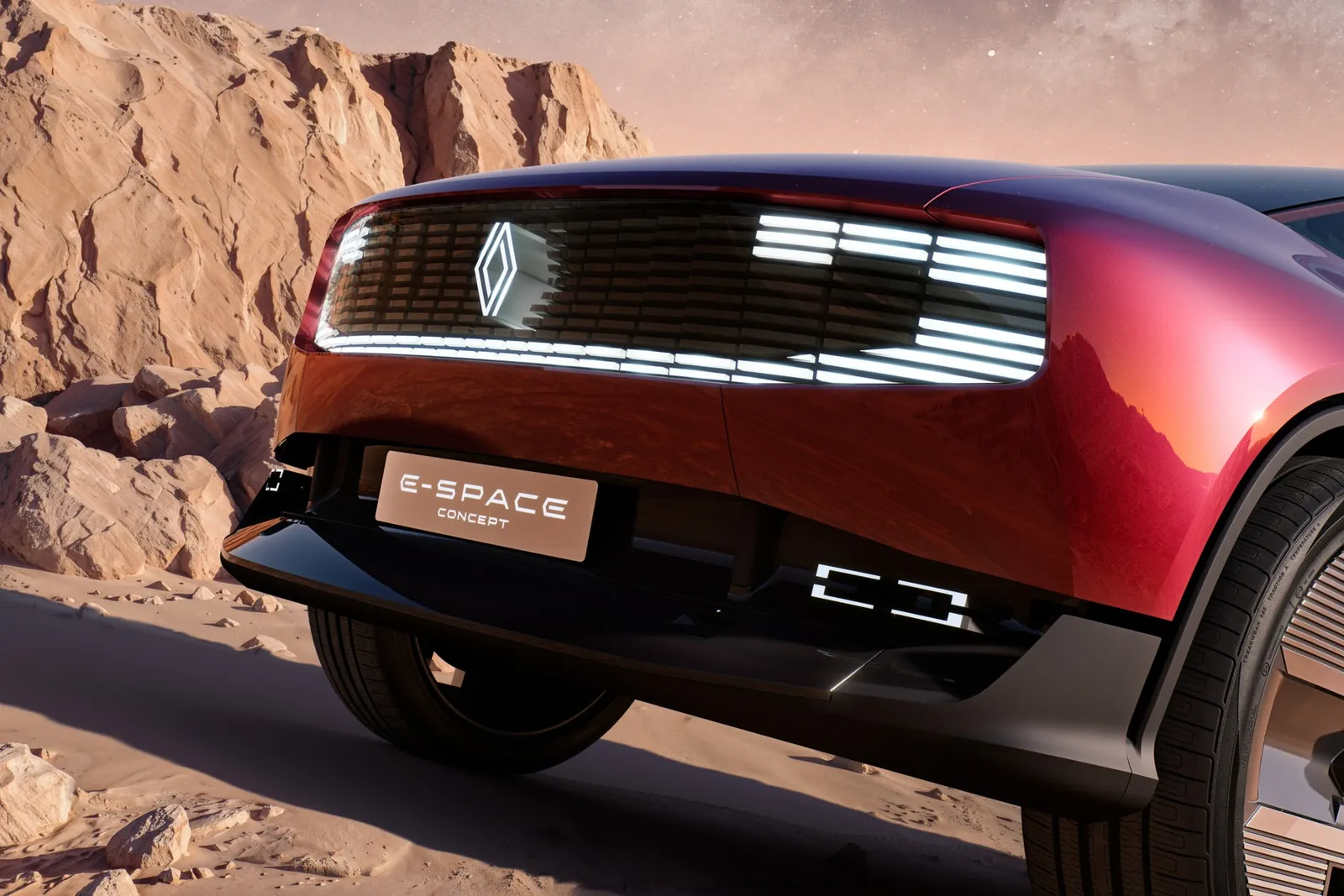
On October 12, 2026, Renault unveiled the E-Space concept at the Paris auto show, the electric successor to the original Espace. The van is 4.70 meters long, features six rotating seats, and has an interior-focused design, but the manufacturer has not revealed any details about the battery, propulsion system, or production plans.
Table of Contents
Show
Hide
Renault presents the E-Space as an alternative to SUVs and limousines. However, it is not another tall crossover with a large screen; rather, it represents a return to the concept of a family car where passenger space is more important than a muscular silhouette.
The Espace is once again a van, not an SUV
The original Renault Espace from 1984 helped popularize large family vans in Europe. The current generation carrying this name is already an SUV, so the E-Space Concept seems to be an attempt to remind people of what this model was like in its early days.
The concept measures 4700 mm in length, 2020 mm in width, and 1670 mm in height. Its dimensions are thus similar to those of the Kia PV5 sedan and the compact Volkswagen ID. Buzz. Renault has added very short overhangs, large 23-inch wheels, and lowered the body relative to a typical SUV.
Renault E-Space Concept
Specifications
Length
4700 mm
Width
2020 mm
Height
1670 mm
Seating capacity
6
Wheels
23 inches
Passenger screens
2 x 12.3 inches
The design draws inspiration from the first-generation Espace, while the rear spoiler resembles those on the second and third generations. The designers also paid attention to aerodynamics. At higher speeds, a front splitter can extend outward, which Renault claims reduces air resistance.
This concludes the details regarding driving. The company did not provide information on battery capacity, engine power, range, or charging speed. It is therefore impossible to determine whether the E-Space would be a practical family electric vehicle or merely an impressive concept of a car with a cabin on wheels.
Six seats and a table like in a train carriage
The vehicle was designed from the inside out. Low window lines, a glass roof, and large panes of glass are intended to provide plenty of light and visibility similar to classic vans. Renault cites inspiration from Bauhaus architecture and the works of Ludwig Mies van der Rohe.
The rear doors open in the opposite direction to the front doors. There is no traditional center pillar between them, so opening them creates a wide entrance to the cabin. The flat floor accommodates six separate seats, each of which can rotate.
The most interesting layout is created by rotating the second row 180 degrees. Passengers then sit facing those in the third row, similar to a four-person table on a TGV train. If the seats remain facing forward, users can use fold-down tables and two 12.3-inch screens mounted behind the front headrests.
When the seats in the second row are folded down, their back sections form a large table. The sliding console houses an air purifier, a small refrigerator, game controllers, and a physical Connect 4 game. It sounds more like equipment for a lounge than a car, but that was exactly the goal of the design.
Renault also paid attention to lighting. Ambient strips run throughout the cabin, night lights are built into the speakers, and separate reading lights are located on the central track under the glass roof.
Full-width screen and steering wheel without mechanical connection
The cockpit is dominated by a curved OpenR Panorama screen measuring 1130 x 110 mm, stretching almost from one pillar to the other. It is not touch-sensitive and serves solely for displaying information. Control is handled through two smaller, movable touch screens located next to the steering wheel.
The steering wheel itself uses steer-by-wire technology. Hand movements are transmitted to the wheels electronically, without a traditional mechanical connection to the steering column. This gives designers greater freedom in shaping the cockpit, although such a system must include appropriate safeguards in a production vehicle in case of failure.
OpenR Panorama is not meant to remain just a novelty gadget. Renault plans to apply this control concept to more expensive models, citing the Rafale and Scenica as examples. However, this does not mean they will receive the full E-Space cockpit in its shown form.
The French are also experimenting with materials. The floor features a 3 cm thick wool carpet, the table surfaces are made from dyed straw, and the steering wheel is covered with a biomaterial containing castor oil and cotton. The paint uses resins derived from biological sources, while the tires contain about 19% natural rubber from sustainable sources. This builds on Renault’s plan for recycled materials to account for at least 30% of the materials used in its lineup.
E-Space effectively reminds us why vans have been the smarter choice for large families over many years compared to many SUVs. For now, however, it is just a concept of the interior and samples of new materials, not an announcement of a finished vehicle. Renault has not confirmed a production version or a potential launch date. Only the battery, range, weight, and price will determine whether this 1984 concept can truly return to the roads.
LovEV Newsletter
Want more content like this?
Sign up — we’ll send you a weekly summary once the newsletter starts.