
Home charging for service vehicles: Ewera reimburses on a per kWh basis, without chargers or units


Approximate fees or unverifiable charging station records: covering employees’ home charging remains a challenge for companies. To simplify things for professionals, the St. Étienne-based startup Ewera has launched a web application that uses vehicle data to measure the actual energy received by company vehicles. Let us explain!
A blind spot in fleet electrification
According to Arval Mobility Observatory’s 2026 survey, 67% of companies have already included electric or rechargeable hybrid vehicles in their fleets. Yet one issue remains poorly addressed: charging employees’ cars at home.
In theory, everyone benefits. The employee charges their device in the evening or during remote work days. The company repays the electricity cost at a rate much lower than that of public charging stations. It also relieves its own parking lots, which may sometimes be unable to be equipped due to lack of space or sufficient electricity supply.
To reimburse the expenses incurred by the employee, some companies opt for a monthly flat fee. This is a simple solution to manage but risky in the event of an inspection. To date, URSSAF has not published any specific flat-rate schedule for charging expenses. However, in principle, any payment to an employee is considered wages subject to contributions, unless the employer can prove it is a precise reimbursement of actual professional expenses incurred.
"The question for businesses is: how to avoid getting taken advantage of?" summarizes Sylvain Bruyas. This former Mercedes employee founded Ewera in October 2024. Based in Saint-Etienne, the five-person startup assists around thirty companies, mainly medium-sized enterprises, with their electric transition: training teams, managing access, and overseeing charging stations on site. It was at the request of its clients that the app for home use was created. It has been tested in about a dozen companies since the beginning of the year.
Also read
Over 8 out of 10 electric cars purchased by businesses now meet this criterion
A direct connection to the vehicle
No box, no equipment at home, and just about three minutes to activate the service... To recover the energy consumed, Ewera connects to the vehicle through the manufacturer’s API with the driver’s consent. Since all electric vehicles are connected today, and fleets mostly consist of newer models, compatibility isn’t a problem according to the executive. In addition to 100% electric vehicles, rechargeable hybrids are also supported.
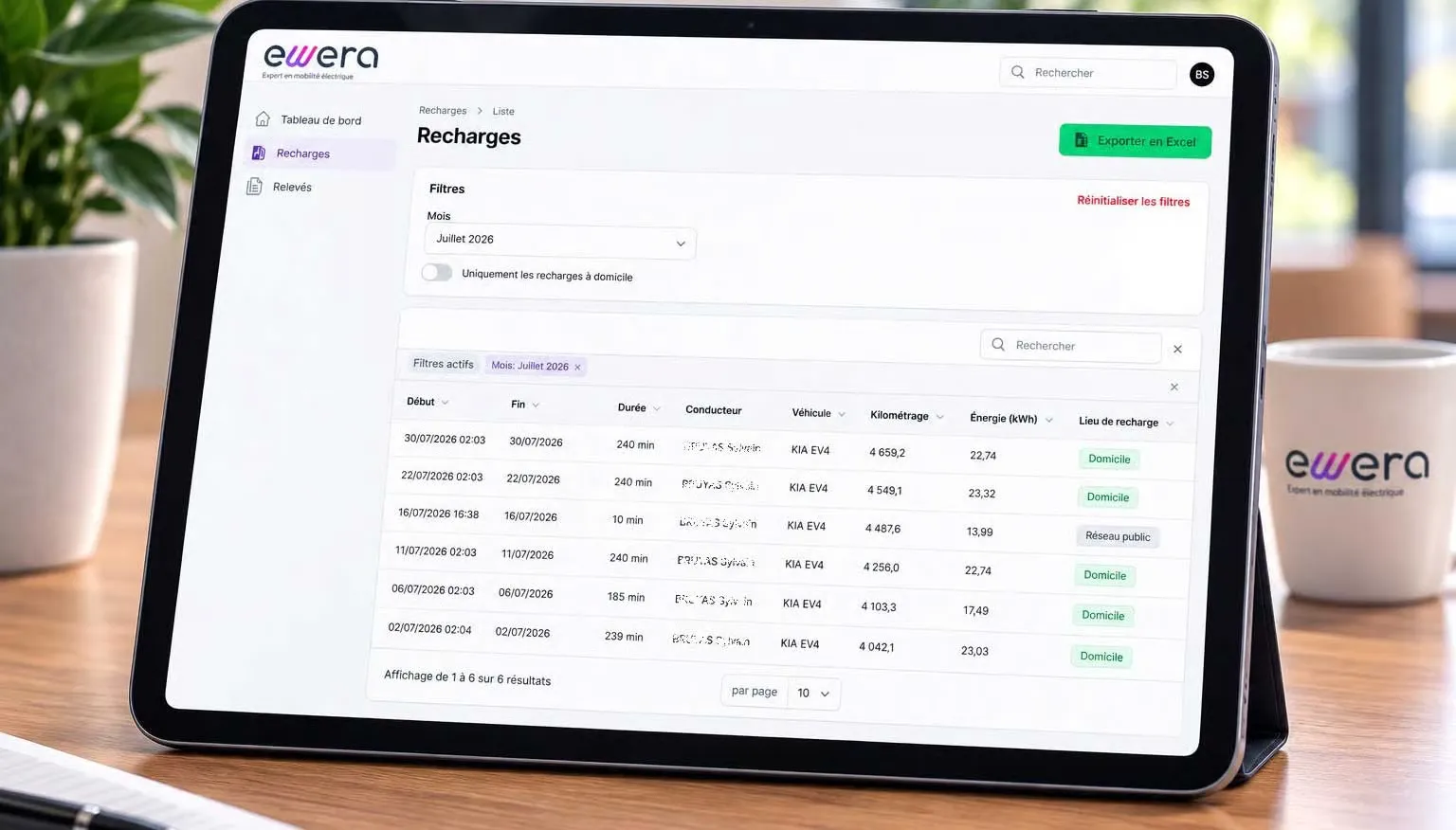
Whether it’s a dedicated charger, a reinforced outlet, or even a regular socket, since what matters is the energy received by the car, the charging equipment itself isn’t important. This is a key advantage for renters who can’t always install a wallbox.
The company sets a fixed rate per kWh, and reimbursement is based on the consumption recorded by the app. Each month, the employee checks their charging history and the amount to be paid to them. The employer has access to the same data for all their drivers.
This solution offers another advantage over monitored chargers: only the company vehicle is tracked. Employees can freely charge their spouse’s or family members’ vehicles at their own charger without it being reported to the employer.
“The car isn’t tracked.”
Accessing a car’s data inevitably raises concerns among employees and works councils. Ewera explains that she resolved the issue by limiting the data she transmits. The employer only sees the time and location of each charge (at home, at the company site, or elsewhere), but not the time or location of charges made in other places. The raw data remains with Ewera. “With a fuel card, your employer knows where, when, and how much you filled up. We reveal less information,” argues Sylvain Bruyas.
A tool for fleet managers
Beyond reimbursement, the platform provides fleet managers with a clear overview of usage patterns. For each driver, it calculates how charging occurs between home, company locations, and outside areas. “We can see that Paul charges 30% at the office, 30% at home, and 30% outside, allowing us to determine if this is normal,” explains Sylvain Bruyas.
The primary concern is financial. According to Ewera, a full charge costs 12 euros at home, compared to over 36 euros on public charging networks. Therefore, every charge made at an external location that is later used at home or the company site directly affects the fleet’s energy budget. The data helps identify drivers who rely too heavily on public charging stations and encourages them to change their habits.
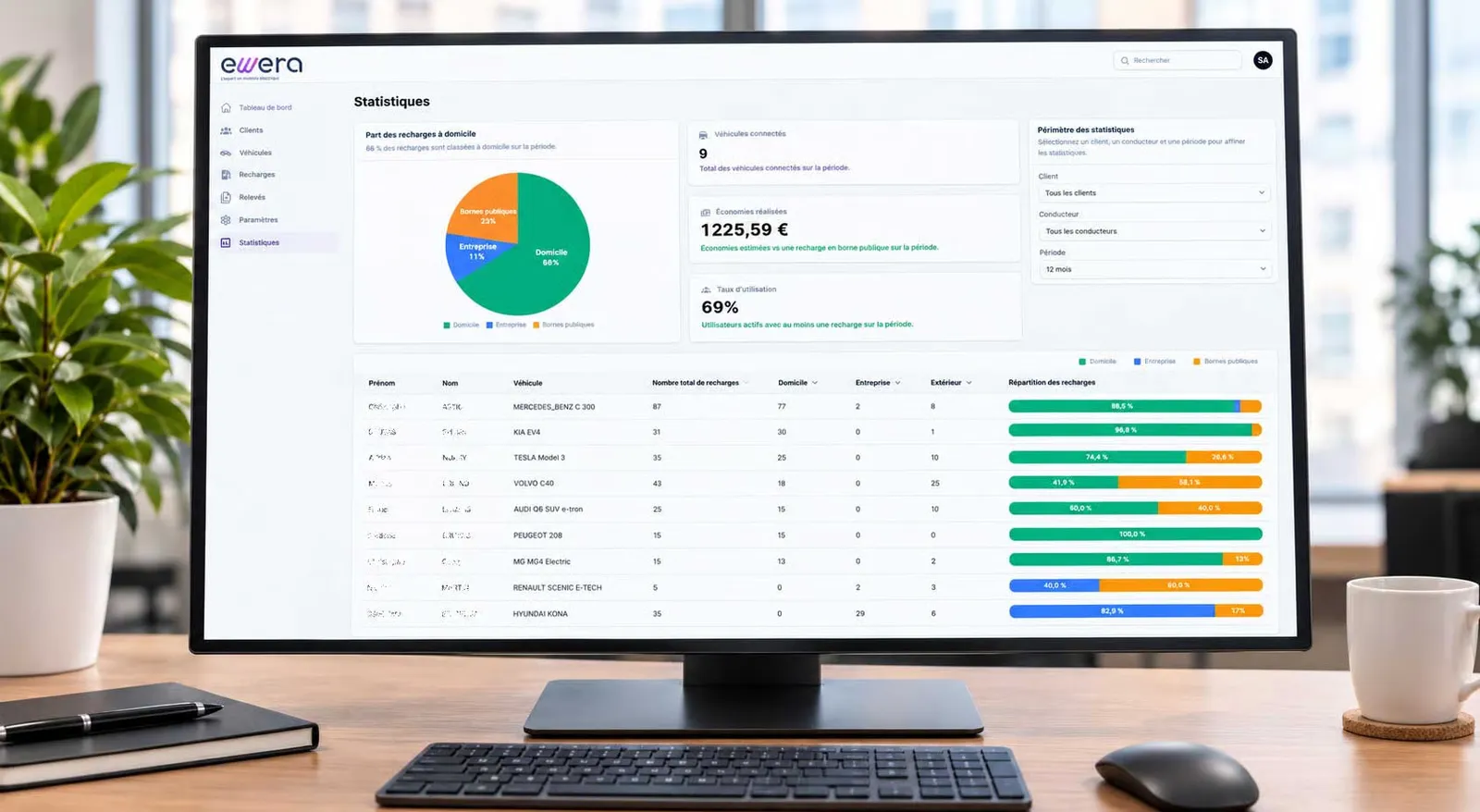
They also help to better direct investments. An employee whose home charging station cost 1,500 to 2,000 euros but who only charges at the office indicates a poor choice of equipment. Especially if that employee occupies a spot that could be used by a colleague who lacks a home charging solution. “We can optimize, understand, and change behaviors, or decide whether to make investments or not,” summarizes the founder. And since nothing is installed at the employee’s home, the issue of taking charging stations away when they leave no longer arises.
10 euros per month per vehicle
Ewera charges 10 € per month per vehicle. As usual, the price decreases depending on the size of the fleet. In France, the startup is starting out modestly. It aims to have 300 connected vehicles by the end of 2026, and then 1,000 by the end of 2027.
A Already Competitive Market
Supported by the MIND program of Saint-Étienne Métropole and Bpifrance, Ewera is preparing for a funding round in 2027. However, this young startup isn’t alone in this space. VoltaBack offers a similar solution: no mandatory connected charger, no smart cable or box, with the ability to combine vehicle data with that from the Linky meter. ChargiZ also connects directly to the vehicle through manufacturers’ interfaces.
Other players, on the other hand, rely on hardware. Chargemap Business offers a connected cable developed in partnership with Mister EV and NRGkick, which also sells its own billing platform, Charging4Fleets. Virta, meanwhile, depends on a charging station or wallbox connected at home.
