
ADEME report on the carbon footprint of traction batteries
Following the entry into force in 2023 of the European regulation aimed at establishing a circular economy for batteries, ADEME produced a report titled “Carbon Footprint of Electric Vehicle Batteries.” A calculator for modeling this carbon footprint was also developed in Excel as part of this effort. It takes into account 35 technical, geographical, and methodological parameters. Both documents can be downloaded free of charge in one go from the organization’s website. They complement ADEME’s guidance on electric vehicles and charging, regarding which we recently published an initial article.
Methodology and Calculator
Starting from February 18, 2024, the European regulation UE 2023/1542, aimed at establishing a circular economy for the battery sector, is being implemented gradually. This regulation covers all stages of these batteries’ life cycle, from design to waste disposal. It specifically seeks to create environmental classes for batteries used in electric vehicles, with the goal of setting maximum thresholds that will determine market approval for various types of traction batteries.
The 63-page report titled “Carbon Footprint of Electric Vehicle Batteries,” filled with numerous references, begins to explain in detail the methodology for calculating and verifying the carbon footprint of this essential component in connected mobility.
The stages of the life cycle included are: extraction and refining of raw materials; production of active materials; manufacturing of cells and components; assembly of the pack and its elements; distribution of the complete system; and recycling. Transportation is also taken into account, except at the end-of-life stage. In contrast, battery installation in the vehicle, transportation of the vehicle itself, and use of the pack are excluded.
In the following section, the report briefly introduces the calculator that accompanies it. However, its user manual is directly available in the English-language Excel document.
Example with a 50 kWh pack produced in China
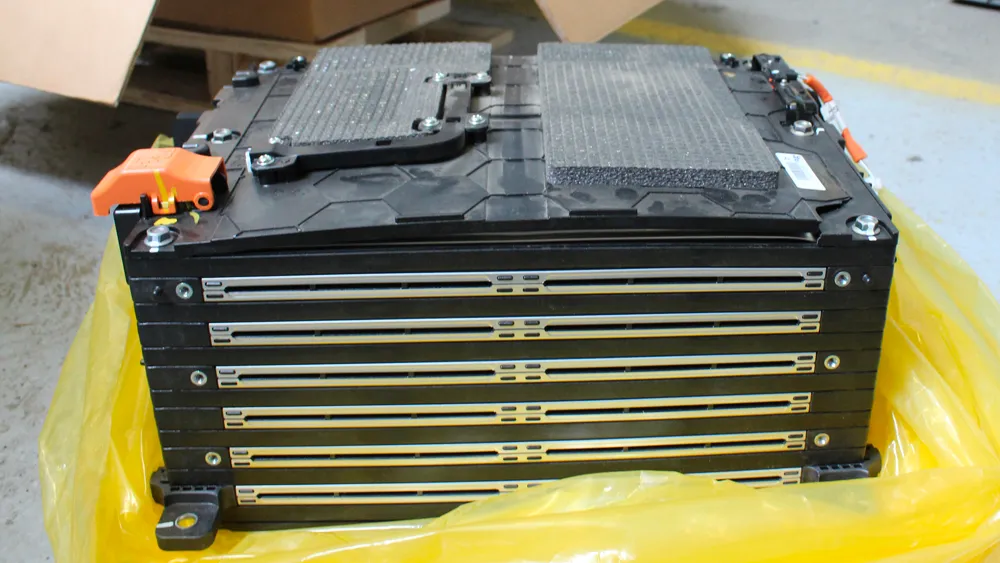
Among the interesting points in this ADEME report is the precise calculation of the carbon footprint of a battery (with 50 kWh capacity) produced in China, used in France, and recycled in Europe. Its cells are of the NMC811 type with artificial graphite. Batteries of this kind, composed of 80% nickel, 10% manganese, and equal amounts of cobalt, can be found in models such as the Tesla Model 3 and Model Y, Peugeot e-408, Kia EV6, Hyundai Ioniq 5, and BMW iX3.
If recycling is excluded, greenhouse gas emissions for such a pack are estimated at 7 tons, or 140 kg CO2eq per kilowatt-hour of capacity. With recycling, this carbon footprint drops to 6.4 tons. The main contributors fall into three categories: active materials (about 53%); cell manufacturing, including the energy used for this process and waste; and aluminum found in cells, modules, and the pack (less than 10%).
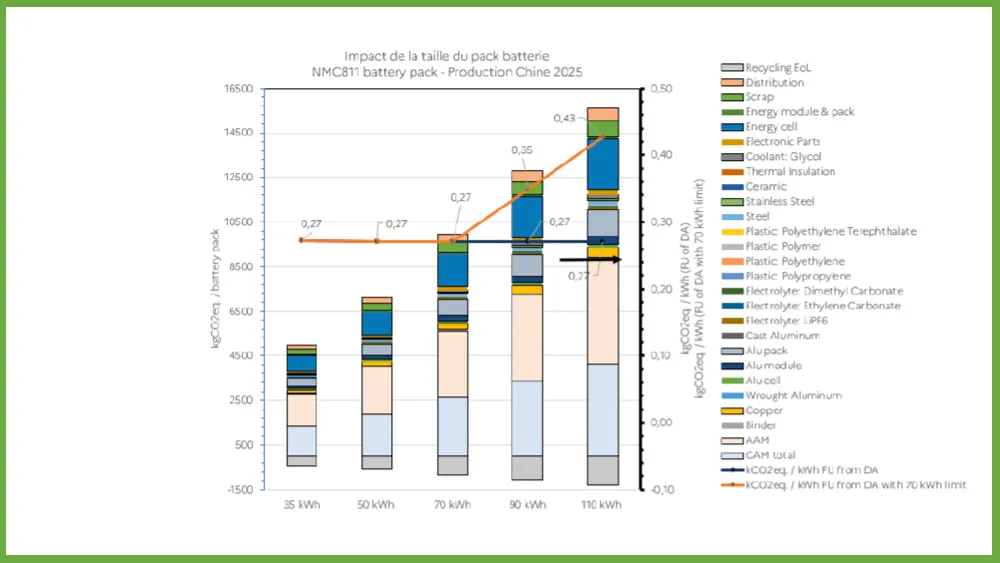
This battery will serve as a basis for identifying factors that can affect environmental impact in the report. Starting with energy capacity, ADEME has outlined batteries with capacities of 35, 50, 70, 90, and 110 kWh. Next is the chemistry aspect, comparing 9 50 kWh battery packs: NMC532, NMC622, NMC811, NMC955, LFP (lithium iron phosphate), LMFP (lithium manganese iron phosphate), sodium-ion NVPF (sodium vanadium phosphate fluoride), and solid LMP (lithium metal polymer).
Other factors affecting carbon footprint
Next is the vehicle category, with a yearly difference in charge/discharge cycles: 60 for vehicles in M1 and N1 categories (passenger cars and pickup trucks with 50 kWh batteries), 20 for two-wheelers and similar vehicles (L category, 20 kWh battery pack), and 250 for coaches and buses (M2, M3) and trucks (N2, N3). For these heavy vehicles, the battery energy capacity has been set at 350 kWh. The number of years in operation is also taken into account for all vehicle categories.
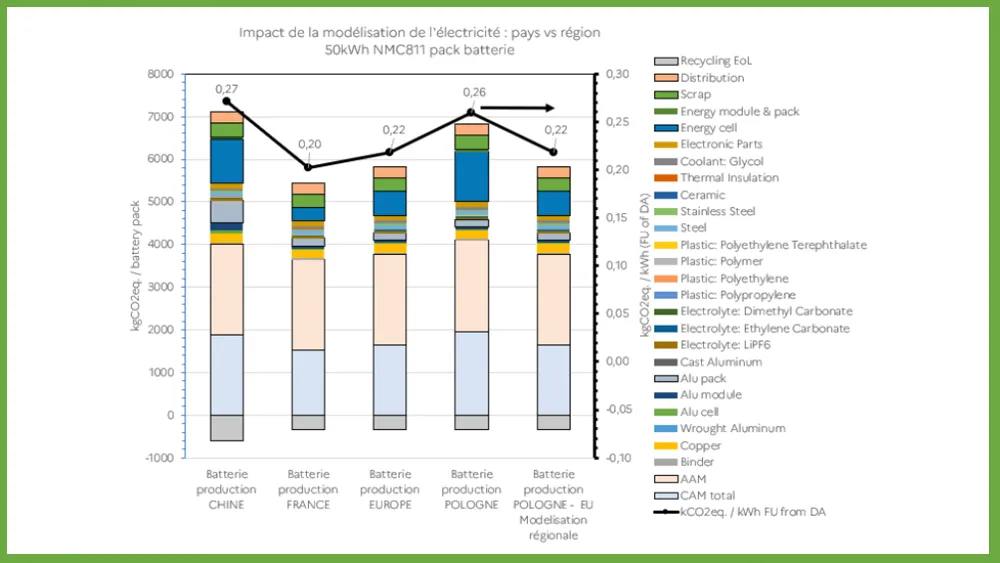
Each country has its own energy mix, which significantly influences the carbon footprint of battery production. Our 50 kWh pack with NMC811 cells is manufactured in China, France, or Poland. In light of the debate criticizing the European Commission’s approach of considering matters on a national scale, Ademe has also included some expanded models: the European continent and the EU market.
At the end of a battery’s life, the equivalent CO2 emissions can vary depending on the processes used to recover recyclable materials. The report also examined the locations where battery packs, modules, and cells are manufactured, with particular attention to the availability of materials on site.
To Achieve Effective Decarbonization
At the conclusion of its investigation, ADEME found that “relocating the manufacturing of battery packs, modules, and cells to France without relocating the active materials is not sufficient on its own to achieve a significant reduction in carbon footprint.”
According to ADEME, what could change the situation lies in seeking low-carbon solutions for graphite production, the synthesis of active cathode materials, sourcing various components (nickel, cobalt, lithium, aluminum), and the manufacturing of cells (decarbonized mixtures). Additionally, reducing waste rates is important.
The agency also highlights the European Commission’s methodology, which results in assigning the same carbon footprint to a battery pack regardless of its energy capacity.
Download the report and calculator