
Project BELLE sees depot stores as the key to scaling up electric trucks
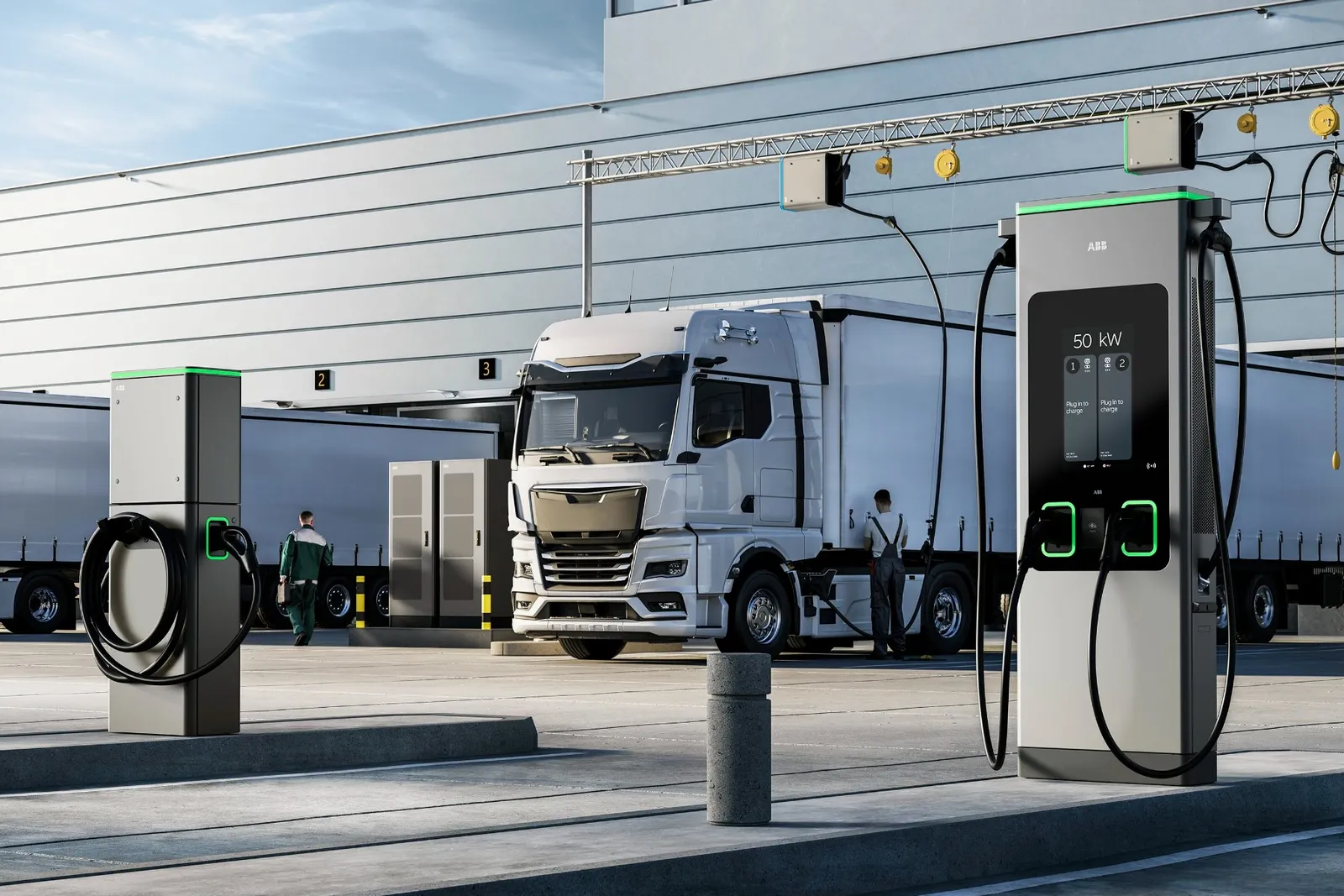
The BELLE research project explored how depots for heavy electric trucks can be electrified. A key finding: it’s not just the vehicles themselves that matter, but primarily grid connection, charging infrastructure, and intelligent charging management.
BELLE will demonstrate how depots can be electrified to support larger fleets of electric trucks.
Image: ABB
After three years of research and practical work, the BELLE project has been completed. Led by hysolutions, Hamburger Energienetze, HAW Hamburg, Stadtreinigung Hamburg, ABB E-mobility, Dachser, Brock, and Daimler Truck investigated how heavy battery-electric commercial vehicles can be integrated into existing operational processes.
BELLE stands for “Betriebshofelektrifizierung – Ladeinfrastruktur und Lastmanagement in der praktischen Erprobung.” The project began in 2023 and was funded by the federal government with just over one million euros. It focused on designing charging infrastructure, load and charging management, grid connections, integrating electric vehicles into existing processes, and the cost-effectiveness of using electric trucks.
A key insight relates to charging stations. A large portion of charging for heavy electric commercial vehicles already takes place today on company premises. These locations are thus increasingly assuming the role of energy hubs as well. From the perspective of project partners, the deployment of electric trucks depends not only on range or vehicle availability but also on how much power is available at the site and how efficiently it can be utilized.
The importance of depot charging aligns with recent model calculations by Fraunhofer ISI and ICCT. According to these, in most European countries, more than 70 to 80 percent of the charging needs for electric trucks are likely to be met at depots in the long term as well. Meanwhile, the annual charging energy demand for heavy electric trucks in Europe could rise to around 100 TWh by 2035. This increases the pressure to expand grid connections and energy management at major logistics locations ahead of time.
Depot charging takes center stage for electric trucks
BELLE also shows that a charging station does not necessarily need to design its power connection based on the sum of all maximum charging capacities. ABB E-mobility cites the experience gained from projects with Hamburg’s waste management service and Dachser. If charging sessions are intelligently distributed across different times, the required connection capacity can be reduced.
This is particularly important when gradually expanding a fleet. Companies can align charging capacity with vehicle needs and expand infrastructure step by step. However, this requires seamless coordination between charging technology, energy management, vehicle scheduling, and corporate IT systems.
"The real challenge lies not in the vehicle itself, but in intelligently connecting energy supply, charging infrastructure, and operational processes," says Christoph Steinkamp, CEO of hysolutions. Thus, fleet transformation is increasingly also an energy system project.
Economically as well, BELLE is sending positive signals according to the project partners. Battery-electric commercial vehicles can already be operated profitably in various applications today. The participants see additional potential in reducing greenhouse gas emissions, opening up charging infrastructure to third parties, and ultimately providing flexibility for the power system.
The importance of infrastructure and power supply as fleet sizes grow is illustrated by the example of Dachser. The logistics company put its first electric truck into operation at its Hamburg site in 2019 and now has a charging facility there that can theoretically charge up to 30 heavy commercial vehicles. Currently, the logistics company delivers goods to designated downtown areas in 25 European cities without local emissions, using 60 electric vehicles among other means. The transportation activities relevant to Scope 1 at this site have now been largely electrified.
For a complete transition to larger, heavier fleets, Dachser’s logistics manager Christoph Kellermann still sees the availability of sufficient electricity as a key challenge. In addition to powerful grid connections, he mentions megawatt chargers and a sufficient number of charging points for short stop times. He also suggests alternative battery systems, such as those that allow batteries to be charged more flexibly using one’s own solar power generation.
_Source: Information via email_
