
Porsche Cayenne S Coupé Electric in testing: the PPE, one step further
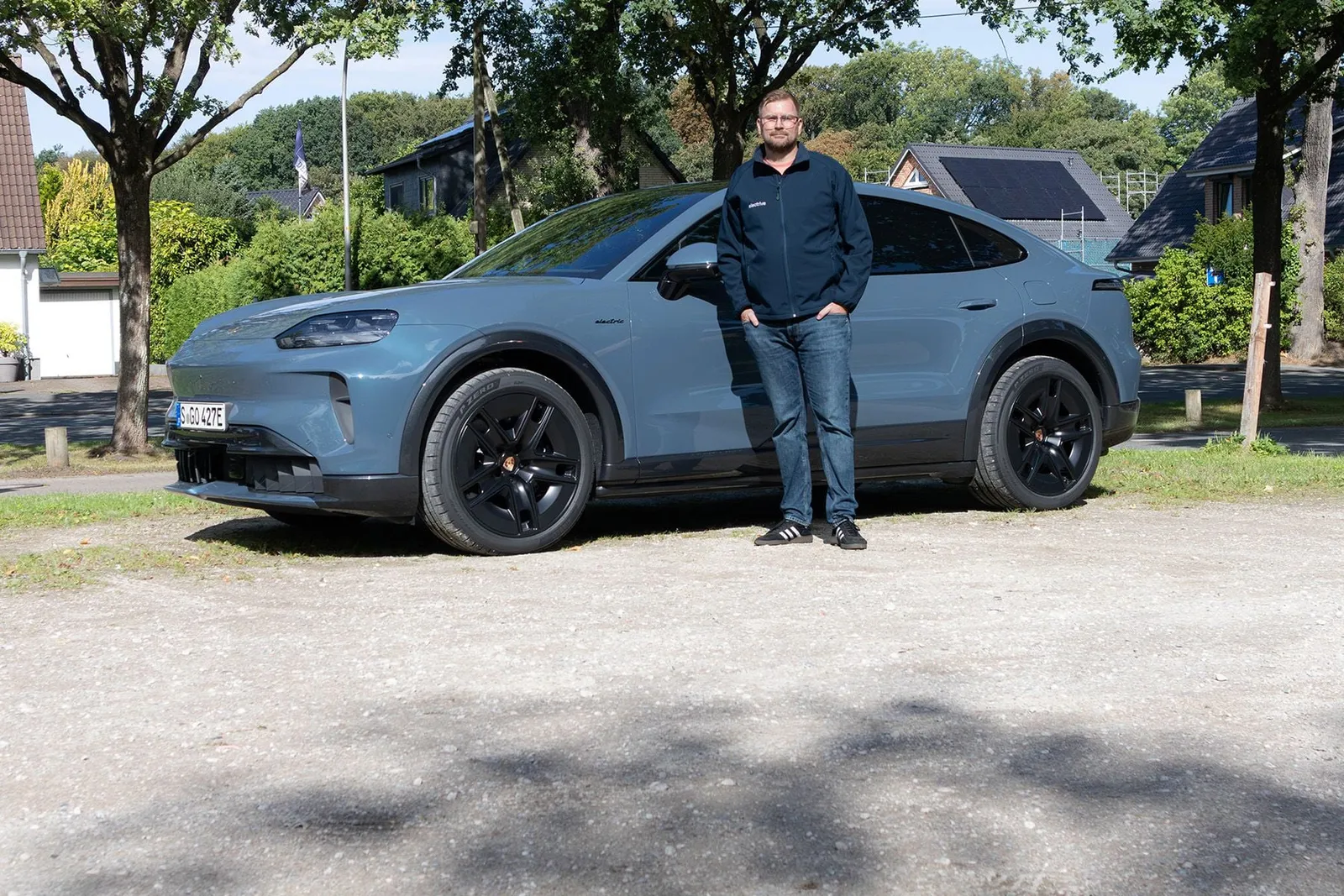
Porsche has expanded its largest SUV lineup with a fully electric version of the Cayenne Electric. Following its world premiere in November 2025, production began in Bratislava at the beginning of February 2026. In March, Porsche added an S version to the initially available base and Turbo electric models. My test vehicle is that S model in coupe form.
With up to 400 kW in normal driving conditions and 490 kW with Launch Control, the S sits between the base model with 300 kW (325 kW with Launch Control) and the Turbo version with 630 kW (850 kW). With Launch Control, this mid-tier model is supposed to achieve 100 km/h in 3.8 seconds, with a top speed of 250 km/h. For comparison, the base model takes 4.8 seconds to reach 100 km/h and has a top speed of 230 km/h, while the Turbo version does it in 2.5 seconds and reaches 260 km/h. So even the base model would be more than sufficient for a trip to the bakery or for quick highway driving.
The technical foundation, similar to the Macan, is the Premium Platform Electric, or PPE. For the Cayenne, however, Porsche has completely redesigned two key components compared to the Macan: a battery that is more integrated into the vehicle’s structure, and in the S model, an oil-cooled rear-wheel motor. Additionally, the optional Porsche Active Ride system provides an active suspension, which Porsche is using in an SUV for the first time.
Oil-Cooling for the Rear-Wheel Motor
Synchronous motors with permanent excitation are mounted on both axles. The front engine is essentially derived from that in the Macan. In contrast, the rear axle features a specially developed engine with direct oil cooling, available only on the S and Turbo models. The base model comes equipped with a water-cooled engine here. Porsche obtains the additional power from the Turbo not by using a different engine, but by employing a longer version of the same engine design—the S model gets the shorter version, while the Turbo gets the longer one.
A non-conductive oil transfers heat directly to the copper windings. With conventional water-cooling, heat must first reach the outer cooling jacket. This cooling method is designed to help maintain performance for longer even under heavy loads. Porsche claims an engine efficiency of up to 98 percent. Porsche cites this more efficient cooling as one reason why the S model achieves even a slightly longer range despite higher power output compared to the base model.
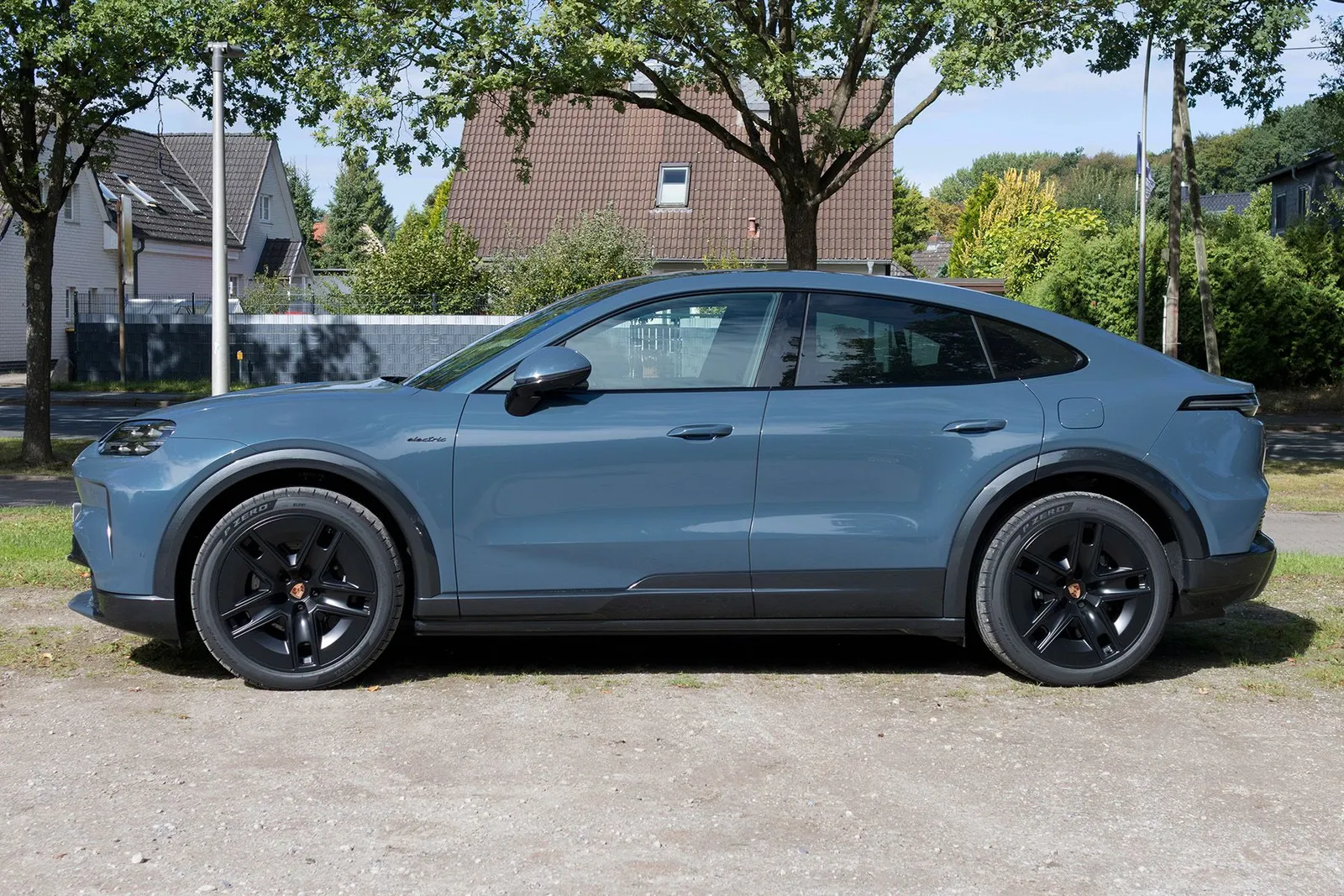
Image: Daniel Bönnighausen
- 1/4
- 2/4
- 3/4
- 4/4
Auspicious suspension for its weight
On the road, the S delivers consistent and powerful thrust without me needing to use launch control. The torque available at all times makes overtaking effortless, and even during repeated full-throttle bursts, the driving force remains remarkably steady. I’ve never experienced premature throttle shutdown.
But acceleration is just one aspect: the specifications already list a curb weight of 2,560 kilograms for the standard S Coupé. The drivetrain must not only propel this weight forward; the suspension also needs to keep it under control when turning, braking, or on poor roads.
Standardly, it comes with an adaptive air suspension featuring electronic damper control. My test vehicle had Porsche Active Ride added for 8,324 euros. Its active dampers are connected to a motor-pump unit per axle. The system generates targeted forces at each wheel and functions without mechanical stabilizers. It stabilizes the chassis during dynamic driving. In Comfort mode, it can even overcompensate for roll and pitch movements to reduce the forces acting on the passengers.
The driving feel depends heavily on the mode selected. In Comfort mode, the Cayenne smooths out major unevennesses, and when turning, it doesn’t lean outward but rather slightly into the curve — an unusual sensation that noticeably relieves the occupants. When switched to Sport or Sport Plus mode, the vehicle remains remarkably flat in its handling without becoming overly stiff. Combined with the precise steering and the steering-assist rear axle, the S model feels more agile than one would expect from a vehicle of this size and weight. Normal mode offers a good balance in this regard. However, the vehicle’s weight cannot be completely ignored: if pushed too far, the S model tends to pull out of turns through the front axle, and the 22-inch wheels allow short, sharp edges to reach directly into the cabin unfiltered.
The driving experience also includes the level of deceleration. Porsche integrates regenerative braking with the use of the brake pedal, with the friction brakes supplementing it when needed. The transition between these systems is nearly imperceptible. The ceramic brakes installed in the test vehicle, complete with black brake calipers, cost over 10,100 euros. This extra feature is not necessary for everyday energy recovery.
The rear-wheel steering, mentioned earlier, is highly recommended and costs around 1,700 euros. It reduces the turning circle from 12.7 meters to 11.6 meters—a significant practical advantage for a car that is just over five meters long.
Brand new battery
The powerful drive is powered by a battery with a gross energy capacity of 113 kWh, of which around 108 kWh are expected to be usable. Porsche uses six modules containing a total of 192 pouch cells. This changes the cell design compared to the prismatic cells in the Macan. The chemistry is also new: a nickel-rich NMCA cathode (about 86 percent nickel) and an anode with six percent silicon increase the energy density by roughly seven percent compared to the previous NMC-811 chemistry, according to Porsche. As a result, the battery holds eight kilowatt-hours more than that of the Taycan and is about 103 liters more compact.
The silicon in the anode not only improves energy density but also fast charging capability. However, full charging power is available only when the battery is within the optimal temperature range. To reach this range as quickly as possible, it can be pre-conditioned.
Two cooling plates per module heat or cool the cells from above and below. According to the manufacturer, the pressure fans used require about 15 percent less energy than conventional suction fans. Pre-conditioning is automatically triggered by the Charging Planner once a charging stop is set as a navigation destination. Porsche does not provide a way to start it manually independently of this process. Therefore, those who drive to a fast charger spontaneously without route guidance cannot pre-heat the battery intentionally.
High charging power over long distances
The driver information display shows whether the battery is within the temperature range. It also lets you instantly see what charging capacity is possible at the current temperature. Once it reaches this range, the Cayenne maintains a high charging rate for most of the charging process. Excellent!
Porsche shifts the charging curve to an earlier peak: According to our in-depth technical analysis, power exceeds 300 kW already at around 5 percent charge level, with the theoretical maximum reaching about 55 percent. My own measurements at an EnBW HyperCharger started at a charge state of 9 percent. At 12 percent, the power was already 333 kW, and around 13 percent it reached about 360 kW. After that, the power rises slowly and reaches its maximum of 386 kW at 44 percent charge. The target of 390 kW listed in the specifications is just out of reach, and this is due to the charging station rather than the car: Porsche specifies 390 kW only at over 520 amperes, but the HyperCharger can deliver a maximum of 500 amperes. For 400 kW, Porsche cites an even stricter set of conditions—over 850 volts, a battery at 40 to 42 degrees Celsius, and a charge level of 45 to 48 percent.
The key factor for keeping the charging stop as short as possible is the subsequent progression to 80 percent charge. After the initial drop in power, the Cayenne continues charging at around 290 kW. Between approximately 60 and 71 percent, it maintains about 270 kW, while at 80 percent it drops to 183 kW. Only after that does the power drop significantly again. It takes around 16 minutes, according to my timer, to go from 10 percent to 80 percent—exactly as specified in the configuration. This is an impressive figure for this class.
Charging quietly with almost the same time
A drawback of the charging performance of the Porsche Cayenne S Coupé Electric became apparent during the first fast charge: During charging and for some time afterward, the cooling fans operate very loudly. Therefore, I recorded a second charge session using Quiet Charging at the same charging station on another day.
This is a special mode offered by Porsche. It can only be activated after the charging process has started, manually via the display. It reduces the fan speed solely, which lowers cooling efficiency and causes the battery to heat up faster — so that once it reaches its limit temperature sooner, the vehicle must adjust the charging power. This is how Porsche explains it upon request.
In my comparison, the vehicle was noticeably quieter. However, it still only took 16 minutes to achieve the same lifting height. The peak power was almost identical at 385 kW. The curves are not completely matching, though: in Quiet Mode, the high plateau ends at 42 percent. At 44 percent, therefore, 325 kW in Quiet Mode is compared to 386 kW in Normal Mode. For much of the rest of the range, the values remain closely aligned.
This cannot be generalized from a single measurement, as there is only one cycle in each case. Quiet Charging is intended to achieve just one thing—reduced noise. Porsche confirmed upon request that under moderate conditions, only the sound level indeed decreases. During my tests, the outdoor temperature was around 20 degrees Celsius. A noticeable reduction in performance occurs only at high battery and outdoor temperatures. As an example, the manufacturer cites a charge increase from 10% to 80% at a battery temperature of 35 degrees Celsius and an outdoor temperature of 45 degrees Celsius. In such cases, the charging time can increase by about one minute. A general statement is impossible due to the many parameters, ranging from outdoor temperature to battery condition and charge level.
Charging Away from Fast Charging Stations
The new optional 22-kW AC charger in my test vehicle helps with longer driving ranges. It costs 1,666 euros and reduces the charging time from zero to 100 percent from 11 hours to 5.8 hours. The standard option is 11 kW. This is an important update to our earlier reporting, when the 22-kW option was not yet available.
Since the model year change in September 2026, induction charging has also become available for regular ordering — my test vehicle is only prepared for it. For Porsche Wireless Charging with 11 kW and a efficiency of around 90 percent, the vehicle’s charging plate and the floor plate in the parking space are required. However, it is not cheap: Porsche charges 5,117 euros for this feature.
What’s possible between charging stops
Short breaks help during a journey, but they cannot replace low fuel consumption. For the specific configuration, Porsche lists a combined WLTP range of 616 kilometers. However, the S Coupé model range goes up to 669 kilometers, while the S with an SUV body reaches up to 653 kilometers. This is the highest value among the Coupé variants: the base model achieves up to 661 kilometers, and the Turbo version only reaches 637 kilometers.
In mixed driving conditions involving city roads, country lanes, and highways, the fuel consumption ranged from about 20 to 27 kWh/100 km depending on speed. When driving more deliberately slowly, I approached the 20-kWh mark; in typical daily driving, the reading settled around 24 kWh/100 km, while at higher highway speeds it reached just under 27 kWh/100 km. With a usable battery capacity of around 108 kWh, 24 kWh/100 km theoretically allows for approximately 450 kilometers per full charge. If the driver uses the battery level between 80 and 100 percent during travel, the range under the same assumptions is around 315 kilometers. However, these onboard computer readings cannot be directly compared to WLTP standard consumption figures, as the latter includes charging losses that are not shown in the vehicle’s display.
| Cayenne | Coupé Electric | S Coupé Electric | Turbo Coupé Electric |
| --- | --- | --- | --- |
| Drive System | AWD | AWD | AWD |
| Power | 300 kW | 400 kW | 630 kW |
| Overboost Power | 325 kW | 490 kW | 850 kW |
| Acceleration | 4.8 s | 3.8 s | 2.5 s |
| Top Speed | 230 km/h | 250 km/h | 260 km/h |
| Battery (gross) | 113 kWh | 113 kWh | 113 kWh |
| WLTP Range | 661 km | 669 km | 637 km |
| DC Charging Power | 390 kW | 390 kW | 390 kW |
| DC Charging Time 10-80% | 16 min | 16 min | 16 min |
| AC Charging Power | 11/22 kW | 11/22 kW | 11/22 kW |
| AC Charging Time 0-100% | 11/5.75 h | 11/5.75 h | 11/5.75 h |
| Trunk Volume | 534 l | 534 l | 500 l |
| Front Compartment | 90 l | 90 l | 90 l |
| Towing Capacity (braked) | 3 t | 3 t | 3 t |
| Towing Capacity with Offroad Package (braked) | 3.5 t | 3.5 t | 3.5 t |
Operation and Practicality on the Road
The comfort of these driving phases also depends on the cockpit. It goes without saying for a vehicle of this class that it’s comfortable to travel in the seats of the Cayenne, and there’s ample space in the front. The infotainment system is controlled via the curved Flow Display. My test vehicle also featured a passenger display and a head-up display with augmented reality. A separate control strip provides direct access to volume and climate settings — so items used frequently don’t need to be searched for in the menu first.
No matter how well-designed the hardware seems, not everything about its usability convinces me. Some functions are hidden in submenus, and the navigation map stutters from time to time. This is annoying while driving. On the other hand, I really liked the optional floor heating, whose extra cost of 934 euros is still reasonable: it warms the armrests and door trims, exactly the areas that are touched constantly.
Despite its cozy interior, the coupe’s flatter roofline limits its practicality compared to the SUV. The trunk holds 534 to 1,347 liters, plus an additional 90 liters in the front compartment. Only the turbo version has 500 liters less. In the back seat, headroom is slightly tighter but still sufficient.
Normally, all three electric Cayenne variants can brake to a stop while pulling a load of up to 3 tons. With the optional off-road package (2,492 euros), the towing capacity increases to up to 3.5 tons — a very strong figure.
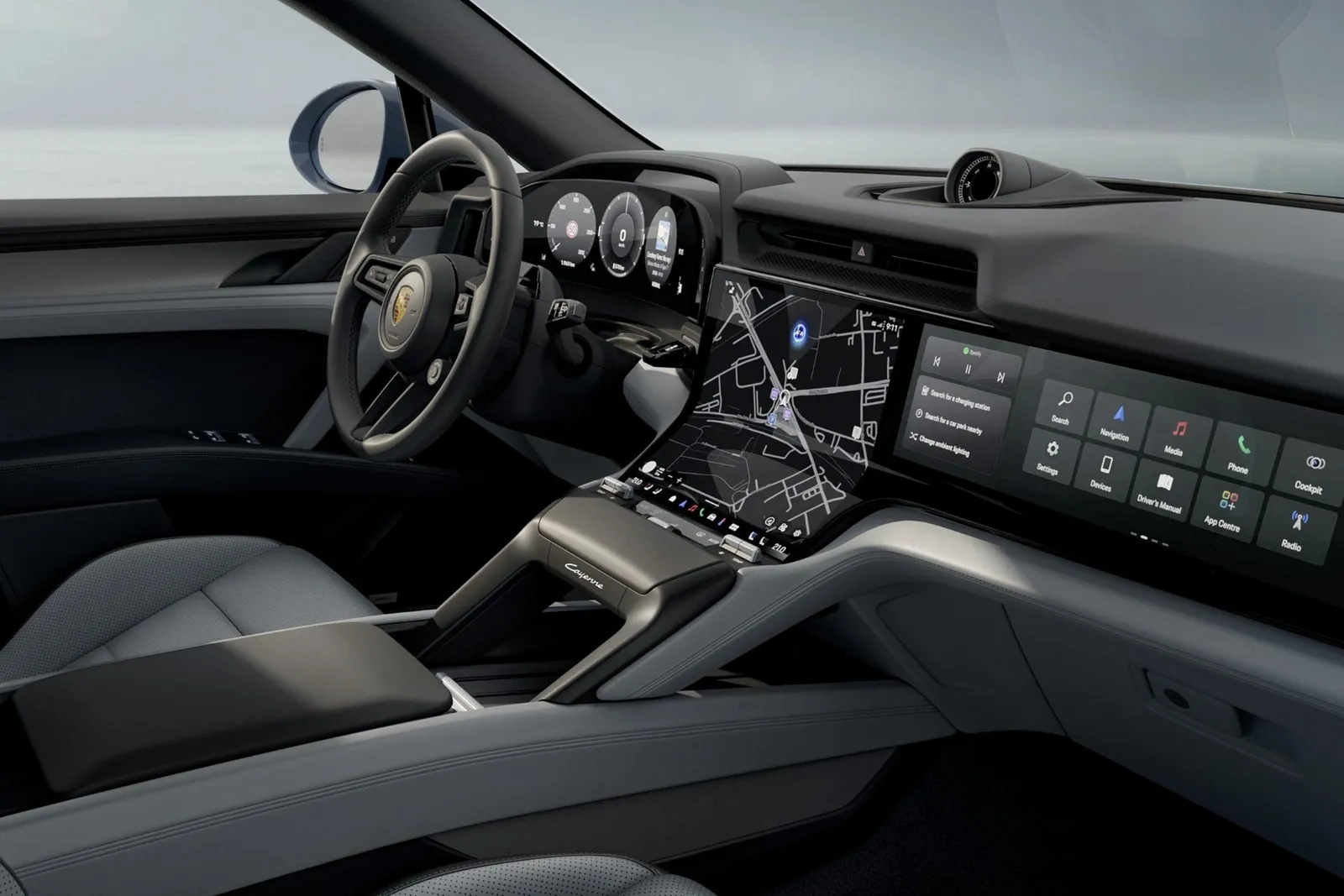
Image: Porsche
- 1/6
- 2/6
- 3/6
- 4/6
- 5/6
- 6/6
The equipment influences the overall assessment
The S Coupé starts at 130,300 euros. In this configuration, additional accessories cost 69,440 euros, bringing the price of the test vehicle to 199,740 euros. Just Active Ride, the ceramic brakes with black calipers, and the lightweight sports package together cost 34,589 euros.
For Porsche, it is less of an exception and more of a rule for a test vehicle to have a price far above the base price. A relatively modest starting price is combined with a long list of expensive options, and it is precisely the costly extras with low production costs that are considered particularly profitable. Many of these items, such as ceramic brakes, are not expensive because the vehicle is special in itself, but because Porsche’s list of additional costs is generally extensive and costly. Genuine features like Active Ride are rather the exception in this regard.
This is crucial for evaluation: the driving experience with active suspension and rear-wheel steering cannot be directly transferred to a standard base model without changes. On the other hand, the large battery and high DC charging capacity are already part of the basic technical specification. Those who primarily want fast travel and to drive a Porsche do not need to opt for every single additional feature.
Conclusion
The progress of the improved PPE is most evident in the fast charger. Here, the Cayenne S Coupé Electric turns its specifications into practical performance: 386 kW at peak power, with a charging time of around 16 minutes to reach 80 percent charge. Quiet Charging remains a comfort feature rather than one focused on performance—at least not under the conditions I tested. In my tests, the car charged much quieter without an increase in charging time.
On the road, the S combines powerful performance with an impressively versatile suspension system. However, weight, handling, and price remain significant drawbacks. As a mid-tier power option, the S need not shy away from comparison with the Turbo model. The test vehicle, costing nearly 200,000 euros, also demonstrates just how much a single trim level in the model range can differ from a base-model car in terms of available options.
In competition, the S faces off against the BMW iX5, Mercedes EQS SUV, and Audi SQ8 e-tron, while its closely related models, the Audi Q6 e-tron and Macan Electric, fall in a lower price category.
The question remains: who is all this for? Porsche sells to wealthy, brand-loyal customers who customize their vehicles thoughtfully and extravagantly — and the electric Cayenne is precisely tailored for them. Those who buy it are purchasing the brand, driving dynamics, and charging performance, accepting the long list of additional costs as part of the package. For such customers, a test vehicle costing nearly 200,000 euros is not surprising but rather the norm.