
Milence integrates private depot charging stations into its electric truck network
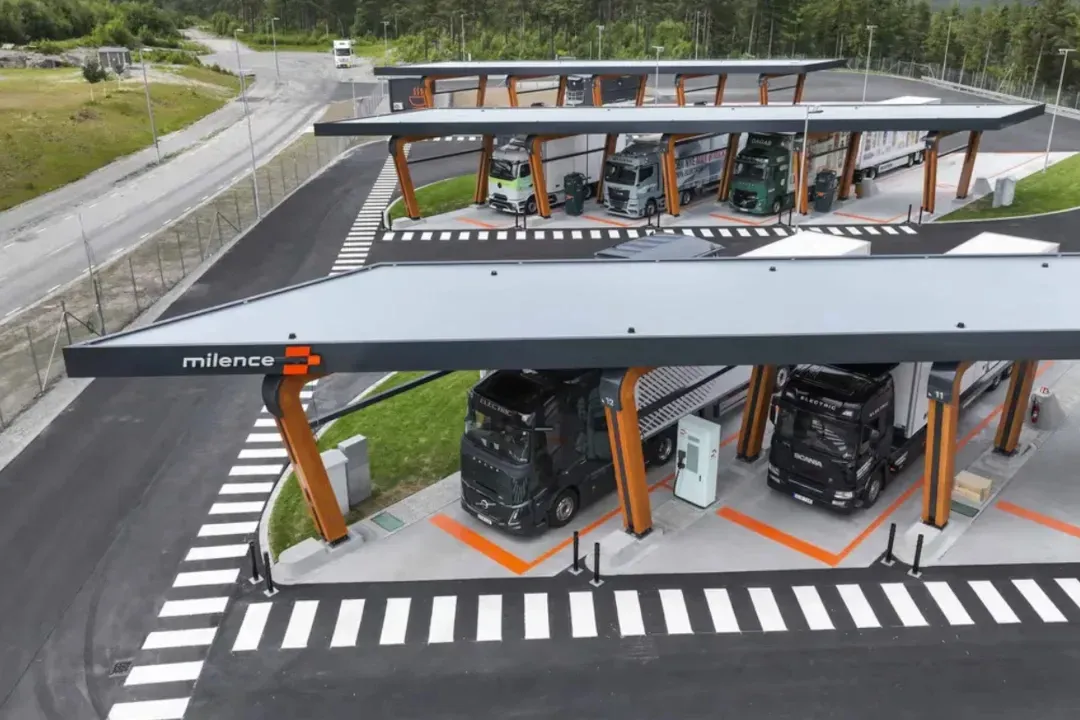
Milence will expand its European charging network for electric trucks by incorporating private charging points at industrial sites. Through a partnership with the B2B platform Depotcharge, fleets will be able to use public Milence hubs and participating depot charging points through a unified platform and settle costs accordingly.
Milence is adding private charging points to its public electric truck charging network.
Image: Milence
According to the online magazine EV Infrastructure News, Milence is integrating charging stations from Depotcharge into its existing offerings. This will enable fleet operators to access private charging infrastructure that other companies make available to third parties on a temporary basis. Milence plans to include these charging transactions in its customers’ regular monthly bills.
Depotcharge operates a B2B marketplace for private electric truck charging infrastructure. Fleet operators can offer available capacity there and decide themselves when, for which fleets, and under what conditions their charging stations are accessible. Options include different user groups, price tiers, and time slots. Users, in turn, receive real-time information about the availability of charging stations.
According to Depotcharge, using private charging stations typically costs between 0.25 and 0.39 euros per kWh. Additionally, operators can reach individual agreements with specific fleets. Germany is set to become the first market to launch this shared service. In the long term, fleets are expected to be able to use both public and private truck charging stations in other European countries through the Milence platform. Milence aims to make route planning easier and increase flexibility in fleet operations.
Germany Launches with Milence and Depotcharge
The opening up of private charging infrastructure aligns with projections for future electric truck charging demands. A recent study by Fraunhofer ISI and ICCT concludes that in most European countries, more than 70 to 80 percent of the charging power demand for heavy electric trucks is likely to come from depots. At the same time, demand is highly concentrated in specific logistics locations and freight corridors. Depending on the country, 10 percent of these locations could account for 60 to 90 percent of the total charging power demand.
As a result, private depots, especially in logistics hotspots, could serve as an important complement to the public charging network. Rather than building new charging infrastructure from scratch, existing capacity can be utilized more effectively through platforms like Depotcharge.
Milence continues to expand its own fast-charging network alongside major European freight transport and TEN-T corridors. The joint venture, established in 2022 by Daimler Truck, Traton, and Volvo Group, currently operates around 40 charging parks in Europe. The goal is to reach 70 locations by the end of 2027, with Milence setting a target of 90 fully operational charging hubs by the end of 2028.
In May, the company received financing of over 120 million euros for further network expansion. At that time, 34 hubs were in operation and another 16 were under development. The funds came from sources including Edmond de Rothschild Asset Management’s BRIDGE infrastructure financing platform, Íslandsbanki, Invest-NL, and Invest International.
Technically as well, Milence is upgrading its network to handle higher charging capacities. In September, the company established a strategic partnership with Alpitronic to expand megawatt-level charging along key European freight routes. At the core of this effort is the HYC1000, which can deliver up to 1,000 kW of charging power.
