
Energy storage is becoming increasingly important. A house with solar panels but no batteries loses its meaning.
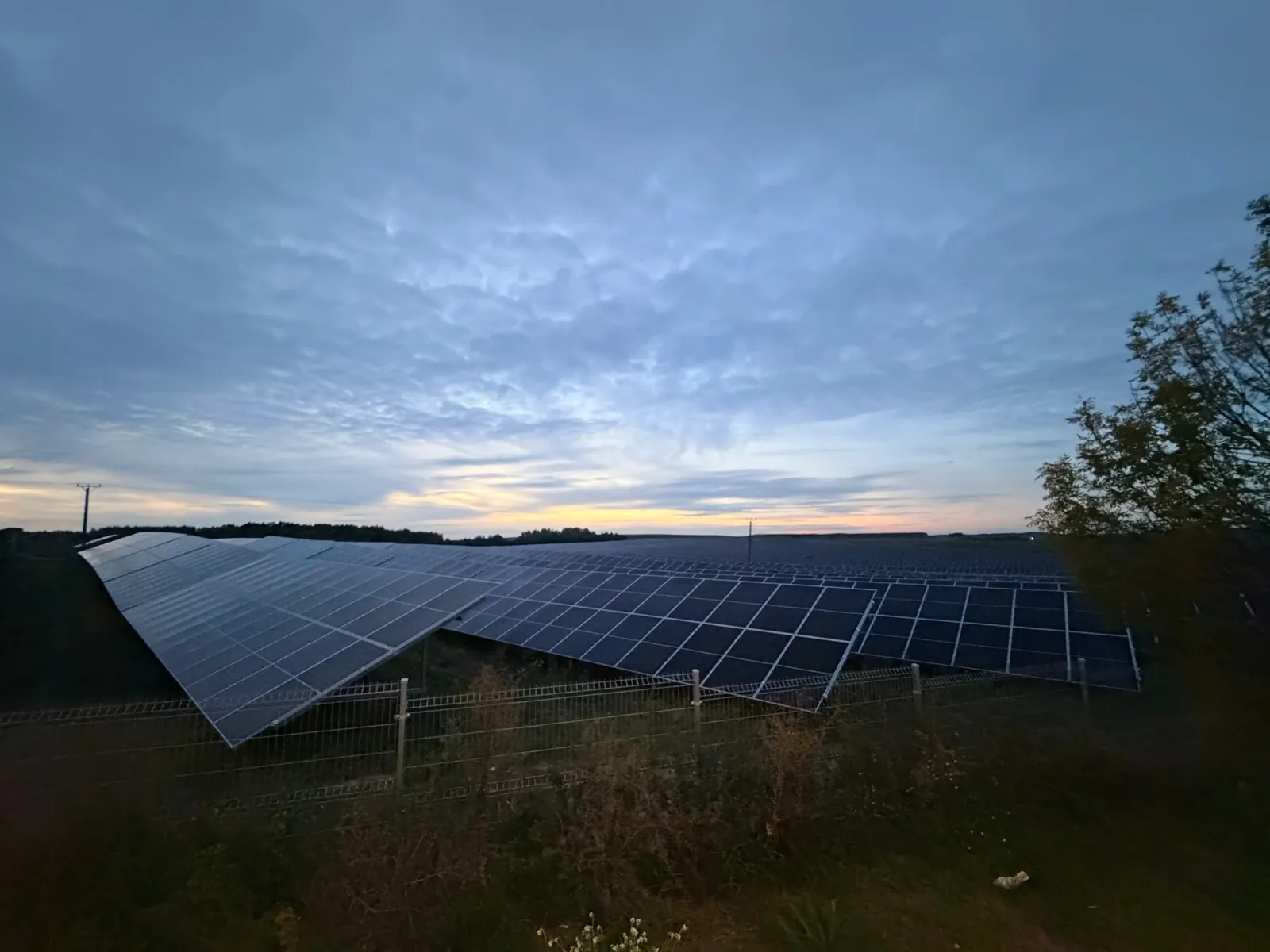
Solar power was the most important element of home energy for several years. All that was needed was to install panels, with the grid largely serving as a storage facility. Today, the situation is changing. Poland now has over 1.6 million prosumer installations, the vast majority of which are solar power systems. In 2025, prosumers fed almost 8.7 TWh of energy back into the grid. The problem is that panel production peaks around the same times for everyone.
On sunny days, there can be plenty of energy available while households use relatively little of it. That’s why not only production but also the ability to store energy for later is becoming increasingly important.
Energy storage allows for greater use of own electricity
Lacking a battery, much of the energy from photovoltaics is fed into the grid during the day. In the evening, when residents return home to cook, use appliances, or charge their cars, the PV system produces little or no energy. A battery allows this energy to be shifted by a few hours, charging when the panels generate excess power and supplying electricity in the evening and at night.
This is particularly important in net billing, where energy sent to the grid is charged at market prices. When there is an abundance of solar energy, its value may be low, making it more advantageous to use as much of the locally generated power as possible. Self-consumption also makes sense in net metering. Although a feed-in tariff system allows some recovery of previously sent energy, it isn’t 100%. Thus, a battery reduces losses resulting from sending energy to the grid.
The energy storage market has grown dozens of times over two years
In the first quarter of 2024, the number of home energy storage systems in Poland exceeded 10,000. By mid-2026, this figure had risen to around 150,000. The government’s goal is to reach over 200,000 such installations by the end of 2027. Subsidy programs certainly contribute to this market growth, but the energy landscape itself is also changing. More and more homes are equipped with heat pumps, air conditioning, or electric vehicles, increasing the amount of energy that can be used locally.
At the same time, periods are becoming increasingly common when the national grid has an excess of power generated from renewable sources. In July 2026, Polish Power Networks ordered the reduction of operations at some solar installations for several consecutive days. For home owners, this means one thing: electricity generation alone is only half of the solution. Controlling when energy is consumed is also becoming increasingly important.
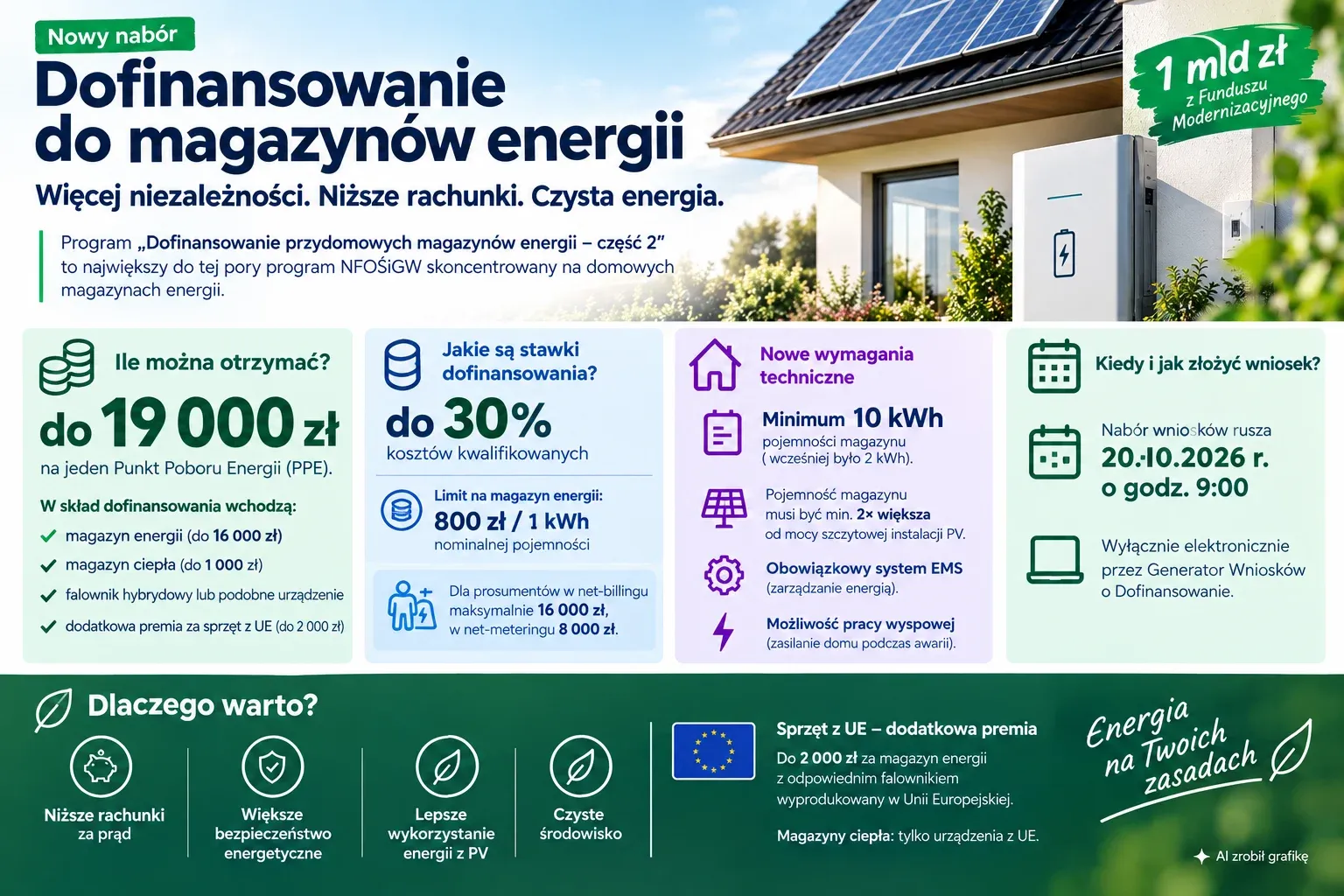
Starting October 20, subsidies of up to 19,000 zł are available
Another program from NFOŚiGW is set to accelerate market development. Applications for the Przydomowe Magazyny Energii 2 program will open on October 20, 2026. The budget allocated is 1 billion zł. Prosumers using net-billing can receive up to 16,000 zł for an energy storage system. Under net-metering, the maximum amount is 8,000 zł.
An additional bonus of up to 2,000 PLN is available for energy storage systems or corresponding inverters manufactured within the European Union, while 1,000 PLN is provided for heat storage systems. Thus, the total support for a single energy collection point can amount to 19,000 PLN. The subsidy covers up to 30% of the eligible costs, with a maximum of 800 PLN per 1 kWh of the storage system’s nominal capacity. The new program also includes prosumers under the older feed-in tariff system, though they will receive lower support than those using net billing.
Not all storage systems will qualify for the subsidy
The new support also comes with specific requirements. The energy storage system must have a nominal capacity of at least 10 kWh. Its capacity should also be appropriately matched to the power of the photovoltaic installation – at least 2 kWh of capacity is required for every 1 kWp of PV. For an installation with a power of 5 kWp, this means an energy storage system with a capacity of at least 10 kWh.
The system must also be equipped with an EMS, or energy management system, which controls the flow of electricity between the panels, the storage system, and the appliances in the home. Island mode operation is also required.
Storage doesn’t always mean power during outages
The mere presence of batteries does not automatically mean that the lights in a home will remain on after a power outage. This requires an appropriate installation, an inverter, and a backup function that allows the building to be disconnected from the grid and powered by batteries for selected circuits or the entire house.
The new program demands islanding capability, so that subsidized installations serve not only economic purposes but also enhance the household’s energy security. For some owners, this can be just as important as cost savings. A battery storage system with a capacity of several dozen kWh can power lighting, refrigerators, the internet, home automation systems, or other essential devices for many hours during an outage.
Energy Storage and Home Maintenance Costs
When buying a house, price is no longer the only factor considered — future expenses also play a role. Photovoltaic systems, heat pumps, energy storage, and proper control mechanisms can reduce the amount of electricity purchased from the grid. This doesn’t mean that every house with energy storage will automatically become much more valuable, but such a system can serve as an additional selling point.
This is especially true when buyers compare two similar properties, and one of them already has a complete PV system with storage and backup power capabilities. However, the actual operating costs remain the most important factor. An improperly chosen storage system that is too large for the installation or used in a home with low energy consumption may not yield quick returns.
What kind of storage makes sense?
There is no single capacity that is good for everyone. When making a choice, one must first consider the annual output of the PV system, energy consumption at home, and its distribution throughout the day. Families that use most of their energy in the evening have different needs, as do homes with heat pumps, and those with electric cars charged at night.
The capacity of the storage system itself is also very important, meaning how quickly it can release energy. A battery with high capacity but low power may not be sufficient to supply multiple large appliances simultaneously. It is also worth paying attention to the warranty, the number of declared cycles, compatibility with inverters, and the possibility of increasing capacity later on.
Photovoltaics enter a new phase
Just a few years ago, the development of prosumer energy meant mainly adding more panels to rooftops. Now, what happens to the generated energy afterward is gaining increasing importance. With over 1.6 million prosumer installations, the grid cannot be treated indefinitely as an unlimited storage facility for all solar surpluses.
That’s why batteries, smart control systems, and greater self-consumption will become increasingly vital. The rapid increase in home energy storage units, along with another program funded at 1 billion zł, suggests that what was once a solution for a relatively small group of prosumers is now becoming one of the key elements in the further development of home solar power.
Piotr Sobczyk