
Judges challenge DGT: one of its most common automatic fines has a flaw that is already overturning dozens of penalties.

07/10/2026 15:00
Updated to
07/10/2026 15:00
The cameras allow the DGT to monitor certain violations without an officer needing to be physically present at the location, but automating the process does not eliminate the obligation to prove what occurred. Several penalties related to crossing solid lines have been overturned in court because the photographs included in the file did not provide clear enough evidence of the alleged violation.
The issue isn’t so much about there being one or two images, but rather what is actually shown in them. A sequence showing the vehicle in two different positions can help reconstruct what happened, but it isn’t necessarily sufficient to prove it. This is precisely the argument being used to uphold some fines when no image shows the car hitting or crossing the road mark it is alleged to have exceeded.
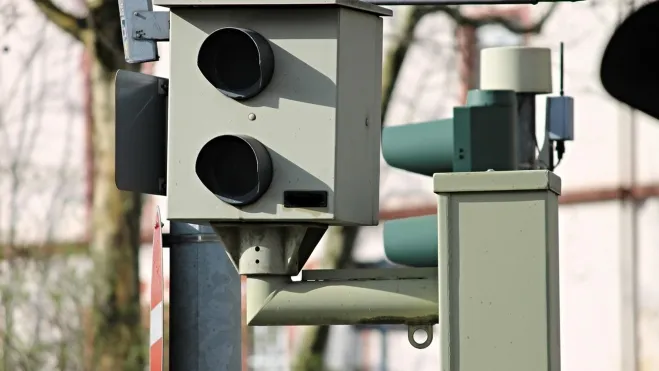
DGT’s system photographs the car at two different points
The DGT itself explains that its automated surveillance system uses two cameras to monitor specific sections with continuous lanes, especially at intersections, so that the vehicle can first be detected in the acceleration lane and then in the right lane of the main road. The photographs taken are sent to the Automated Complaints Processing Center to analyze the sequence and, when appropriate, issue the corresponding penalty.
The issue arises in those cases where the two photos only show that the vehicle was at one location and, a few meters further ahead, it appears at another, without any image of the exact moment it crossed the continuous line. Courts that have ruled in favor of such appeals believe that reconstructing the maneuver through inference is not sufficient if the provided evidence does not adequately prove the fact that gave rise to the penalty.
The difference is also significant compared to a report filed directly by an officer, as Article 88 of the Traffic Law stipulates that incidents reported by officers responsible for surveillance carry evidential weight unless proven otherwise. In a procedure based solely on automatic devices, there is no such direct observation of the maneuver, so photographs and other elements included in the file become particularly important.
A certified camera does not by itself prove that the car crossed the line.
The technical certificates accompanying these systems also do not necessarily address that evidentiary gap, as they can prove matters such as the proper functioning of the equipment, but that is different from verifying the specific behavior attributed to the vehicle. Just because a camera operates according to its specifications does not mean that any footage captured by it can automatically prove a violation.

This is compounded by the principle of presumption of innocence enshrined in Article 24 of the Spanish Constitution, which must also be respected within administrative sanction procedures. Therefore, the administration needs sufficient evidence to support the alleged facts, rather than merely relying on an reconstruction of what likely happened between two photographs.
This does not mean that all fines for crossing a solid line captured by cameras can be successfully appealed, nor that a sequence of two images always lacks value. What matters is the specific content of the case file and whether the evidence confirms the violation, but known cases show that an earlier and a later photograph may prove insufficient when neither clearly shows crossing the solid line.
