
The cheapest electricity rates in Spain 2026: prices and offers from Iberdrola, Niba, and Octopus
Choosing an electricity rate might seem like a simple task until it’s time to compare the terms offered by each supplier. The price per kWh, contracted power, time periods, promotions, and potential additional costs mean that what appears cheap at first glance isn’t necessarily the best option for every household.
Moreover, rates change frequently. What seems particularly attractive today might stop being so in a few months, so it’s wise to look beyond just the prominently displayed price. The actual consumption of each home is what ultimately determines how much is paid at the end of the month.
The National Commission for Markets and Competition (CNMC) itself recommends comparing the various offers available before changing electricity suppliers. Its comparison tool allows users to enter their supply details and check the existing alternatives at any given time. In fact, more than a third of households that changed their electricity tariffs used a comparison tool to make the decision.
In this comparison, we will put three suppliers that offer different options for the domestic market side by side: Iberdrola, Niba, and Octopus. The goal is not merely to focus on the lowest price per kWh, but to understand what each supplier offers and which may be more suitable for different consumption patterns.
Three different ways to pay for electricity
Among the options analyzed are rates with a fixed price throughout 24 hours and others that divide the day into different periods. This difference can be significant. A rate with time-based pricing may be attractive to those who can shift part of their consumption to the cheapest hours, while a fixed price offers greater simplicity and eliminates the need to keep track of the time.
Iberdrola
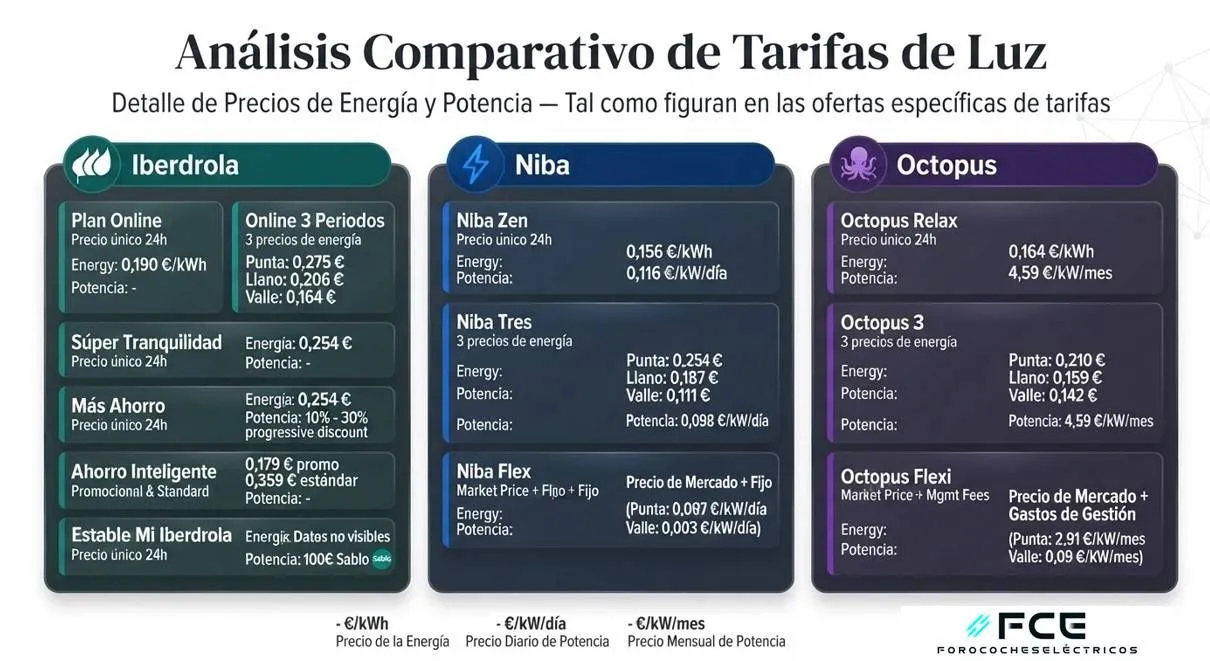
Iberdrola offers several plans, among which the Plan Online stands out as the most notable option analyzed here, as it uses a single price throughout the 24 hours. The reference rate used for this comparison is 0.190 euros/kWh, though it’s important to check the current price and specific terms before signing up.
We also find Online 3 Periods, which divides the energy price into three tiers. According to the data analyzed, the peak period costs 0.275 euros/kWh, the flat rate is 0.206 euros/kWh, and the off-peak rate is 0.164 euros/kWh. The difference between these tiers can be significant, so this option makes more sense when users can concentrate part of their consumption during the cheaper hours.
Iberdrola’s offer includes other plans such as Súper Tranquilidad and Más Ahorro, both with a reference rate of 0.254 euros/kWh based on the data used. For Más Ahorro, an additional progressive discount is applied to the power usage, which can reach up to 30% over five years according to the plan’s terms.
Another option is Ahorro Inteligente, which sets a price of 0.179 euros/kWh during promotional hours, while the rest of the consumption is charged at 0.359 euros/kWh. Here, it’s even more important to understand the habits of each household, because a lower price during certain hours might be offset if a significant portion of the consumption occurs outside those times.
Niba
Niba offers a slightly simpler structure with Niba Zen, a plan featuring a single price throughout the 24 hours. The figures used for this comparison show a cost of 0.156 euros/kWh and a capacity fee of 0.116 euros/kW per day.
With these rates, the energy price is lower than the other two fixed-price options analyzed. However, it should be noted that the kWh price is not the only factor in the bill. The contracted capacity also incurs a cost and can significantly affect the final amount depending on each household’s consumption.
Niba also offers Niba Tres, which has three different energy prices: 0.251 euros/kWh during peak times, 0.187 euros/kWh during off-peak times, and 0.111 euros/kWh at low demand times. The capacity fee for this plan is 0.098 euros/kW per day.
For those who prefer a rate tied to the market, there is also Niba Flex, where the energy price depends on market fluctuations and an additional monthly fee of 6.23 euros is applied. With this type of rate, prices can vary, so it makes no sense to compare them directly with a fixed-rate plan using only a single point in time.
Octopus
The third option is Octopus, which offers different plans to suit various consumption patterns. Among them is Octopus Relax, which has a single price throughout the 24 hours. The reference rate is 0.164 euros/kWh, with a capacity fee of 4.59 euros/kW per month.
There is also Octopus 3, which divides the energy price into three periods. According to the analyzed data, the energy costs 0.210 euros/kWh at peak times, 0.159 euros/kWh during normal times, and 0.142 euros/kWh at off-peak times, with a capacity fee of 4.59 euros/kW per month.
The third option is Octopus Flexi, which is linked to market prices and has a management fee of 0.157 euros per day. The indicated capacity fees are 2.91 euros/kW per month at peak times and 0.09 euros/kW per month at off-peak times.
The main difference compared to a fixed tariff is precisely this uncertainty. When market prices are favorable, it can be attractive, but there is also a risk that certain periods may increase the energy cost. Therefore, an indexed tariff requires looking beyond just the price of a specific day.
So, which electricity tariff is most appealing?

The answer depends much more on consumption patterns than it might seem when comparing just three figures. A household that uses electricity fairly evenly throughout the day may particularly benefit from a flat-rate tariff, while a home that runs washers, dishwashers, space heaters, or electric car charging at certain times might gain more from a tariff with different time periods.
Attention must also be paid to power capacity. Slightly reducing the price per kWh may have a relatively small effect if the contracted capacity remains higher than what the home actually needs. The CNMC has pointed out that a significant portion of households contract more capacity than necessary.
Tariffs with different hourly rates are not necessarily more complicated to take advantage of. According to the CNMC, nearly half of domestic consumers have contracts that allow them to save by adjusting their consumption to price signals, and shifting part of the consumption to cheaper hours can result in substantial savings on annual bills.
Therefore, there is no universally cheaper rate for everyone. Niba Zen has the lowest energy price among the three fixed-rate options analyzed, while Octopus Relax is slightly higher, and Iberdrola’s Plan Online starts at a higher price in this comparison. However, the final result can change when the contracted power capacity, taxes, promotions, and especially each household’s actual consumption are taken into account.
Welcome promotions also deserve attention. A discount or incentive can make an offer particularly attractive during the first few months, but it should not be the only reason to switch providers. What matters most is checking what the energy price will be once the promotion ends and what terms will apply when renewing the contract.
This is especially relevant for evergreen articles. The prices offered by distributors can change, and promotional campaigns have a limited duration, so the figures provided should be viewed as an overview of the analyzed offers rather than a guarantee of permanent prices. Before signing a contract, it is advisable to check the current terms and compare the estimated cost with the actual household consumption.
The CNMC provides an offer comparator that allows users to enter details such as postal code, contracted capacity, and annual consumption to get a more accurate comparison. This tool includes offers from both the free market and PVPC, making it useful as a final step before making a decision.
And there’s one final detail that is often overlooked: changing suppliers is free, and it’s the new company that handles the process. The CNMC states that the procedure takes a maximum of 21 days, but before signing a contract, it’s advisable to check whether the current one includes permanence clauses, additional services, or any cancellation conditions.
In short, focusing solely on the price per kWh can lead to incorrect conclusions. To determine which electricity tariff is truly the best, three factors must be considered: how much energy the home consumes, when it consumes it, and what power capacity is needed. Once these details are known, comparing available offers becomes much simpler and helps avoid paying for months a tariff that is no longer competitive.
