
The European auto crisis is structural. Italian components are at risk.
The crisis in Europe’s automotive industry goes far beyond market fluctuations: it is a structural transformation that poses serious risks, especially for the Italian supply chain. According to an analysis by Allianz Research, competition from Chinese manufacturers, delays in electrification, and the shift of value to batteries, electronics, and software are altering the sector’s balance. In Italy, the consequences are most evident in the components sector, with declining exports, narrower profit margins, and increasing liquidity challenges.
Chinese advancement puts pressure on manufacturers
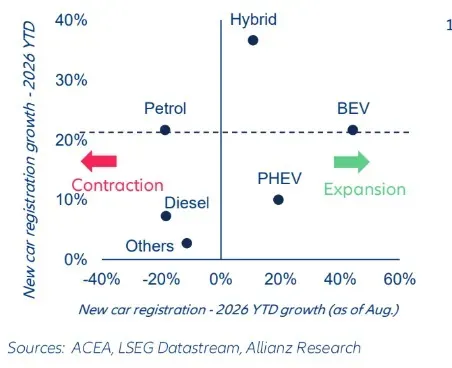
The 5% growth of Europe’s automotive market from the start of the year to August, according to data cited by Allianz Research, is not enough to reflect the true health of the industry. Behind the recovery in vehicle registrations lies a competitive transformation that directly affects segments with higher levels of technology.
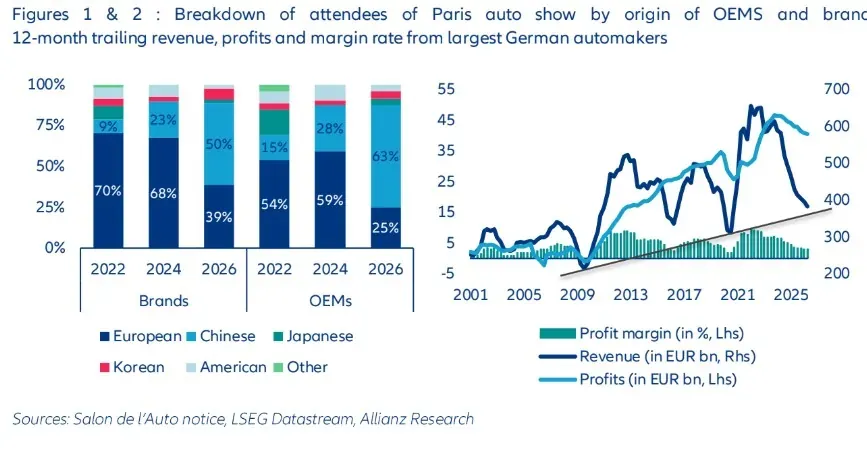
At the 2026 Paris Auto Show, Chinese brands will account for 50% of exhibitors, up from 23% in 2024. Their market share in Europe is around 10% of total registrations, with a particularly strong presence in electric and plug-in hybrid vehicles.
For European manufacturers, the problem isn’t just price competition. According to the study, long-term defense of traditional technologies without sufficient acceleration in electrification and digital transformation risks weakening the position of continental brands precisely in the sectors set to redefine the industry.
Batteries and software are more valuable than mechanics
The shift also affects the distribution of industrial value within cars. In traditional models, the engine and chassis accounted for up to 45% of the vehicle’s value. In electric cars, however, batteries and software can account for 50% to 60% of the total value, according to Allianz Research.
This is a passage that directly affects European competitiveness. The ability to develop batteries, power electronics, semiconductors, and software has become just as crucial as the efficiency of production processes and the quality of mechanical components.
The study indicates that major German automakers have lost market share in Europe and China since 2021. In the European market, the value added per vehicle is said to have declined by between 30% and 45%. If this trend continues until 2030, the estimated further erosion would amount to about 3 billion euros in value added, equivalent to four percentage points in EBITDA margins.
For the European industry, therefore, the challenge is not merely to restore production volumes: it is to retain a significant share of the technologies and skills that determine the value of new cars.
Italy’s Automotive Industry on the Brink of a Revolution
The situation is particularly delicate for Italy’s automotive sector, which comprises over 2,100 companies, approximately 168,000 employees, and generates more than 55 billion euros in revenue. This industry is closely tied to European automotive markets: over 80% of its component exports go to the continent, with Germany, France, and Spain being its main trading partners.
The weakness of the German industry thus affects Italian suppliers as well, through reduced orders and slower production of parts and accessories. This is compounded by the gradual replacement of traditional mechanical components with electronic systems and software solutions.
As Gianluigi Iacovino, head of Credit Assessment MMEA at Allianz Trade, notes, the risk for many companies lies not only in declining volumes but especially in the erosion of added value. To remain competitive, firms must adapt their products and industrial processes by investing in solutions that may be difficult to finance at a time when margins are shrinking.
Higher inventory levels and slow cash inflows: liquidity is the issue
Technological transformation comes with increasing financial pressure. According to Allianz Research, over the past three years, the average days of inventory for components have risen from 63 to 78, while the average collection period has increased from 85 to 89 days.
The result is a deterioration in the cash conversion cycle, which has increased from 41 to 50 days. In practice, a larger portion of companies’ financial resources remains tied up in operational activities, reducing the availability of liquidity for investments and day-to-day operations.
Higher inventory levels also indicate slower product turnover and less dynamic demand throughout the supply chain. Meanwhile, manufacturers are paying more attention to cash flow and profitability, shifting some of the pressure onto suppliers through prices, terms, and investment demands.
The electric transition is dividing suppliers more and more
The supply chain is thus becoming polarized. Companies already involved in electrification, electronics, and software can leverage skills aligned with the ongoing transformation. In contrast, suppliers more reliant on traditional technologies must undertake a more challenging process of industrial and financial restructuring.
The uneven distribution of electric vehicles across Europe adds further complexity to the Italian situation. According to the study, battery-powered electric cars account for 30% of new registrations in France and 26% in Germany, while in Italy this figure remains below 10%.
This disparity limits the speed at which demand can drive industrial transformation in different countries. For Italian manufacturers, the key challenges become twofold: developing expertise in electric and digital technologies while maintaining sufficient liquidity to fund investments. The sustainability of the industry chain will depend not only on production capacity but also on the ability to capture new value in automobiles.
READ ALSO: “Cardinali (UNRAE): Italian electric car moving backward. We need an alarm” and watch the VIDEO