
Interview – Jamy: “We didn’t think climate change could impact roads to such an extent”
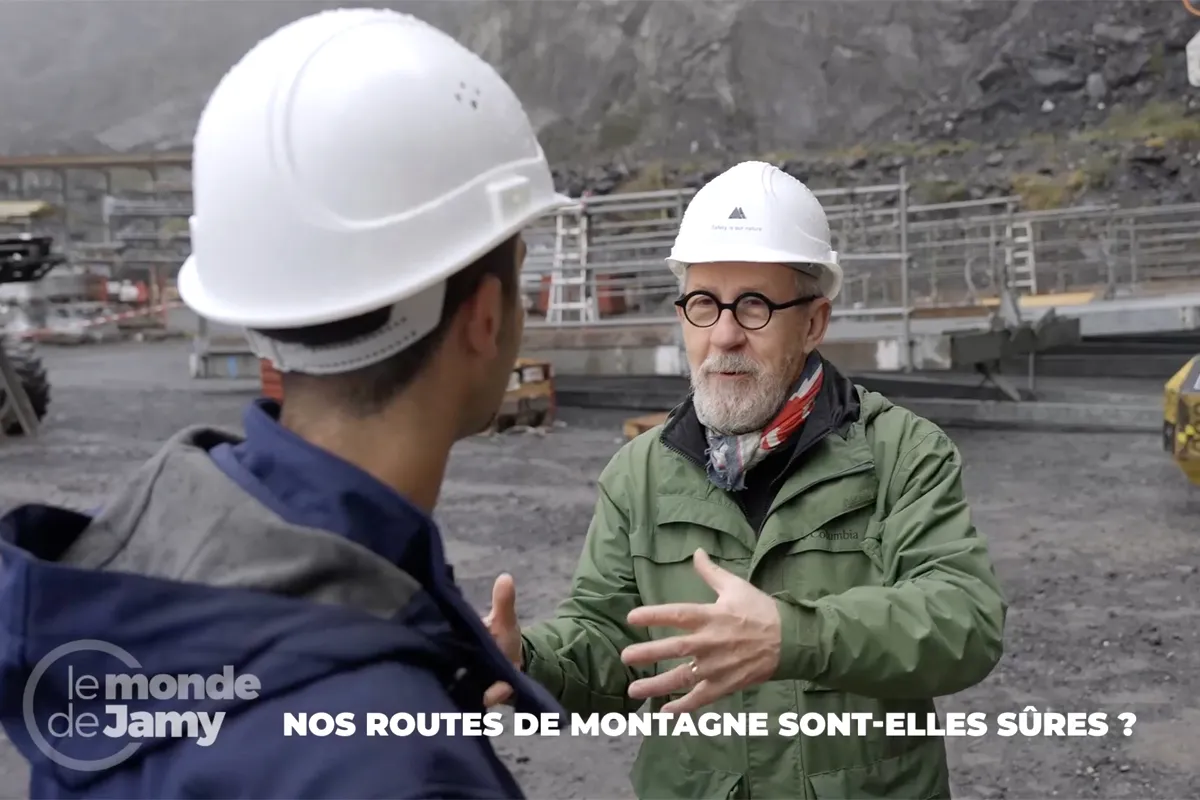
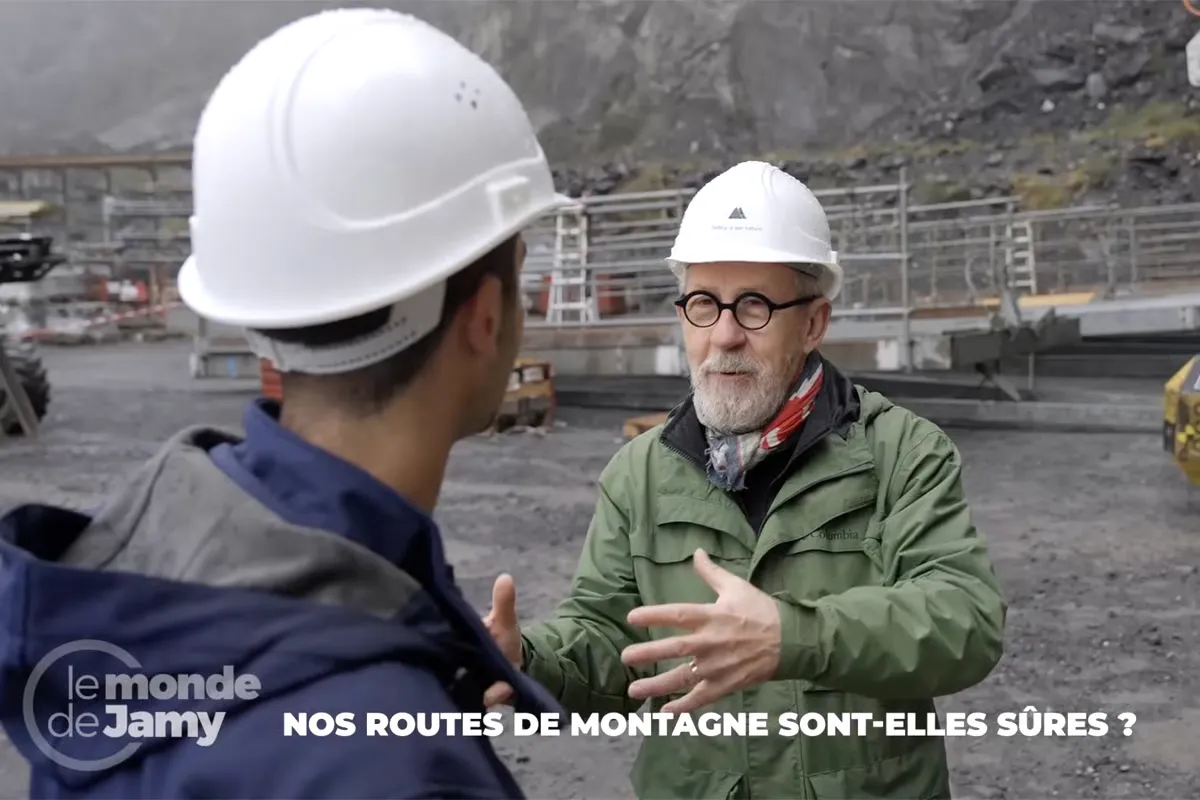
To achieve high-quality sustainable mobility, it’s not enough to have good pairs of shoes or vehicles that emit very little greenhouse gases and pollutants. It’s also necessary to have walkable streets, roads, and bridges. As the episode “Climate Warming: Will Our Roads Hold Up?” is set to air on France 5, we asked some questions of Jamy, the highly respected science communicator from the show Le Monde de Jamy.
A highly dense road network that needs maintenance
On Monday, October 12, 2026, at 9:00 PM, France 5 will broadcast a new episode of Monde de Jamy, this time focusing on the accelerating damage to France’s road network due to climate change. Damaged bridges, melting asphalt, repeated cracks in the pavement, land slips, flash floods, rockfalls, and more: heatwaves and other climate disruptions are intensifying phenomena we were already facing.
It all becomes a challenge for the authorities responsible for road infrastructure: “We didn’t think climate change could affect roads so much, not to this extent. But even though some roads are in poor condition because of it, it’s still possible to travel in France. Sometimes a road may be closed during repairs. That’s the case in Maurienne, as we can see in the program. Traffic has resumed there.”
Also read
Interview – Jamy: “My next car will be electric”
With the financial burden growing as more roads and bridges are affected, new solutions are being added to those that have already proven effective or shown their limitations in repairing damage and preventing recurrence.
If you didn’t already know, the new episode will tell you that France’s road network, with its one million kilometers of roads, is the densest in Europe—twice that of Germany: “It’s historic and it’s due to the abundance of communal and departmental roads. It’s because there was a lot of commercial exchange from one region to another, from one village to another.”
The Mountains Particularly Affected
After watching the episode “Climate Change: Will Our Roads Hold Up?”, one comes away with the understanding that degradation processes are consuming an increasingly larger portion of France’s road network, accounting for more than half of it. The documentary’s goal is not to create an exact map of the most affected areas, but rather to understand and explain these situations.
However, certain locations received more emphasis in the documentary: “Mountainous regions are more affected by climate change, with temperatures rising by about 2.5 °C, compared to 1.7 °C in lowland areas. This difference impacts the terrain and roads, leading to an increase in landslides. Previously, the freezing period could last from November to April, but now temperatures fluctuate dramatically throughout winter, with repeated cycles of freezing and thawing that destabilize the soil.”
The episode also focuses heavily on ways to prevent landslides from destroying roads, railways, and lives. In Switzerland, Jamy got to witness something unique: a test of a solution designed to stop the movement of the most threatening rocks.
Real-life examples as illustrations
To make the phenomena at work almost tangible, the documentary relies on sequences showing affected individuals. For example, an American motorcyclist who falls on a road in France due to a crack in the pavement, and a car driver caught off guard by an avalanche whose consequences were fortunately limited for him: “This is not AI-generated content or edited scenes, but real images found through Internet searches. The team ensures they are royalty-free and unaltered. Whenever possible, we inform the owners that one of their sequences is being used in the program. If they come from France or Europe, we generally manage to trace their origin.”
The Budget Puzzle
Faced with the scale of these phenomena, the infrastructure maintenance officials interviewed in the documentary often speak of lengthy and costly repairs or preventive measures. Sometimes it is necessary to dig under roads or shoulders to prevent cracks caused by repeated shrinking and swelling of the clay. Maintaining bridges is also not easy, especially when they have collapsed. As for landslides, the solution of draining rainwater can seem prohibitively expensive for merely hypothetical results.
As France’s budgetary situation becomes increasingly complicated, with funds needed both to address climate change and to maintain basic social and medical services, is there a risk that the means to keep the road network operational will be lacking? This would almost certainly lead to roads and bridges being closed off and left abandoned. “It’s a risk; I can’t say whether it will happen or not. It depends on the decisions made. We cannot abandon certain roads or bridges, even if they’re just needed to cross a small stream to reach the neighboring town where there are doctors, dentists, food stores, or supermarkets. These routes must remain passable. This is the responsibility of the departments, regions, and the state.”
At the municipal level, this could prove problematic: “Those with few residents and limited revenue may face difficulties repairing damaged roads or bridges. What is the best way to fund these repairs? An assessment must be conducted as quickly as possible, because what is financially feasible today may not be so in the future if conditions worsen.”
A thought for those working on the ground
In Cher, several solutions had to be tested before one was found that ultimately yielded good results; in Savoie, major repairs helped stabilize part of the cliff for about a decade, but several hundred meters above, a new major hazard of a different nature was detected.
How do those who must find solutions and who testified in this episode cope with these repeated, enormous challenges—with confidence or worry? “I haven’t met them all, but it’s probably a mix of everything, with a definite sense of being overwhelmed. All these people didn’t expect so many problems to arise at once due to climate change. It’s several phenomena combining together. There are floods, road subsidence/swelling that affects more than half of the territory, heatwaves causing roads to expand and resulting in poor traction when driving on them. With all this, there’s a lot of work to be done!”
This is clearly felt when engaging with “Climate Change: Will Our Roads Hold Up?”: “My feeling is that a study should be conducted department by department to get a true picture of the situation. However, that’s not the role of our program, and it would require resources we don’t have.”
Adaptation + Reduction of GHGs
At the end of this documentary, which highlights various approaches to adapting road networks to climate change, Jamy emphasizes the need to reduce our greenhouse gas emissions: “Every tenth of a degree avoided helps prevent roads from failing.”
What does this tireless whistleblower think about the actions taken by institutions, companies, and citizens? Is it moving fast enough? “I think things could progress faster, but that doesn’t mean nothing is being done. We can always go faster. There are two aspects: first, there’s work to be done in adaptation. But just because we adapt doesn’t mean we should give up on reducing greenhouse gases, so that the damage is less severe. Every tenth of a degree gained is beneficial, allowing for a less painful adaptation. It’s easier to adapt if the temperature rise is limited to 2.5 °C rather than reaching 3°.”
Jamy’s Mobility
By the end of 2024, we had already had the chance to ask Jamy a few questions. This was just before the release of the episode titled “Car, Plane, Climate: Can We Still Travel?” In line with the content of this documentary, he discussed his own mobility habits, telling us that he rides a bike to Paris and is considering getting an electric car.
Where is he now? “I’m still a bike fan, for several reasons. First, it’s for comfort. Everyone finds their own idea of comfort. For me, it’s about avoiding stress, such as finding a parking spot for a car. Biking allows me to arrive on time for my appointments. That’s the main reason. Additionally, this mode of transportation doesn’t emit CO2. It’s better. Most of the time, these factors align. ‘Personally, I have indeed switched to an electric car.’”
In the episode to be broadcast on Monday, October 12, 2026, Jamy is driving a Citroën ë-C3 Aircross: “It’s a rental car. We try, as much as possible, to find an electric vehicle for filming by using whatever is available.”
Automobile Propre and I would like to express our sincere gratitude to Jamy for his hospitality, willingness to help, and for sharing his insights at our request.
For your reference, any offensive comments directed at our interviewees, their lives, choices, and/or opinions will be removed. Thank you for your understanding.
Author’s Note
The construction projects shown in the episode are enormous. Some on-site interventions resemble band-aids that will only last a very short time on the scale of our history. They at least serve to address urgent problems while buying time to find more sustainable solutions. Another surprising aspect is that climate change can have a fairly positive impact on long-standing phenomena that have always been difficult to control. There is a good example of this in the documentary.
Despite the gravity of what needs to be understood through images, we still find some pleasure in Jamy’s easy-to-comprehend explanations. This is the essence of his skill as an excellent multidisciplinary science communicator. And when he urges us not to slack off in reducing greenhouse gas emissions, we cannot help but agree with his warning.
Philippe SCHWOERER