
Germany Incentives: Less Money, But More Financed Cars (100,000)
Germany offers lower incentives — up to 6,000 euros with an average just over 4,000 euros — yet it still manages to get many more electric cars purchased or leased than Italy: 100,000 between May and the end of September. Unlike Italy’s regional programs, it does not finance polluting internal combustion or hybrid vehicles, with BEVs accounting for over 90% of applications, leaving only a minimal share for plug-in models. Priority is given to larger families with lower incomes, although most applications come from childless households. The most popular cars are the Tesla Model Y (first) and Model 3 (third), followed by Skoda and Cupra. Volkswagen ranks seventh. According to the German government, the decisive factor is “the leasing option” — the same one available in Italy for internal combustion vehicles as well.
Electric cars for 100,000 families at 430 million
The German incentive started in May, but with retroactive effect from January 1, 2026, ignoring the limits set for Italian charging station bonuses. As of the report dated October 1, 97,790 applications have been submitted. Given the intensity of these requests, the threshold of 100,000 electric cars purchased or leased through this bonus has likely already been exceeded. Compared to Italy’s eco-bonus, which exceeded 10,000 euros, the German government offers a maximum of 6,000 euros, with an average so far just above 4,000 euros.
According to BAFA’s statistics — the federal agency under the Ministry for Economics and Climate Action — over half (52.3%) of the approved applications come from the lowest income bracket, namely households with taxable income up to 45,000 euros. The next two brackets together account for approximately another 44,000 applications, while the highest brackets have less than 3,000 applications. Thus, the system has favored the most needy families and the middle class.
As of October 1, BAFA had disbursed 432 million euros to applicants with approved funding, up from 230 million on September 1 and 117 million on August 1, 2026 — an exponential increase.
Electric vehicles are by far the most popular: 91.6% of applications relate to electric cars, while only 8.4% are for plug-in hybrids.
The leasing option chosen by half of the applicants, says the minister: “A measure against high fuel prices”
Environment Minister Carsten Schneider explained the success of this measure: “The incentive program has far exceeded our expectations and has already helped 100,000 families protect themselves from high fuel prices. Every additional electric car reduces our country’s dependence on expensive oil imports and international conflicts. It is particularly important to me that this social scheme is working: families who would never have considered it before can now afford an electric car. The leasing option helps a lot. Additionally, German manufacturers are finally bringing compact cars to the market.”

The applications are almost evenly split between purchases and leases. Leasing is a tool that allows low-income families to access an electric car without having to bear a high upfront cost.
Tesla is the favorite; the most sought-after models are Model Y and Model 3
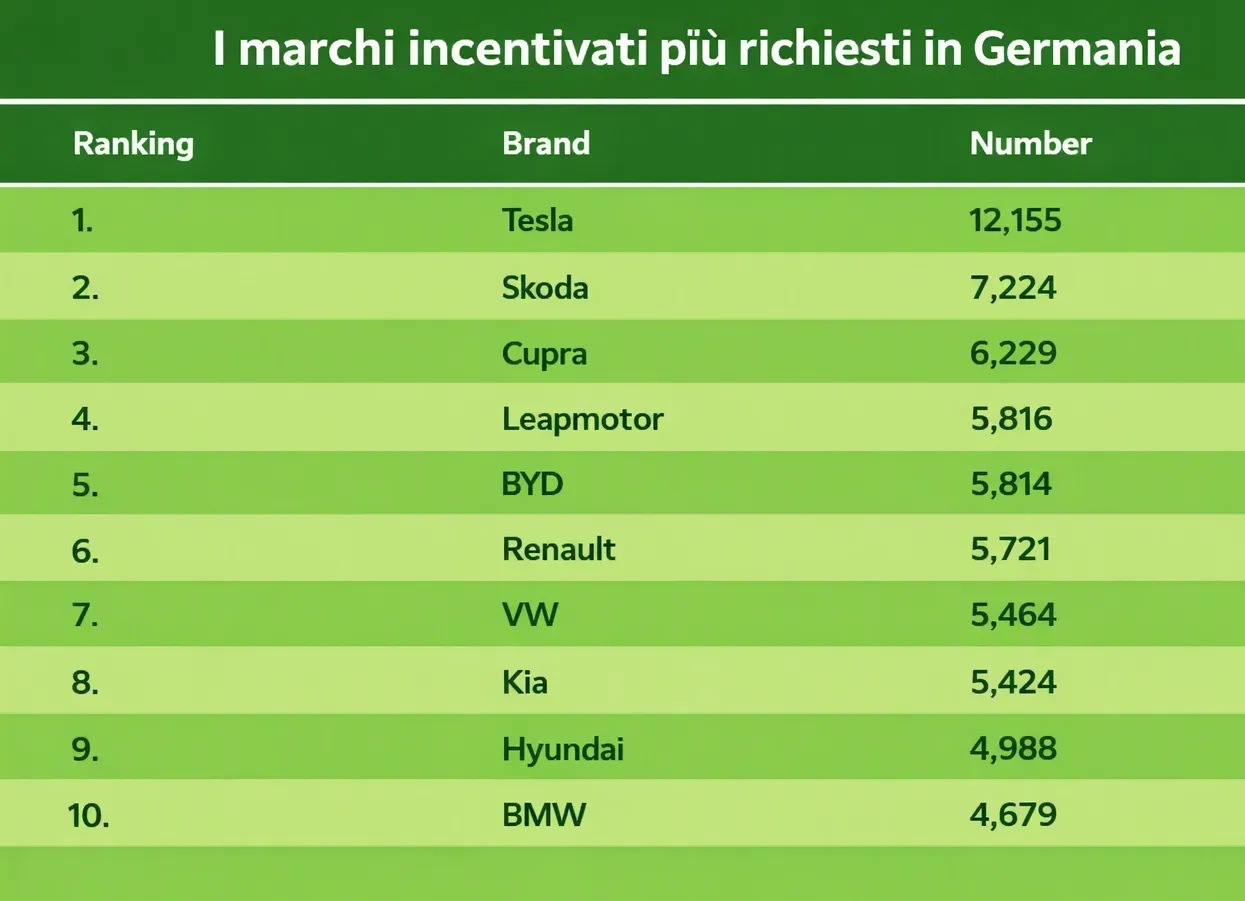
Tesla remains firmly in the lead, followed by the two Volkswagen Group brands, Skoda and Cupra. The two Chinese brands, Leapmotor and BYD, have also risen in the rankings. Leapmotor moved up from sixth to fourth place, while BYD rose from seventh to fifth, overtaking VW and Hyundai. As the Volkswagen executive hoped, the company may soon catch up thanks to its new electric compact models, which are not yet on sale. Renault performed well, jumping from ninth to sixth place in this segment. Kia and BMW remain at the bottom of the list.
Tesla is the favorite among German drivers, ranking first with the Model Y and third with the Model 3. The Citroën e‑C3 has risen significantly in the rankings, moving from ninth to fourth place. The Leapmotor T03 has exchanged (slightly) positions with the VW ID.3. The Dacia Spring now enters the rankings in place of the Fiat 500e.
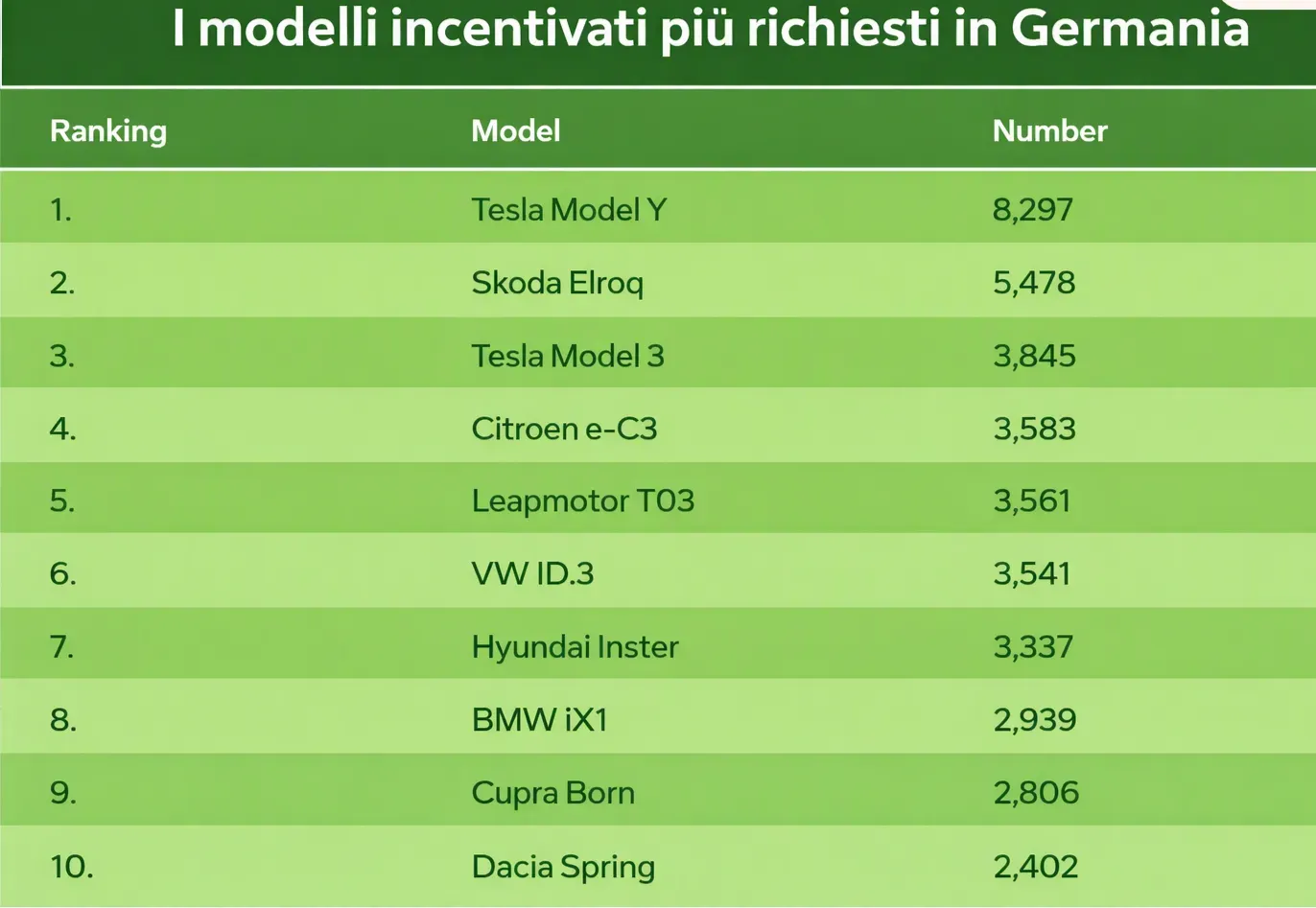
Although Renault has achieved good results in the brand rankings, it does not have any models in the Top 10. The French brand has four relatively popular models among applicants, but none stand out significantly: the Renault 5 received 1,963 inquiries, the E‑Twingo 1,257, the Renault 4 1,241, and the Scenic 951.
Electric vehicles: The EU accelerates (but not too much). What about Italy? Six years behind.
Skoda has another strong model with the Enyaq, as does Cupra with the Tavascan and Leapmotor with the B10. BYD doesn’t have a single dominant model, but the brand has received hundreds of inquiries for many of its vehicles. Additionally, the BYD Seal U DM‑i is the most popular plug-in hybrid, with 1,436 inquiries.
Besides preferences, Germany’s leasing system has enabled widespread access to electric mobility among citizens.
READ ALSO: There’s still hope for charging station bonuses, WATCH our video – Incentive guide
Previous Article
NetZero 2026. Energy on the rise – how to stay competitive? Discussed from October 20 to 22
Next Article
Solar canopies in parking lots: can they power an electric car?
