
Hyundai STARIA Cargo, an electric van with 800 volts, 84 kWh battery capacity, and a range of 450 km
Hyundai continues to expand its presence in the electric vehicle sector with a new offering aimed at professionals. The Korean manufacturer seeks to apply its expertise in electric cars to a market segment where, in addition to efficiency, charging capacity, rapid energy recovery, and comfort during long workdays are crucial.
The new Hyundai STARIA Cargo comes with a configuration tailored for the European market, featuring solutions designed to simplify daily use for those who rely on vans as a work tool. The brand has placed special emphasis on the versatility of the cargo space, towing capabilities, and driving assistance systems, while also addressing aspects such as connectivity and comfort.
One of the key aspects where Hyundai aims to set its new van apart is charging. Its 800-volt electric architecture allows for significantly reduced downtime when using ultra-fast charging stations, which is particularly useful for professionals who need to keep their vehicles operational throughout most of the day. This is complemented by a mechanical setup designed to deliver reliable performance in both urban and road conditions.
The official launch of the Hyundai STARIA Cargo will take place on October 12, during the press event at the 2026 Paris Motor Show. The brand plans to introduce it to the market in the second half of 2026, though the exact timeline will depend on each European country.
Hyundai STARIA Cargo: Dimensions, Loading Capacity, and Performance
Exteriorly, the Hyundai STARIA Cargo measures 5.25 meters in length, 2.00 meters in width, and 2.03 meters in height, with a wheelbase of 3.27 meters. Its body is designed as a three-seater closed van, certified as an N1 commercial vehicle, and tailored to meet the typical needs of delivery, maintenance, and freight transportation companies.
The access to the cargo area is provided by two sliding side doors that allow working from both sides of the vehicle, along with large-opening rear doors. The cargo height of 57.3 centimeters is designed to facilitate loading and unloading operations, while a steel panel separates the cabin from the area intended for goods.
The cargo compartment measures 2.50 meters in length, 1.64 meters in width, and 1.44 meters in height, with a declared volume of 5.46 cubic meters. Hyundai claims it can carry up to three European pallets, a capacity that can be particularly useful in urban logistics operations. The width of access through the side doors is 87 centimeters, while the turning radius is 11.9 meters.
The payload capacity is another of its key selling points. The STARIA Cargo boasts a payload of 1,040 kg and a towing capacity with brakes of 2,000 kg. Hyundai states that both capacities can be utilized simultaneously, allowing the van to travel with its maximum load while pulling a trailer within the specified limits. The declared curb weight is 2,335 kg, with a maximum authorized weight of 3,450 kg.
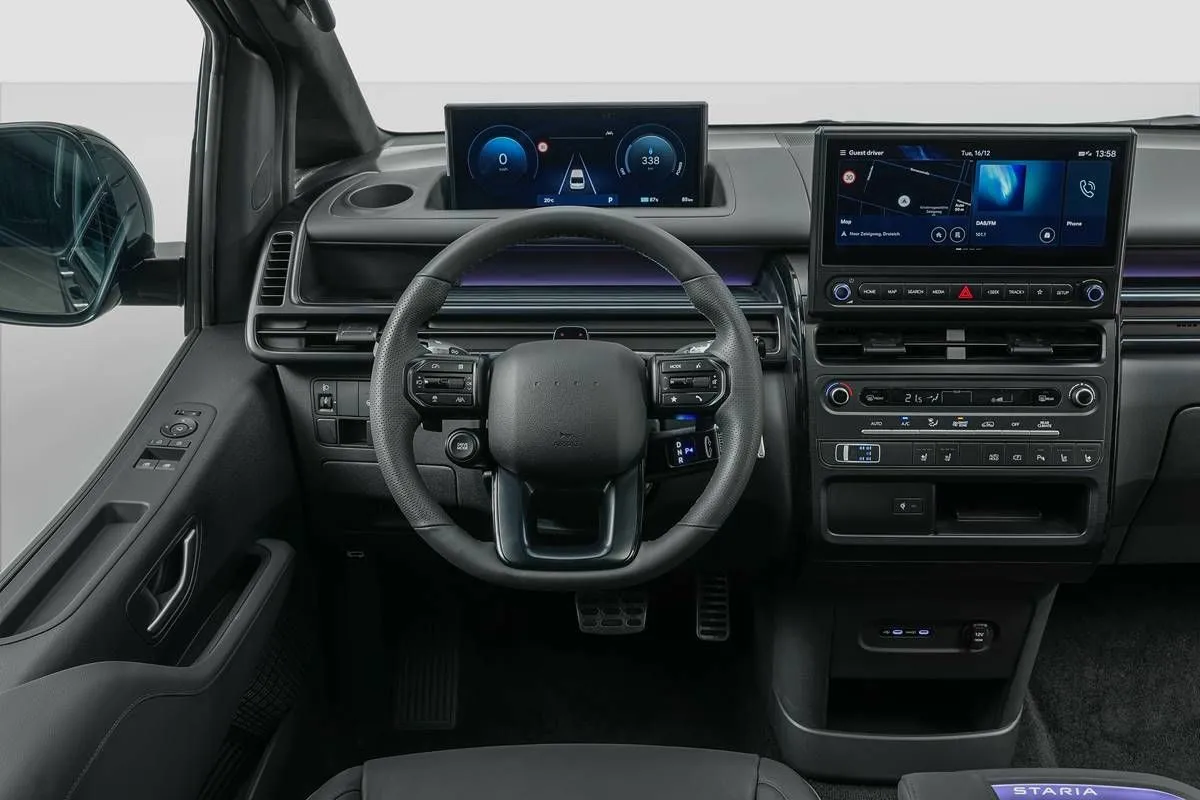
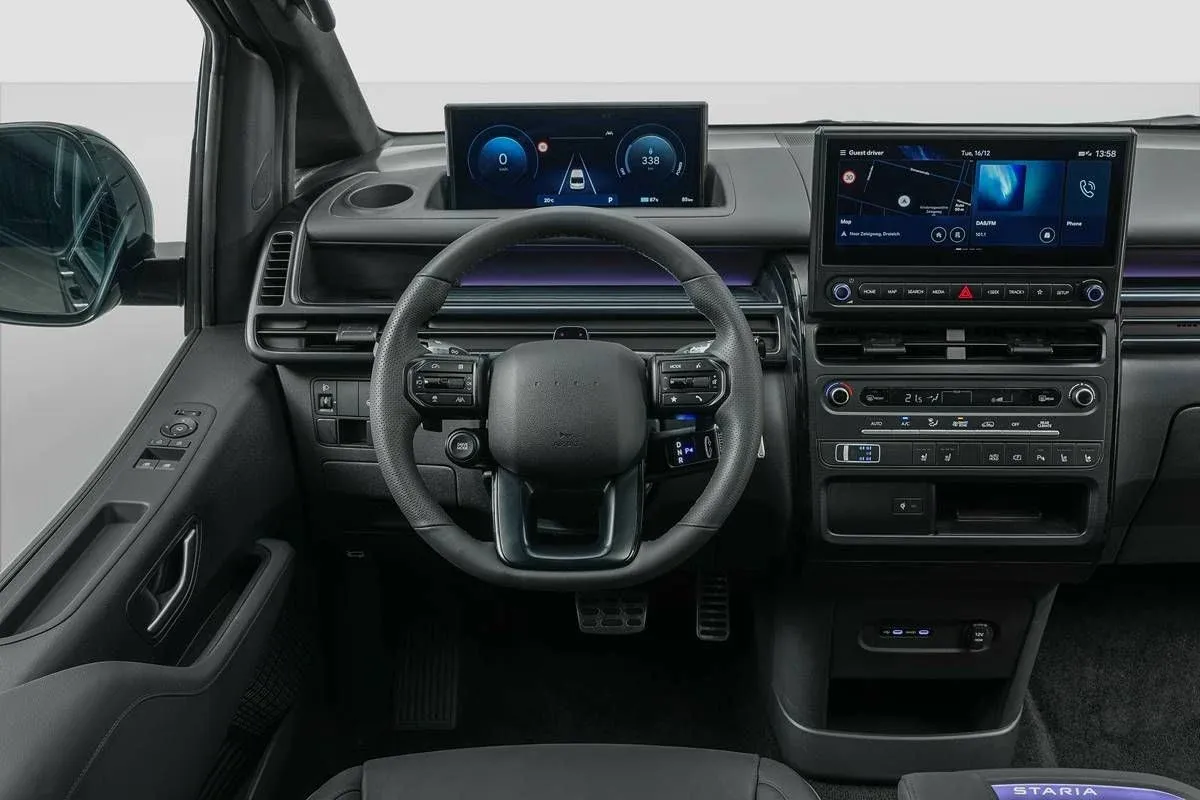
Inside, the model features a 12.3-inch touchscreen and a digital dashboard, integrated into Hyundai’s ccNC multimedia system. Connected features enable checking the load status, remotely managing certain vehicle functions, and controlling the climate system—features that can help streamline daily work tasks.
The safety features include the suite of Hyundai SmartSense assistants. These encompass emergency automatic braking with detection of potential front-end collisions, lane keeping and tracking assist, intelligent cruise control with stop-and-go function, and blind spot collision prevention system. It also features a rear-view camera and front and rear parking sensors, according to information provided by the manufacturer.
Another practical feature is the V2L function, which allows using the energy stored in the battery to power external electrical devices. Hyundai claims a power output of up to 3.5 kW for this function, available either through an external outlet or via a plug located in the charging area. This enables the use of electrical tools and equipment directly from the van, without relying on a separate power source at the work site.
Regarding the propulsion system, the STARIA Cargo is equipped with a front electric motor producing 160 kW (218 HP) and a maximum torque of 350 Nm. It features front-wheel drive, with a claimed top speed of 184 km/h. Beyond this figure—uncommon for a commercial van—the immediate torque delivery and the absence of vibrations typical of internal combustion engines can contribute to a more pleasant driving experience, especially on urban routes with frequent stops.
The battery has a capacity of 84 kWh and enables an estimated range of up to 450 kilometers under the WLTP cycle. This figure places the model in an attractive position for companies that need to cover relatively long daily distances without having to recharge during the workday. As with any commercial vehicle, the actual range will depend on factors such as the load carried, speed, outside temperature, and air conditioning usage.
The 800-volt electrical architecture is one of the most notable features of this proposal. According to Hyundai, the STARIA Cargo can go from 10% to 80% charge in 20 minutes under optimal conditions using a compatible ultra-fast charging station. For recharging at business locations or overnight, it features an onboard 11 kW AC charger, a solution that allows energy to be replenished while the van is parked.
As of now, Hyundai has not announced the prices for the STARIA Cargo in Spain. Its launch is scheduled for the second half of 2026, with dates varying by market. It will then be possible to better assess its position compared to other electric vans, taking into account not only the purchase price but also the payload capacity, operating costs, and the time each company needs to keep their vehicles in service.