
Honda aims to eliminate refueling stops by 2027 thanks to this innovative technology!
What if the next charging station was simply… the road? Honda is developing a technology in Japan that enables wireless power delivery to electric vehicles while they are in motion. The company aims for a power output of up to 150 kW and plans to begin road tests starting in 2027.
Charging an electric vehicle without cables is no longer entirely science fiction. But Honda wants to go even further: instead of parking the vehicle above an induction charging station, the Japanese manufacturer aims to deliver electricity directly from the road surface while the vehicle is moving.
Also read
No need to plug in an electric car anymore: wireless charging is coming to parking lots
Honda envisions coils integrated into the road
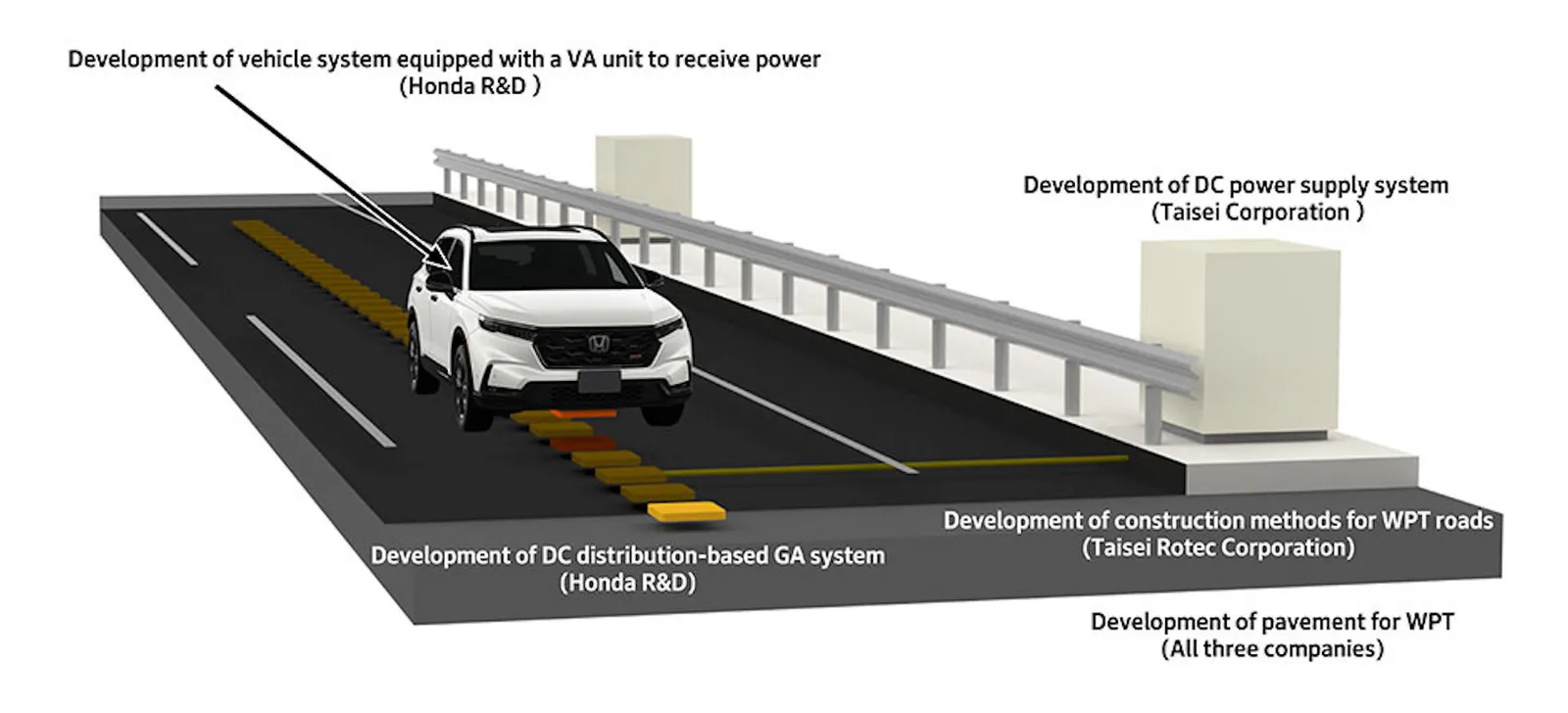
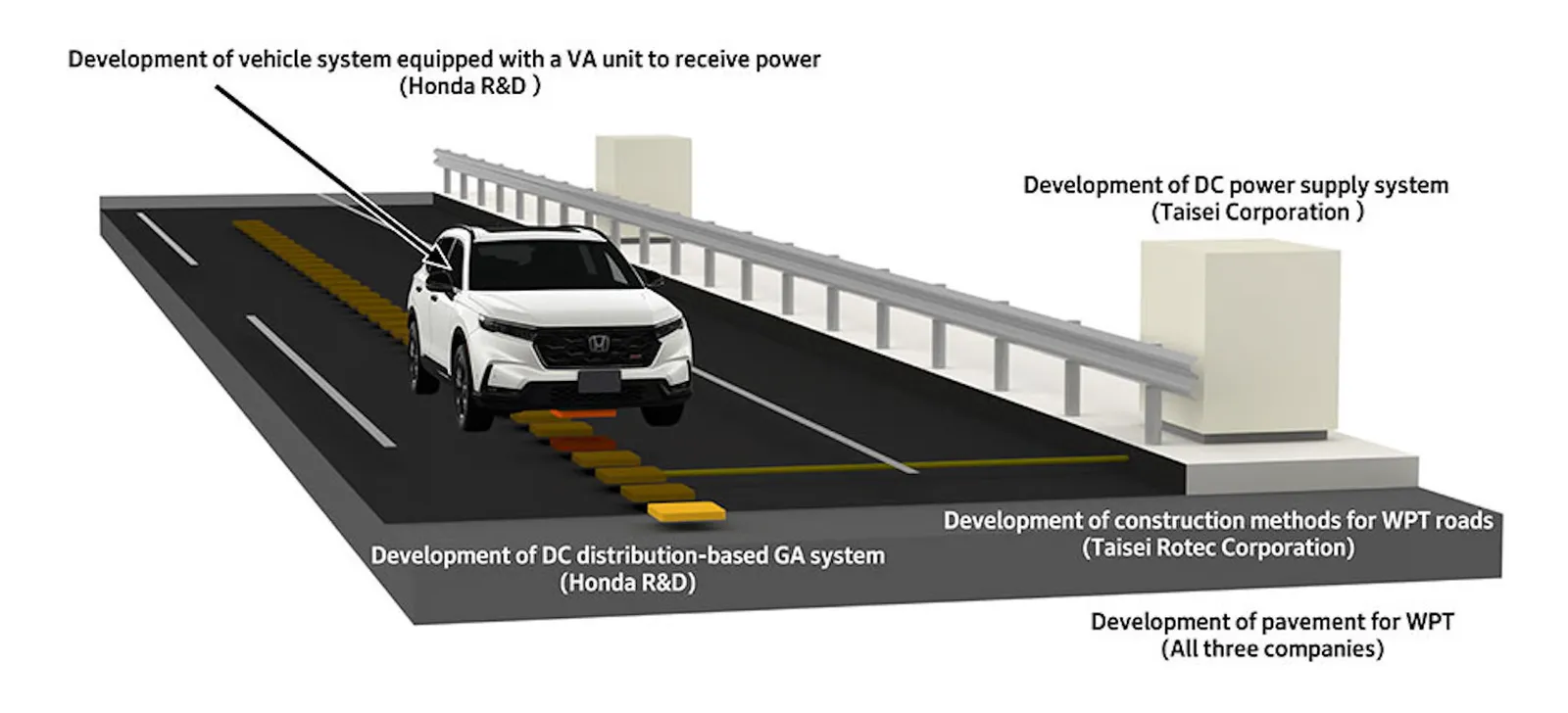
Honda R&D has been working since 2025 with Japanese companies Taisei and Taisei Rotec on a dynamic wireless charging system, or DWPT (“Dynamic Wireless Power Transfer”). It operates using transmitters built into the road surface that generate a magnetic field. A receiver installed under the vehicle then captures this energy.
Each company contributes its expertise to the project. Honda is responsible for developing the components that transmit and receive electricity, Taisei handles the power supply system, while Taisei Rotec focuses on integrating the device into the road surface. One of the key challenges is making this technology compatible with existing roads.
The modules are designed to be installed after the road surface is ground, without requiring its complete reconstruction. Honda also claims that the structure is built to withstand repeated passage by heavy vehicles weighing around 20 tons.
Charging up to 150 kW while driving?
The most impressive figure is the intended power output. Honda plans to operate its system at up to 150 kW, even with vehicles moving at high speeds. This power level is comparable to that of many current fast chargers. However, Honda has not yet specified exactly how much energy a vehicle could actually recover on a road equipped with this system.
Also read
This French startup will install an inductive charging station at a gendarmerie
Before we can imagine our highways transformed into giant chargers, there is still a lot of work to be done. A new testing track must be built by the end of 2026 to evaluate the system’s durability, performance, and any potential electromagnetic field leaks. Honda plans to participate in experiments on the Tateyama Expressway in Chiba Prefecture starting from the 2027 Japanese fiscal year.
The manufacturer is targeting heavy trucks first, as the ability to recover energy without stopping the vehicle could be of greatest interest to them. In the long term, this technology might also apply to passenger cars. But between the cost of equipping roads, their maintenance, and the need to equip vehicles with compatible receivers, the electric highway still needs to prove itself.