
Honda is testing inductive charging while driving

Honda will develop an inductive charging system for charging batteries while driving together with its partners Taisei and Taisei Rotec. The technical foundation is in place, with the first demonstrations set to take place starting next year — even on public roads.
Honda states that it has been working on developing a so-called DWPT technology (“Dynamic Wireless Power Transfer”) since 2021 to enable wireless energy supply for vehicles while in motion. Honda is particularly focused on practical applications in logistics, as “significant advantages are expected here,” according to the company. The Israeli firm Electreon is considered the leading developer in this technology area, having already implemented several pilot projects. Research initiatives such as the PES4E|ROAD project are also exploring dynamic inductive charging.
The principle behind it is that coils embedded in the road surface generate a magnetic field whenever a specially equipped vehicle drives over them. A counter-coil in the vehicle then captures this energy and transfers it directly to the battery.
Honda also aims to get involved in this potential future market. After five years, the automaker claims to have developed the underlying technology for such a magnetic wireless road energy transmission system in collaboration with partners. Together with Taisei and Taisei Rotec, Honda plans to start conducting demonstrations beginning in the 2027 Japanese fiscal year (starting April 1, 2027).
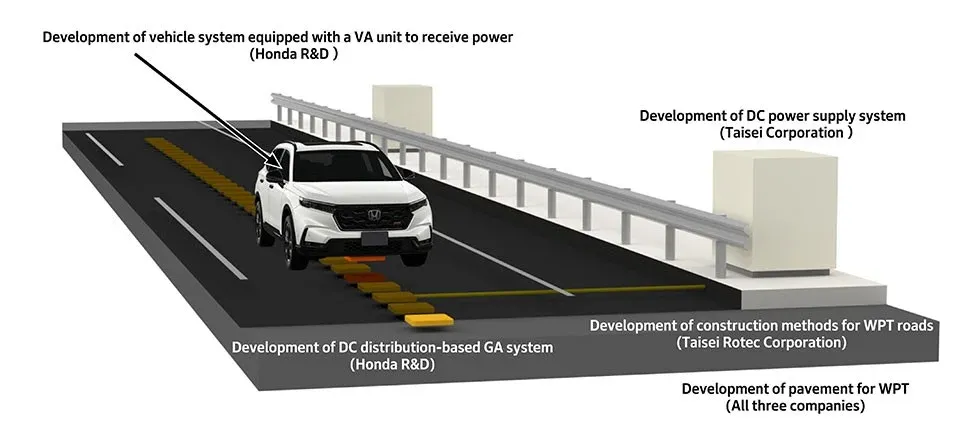
The division of labor is as follows: Honda develops the transmitting and receiving units that are compatible with DC distribution networks, including for use in large commercial vehicles. Taisei contributes a corresponding DC power supply system to electrify roads, while Taisei Rotec handles the necessary construction methods.
Regarding the further timeline, a testing track is set to be built by the end of 2026 at the “Future Technology Field for Taisei Group/Tamura” (T-FIELD/TAMRA). There, the three companies aim to evaluate both the efficiency of energy transmission and the safety of the units installed in the road. After that, the trio plans to further develop its technology for real-world use. This involves assessing “the performance at high output levels of up to 150 kW for potential application in large commercial vehicles, as well as testing the reliability of WPT performance in vehicles traveling at high speeds.”
In addition, the three companies intend to participate in the “Tateyama Project” – a demonstration project for DWPT technology that will be carried out by East Nippon Expressway Company Limited (NEXCO East) on the Tateyama Expressway in Chiba, Japan, starting from the 2027 fiscal year in Japan.
