
Geodis orders 110 battery-electric trucks from Renault and Volvo
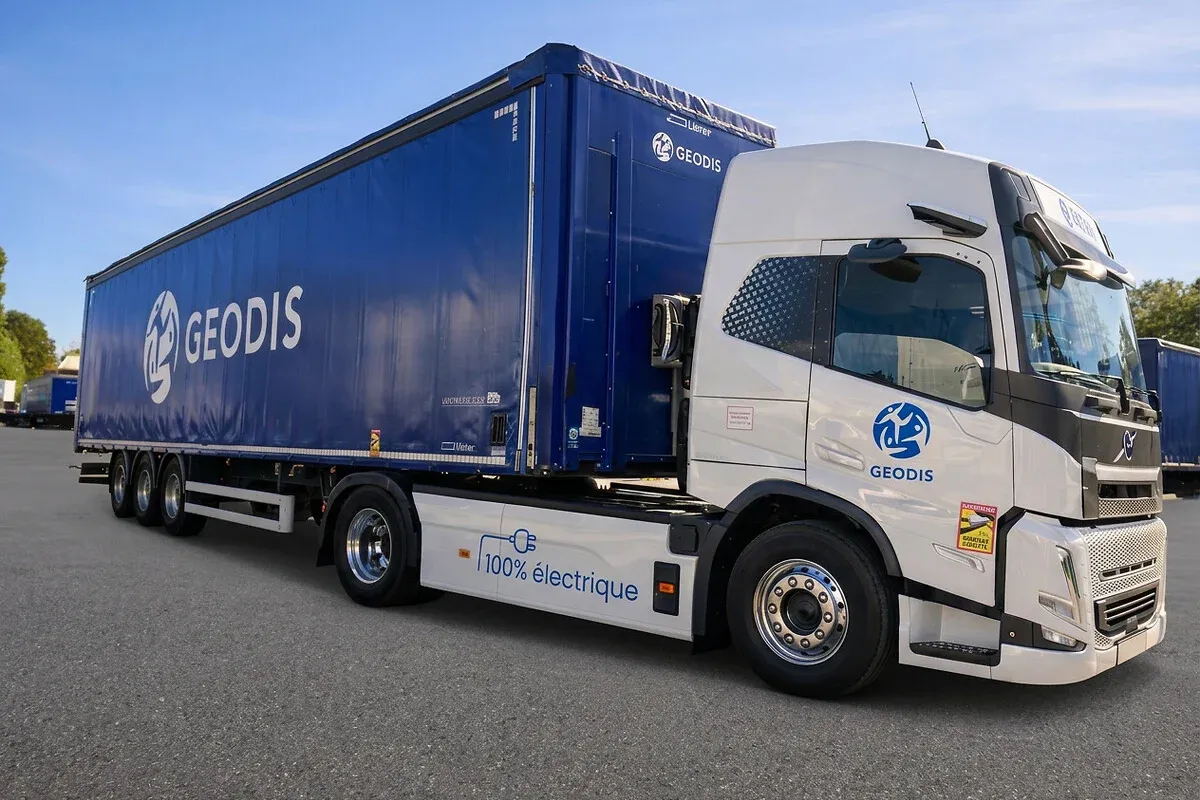
Geodis has ordered 110 heavy-duty electric trucks for its European road transport operations. The 44-tonne vehicles from Renault Trucks and Volvo Trucks are to be delivered by May 2027 and will primarily operate in France on urban and long-haul routes.
Geodis' electric truck fleet is growing to 190 vehicles.
Image: Geodis
The logistics group GEODIS is significantly expanding its electric truck fleet. The company has placed a firm order for 110 battery-electric 44-tonne trucks with Renault Trucks and Volvo Trucks. The vehicles are scheduled for delivery by May 2027.
The new electric trucks will initially be deployed in France. GEODIS plans to use them for both urban deliveries and long-haul transport. With this order, the electric truck fleet of the European Road Network business unit is set to grow to a total of 190 vehicles. GEODIS has not yet disclosed how the 110 vehicles are divided between Renault Trucks and Volvo Trucks, nor which specific models have been ordered. Details on battery capacities, ranges or charging power are also not provided.
Geodis builds its own truck charging corridors
In parallel with the fleet expansion, the logistics provider is investing in charging infrastructure. Along key French transport axes, so-called electric corridors are to be created, offering charging options at intervals of 250 to 500 km. For this purpose, GEODIS will initially rely on an existing network of around 60 charging points. By 2030, this number is expected to rise to more than 200. The company has not specified how many of these will be designed for fast charging of heavy commercial vehicles or what charging power will be available.
The expansion coincides with a phase in which the EU is also placing greater focus on charging infrastructure for heavy-duty vehicles. The European Commission plans to increasingly use funds from CEF and AFIF for e-trucks and buses in the future. One reason for this is that the growing vehicle fleet currently faces only around 3,000 publicly accessible charging points suitable for heavy electric trucks. For long-haul transport, high-performance charging hubs along central freight corridors are therefore becoming a priority.
With its planned charging corridors at intervals of 250 to 500 km, Geodis is therefore specifically building its own infrastructure to support the use of these vehicles in long-haul transport.
“The arrival of these new electric vehicles is part of a global decarbonization strategy and meets the expectations of our clients,” said Marc Vollet, Managing Director of the European Road Network at Geodis. The investment in vehicles and infrastructure underscores the company’s decision to further electrify its own fleet and continue pursuing its CO₂ reduction targets.
Geodis has been working on decarbonising road freight transport for years. In 2020, the logistics provider was one of the founding members of the European Clean Trucking Alliance, which, among other things, called for better framework conditions for zero-emission commercial vehicles and charging infrastructure. Geodis employs around 48,000 people and, according to its own statements, operates in nearly 170 countries. In 2025, the company achieved revenue of 10.6 billion euros. Geodis is part of the French SNCF Group.
