
Fraunhofer deepens battery research with partners from South Korea
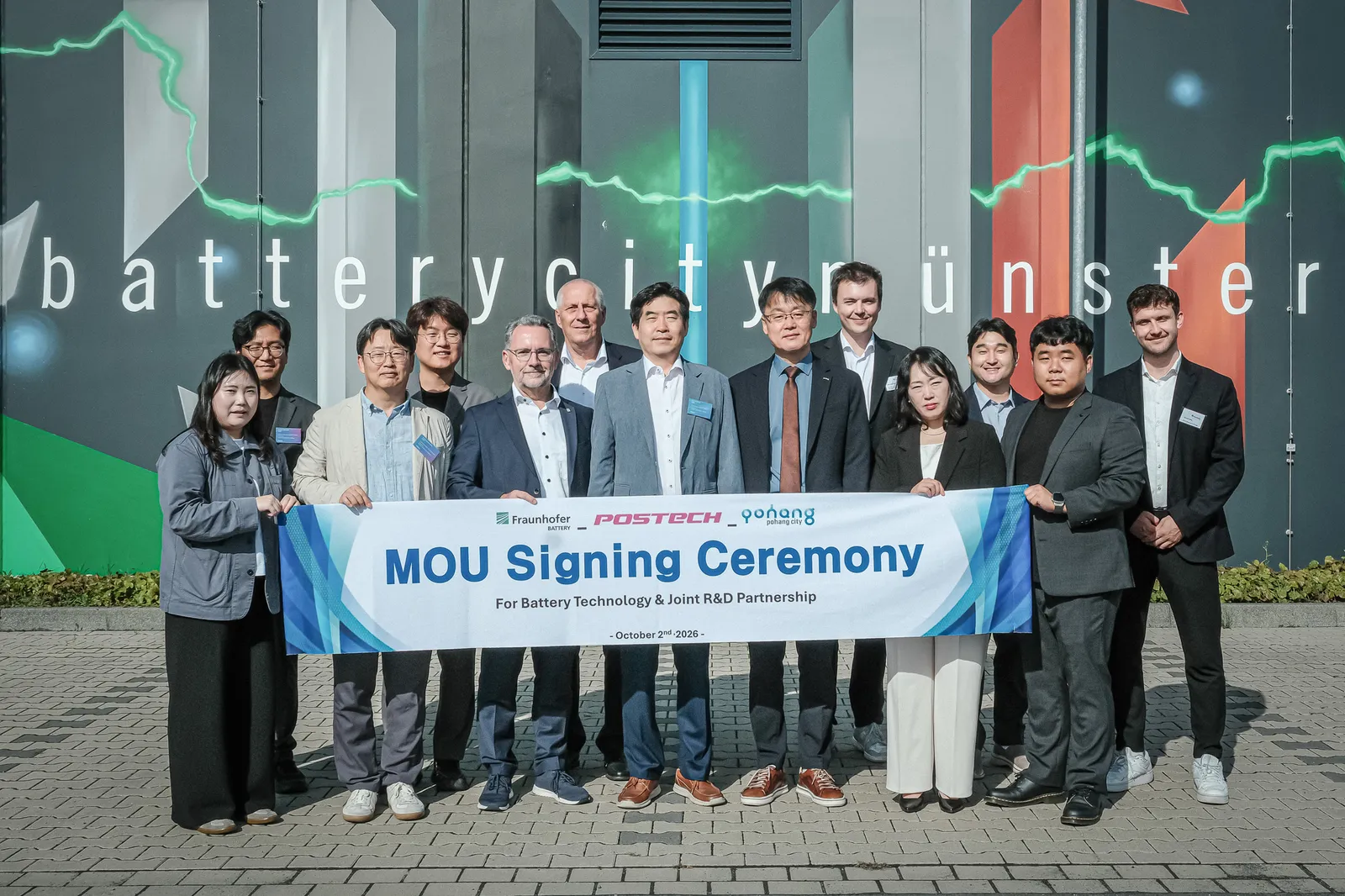
The Fraunhofer Alliance for Batteries is expanding its cooperation with partners in South Korea. Two new memorandums of understanding aim to launch joint research projects on battery materials, cell production, and recycling.
Fraunhofer, POSTECH, and the city of Pohang confirm their collaboration in battery research.
Image: Fraunhofer FFB
During a delegation visit to Fraunhofer FFB in Münster, two letters of intent were signed with Pohang University of Science and Technology (POSTECH), the city of Pohang, and the Korea Environment Corporation (K-eco).
The focus is on joint research and development activities throughout the battery value chain. With POSTECH and the city of Pohang, potential topics range from materials for lithium-ion batteries and next-generation batteries to cell and production technologies, as well as recycling and circular economy approaches. The city of Pohang is expected to provide administrative and policy support for joint activities with local companies as well as international research collaborations.
Postech brings existing experience with next-generation battery technologies to this effort. In early 2026, a research team from the university, together with KAIST and Gyeongsang National University, introduced a lithium-metal battery without anode, achieving a volumetric energy density of 1,270 Wh/l. According to the researchers, after 100 cycles, the cell still retained 81.9 percent of its initial capacity. These results were also confirmed in larger pouch cells.
Fraunhofer FFB to Scale Up New Battery Technologies
A key player in this collaboration is the Fraunhofer Institute for Battery Cell Research and Manufacturing (FFB) in Münster. Its approach integrates laboratory and production research for round cells, prismatic cells, and pouch cells. Depending on the project, individual process steps or entire production chains can be studied.
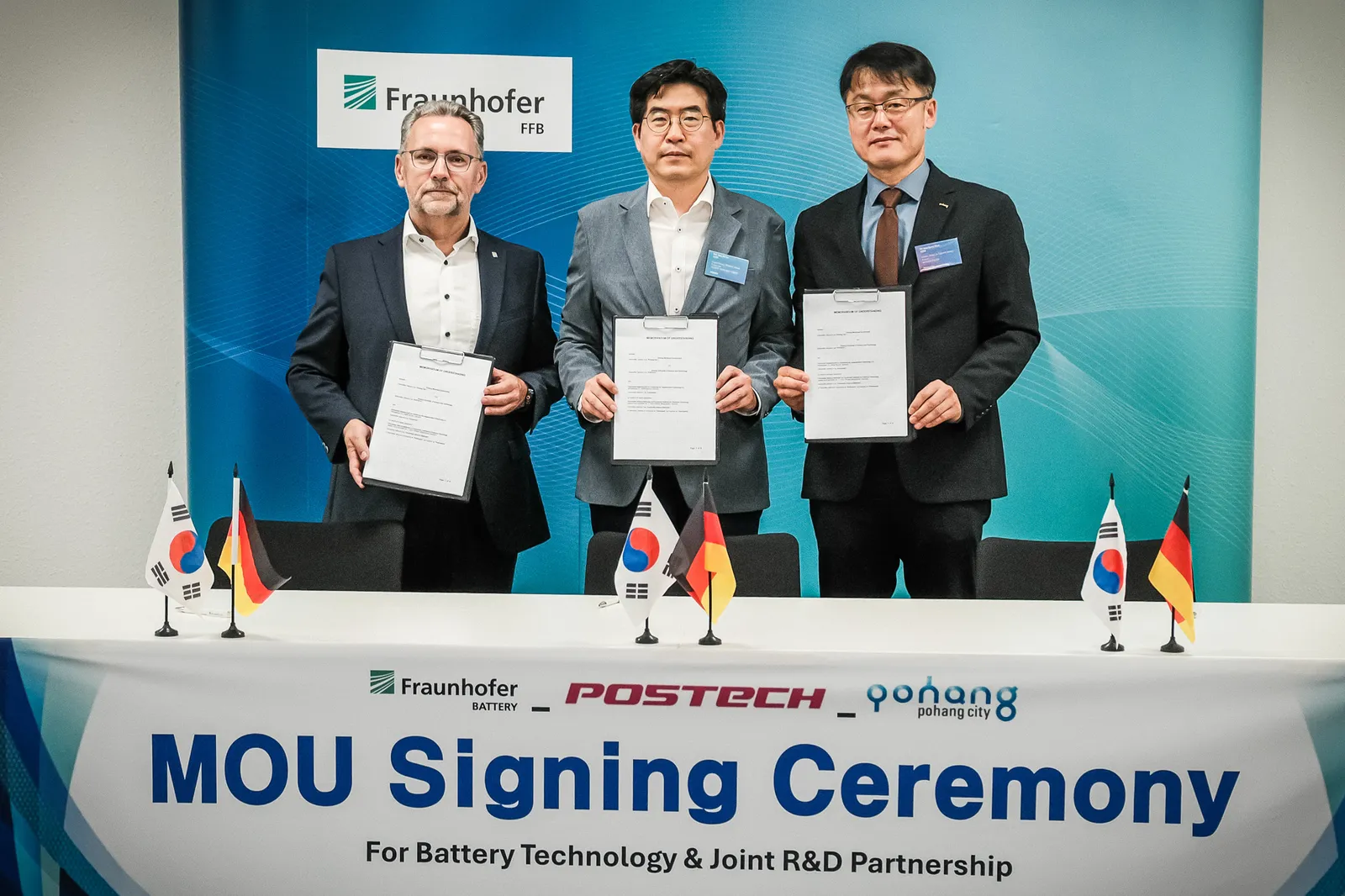
The FFB PreFab in Münster-Amelsbüren is available for these joint activities. There, new materials, cell designs, and manufacturing processes can be tested under conditions similar to those in industry. The goal is to assess their scalability early on and prepare for the transition toward near-series or large-scale industrial production.
"Developing new battery technologies and establishing a sustainable battery value chain require close cooperation between research institutions and industry across national borders," says Jens Tübke, head of the Fraunhofer FFB and spokesperson for the Fraunhofer Battery Alliance. Together with South Korean partners, they aim to pool scientific expertise and develop solutions for battery cell manufacturing and recycling.
The research and production of battery cells is also one of the largest publicly funded battery projects in Germany. The federal government provides up to 750 million euros for research facilities and projects at the Fraunhofer FFB, while the state of North Rhine-Westphalia contributes an additional 320 million euros for land and new buildings. The FFB is integrated into the federal government’s umbrella program for battery research.
The second agreement with K-eco places greater emphasis on battery recycling, material characterization, as well as certification and quality assurance processes for recovered battery materials. Additionally, the partners aim to explore research approaches that can support compliance with the EU Battery Regulation.
This collaboration addresses a sector that is highly advanced technically but still faces significant economic challenges. A study within the EU project Safeloop estimated the current loss in battery recycling at around 1.90 euros per kilogram of battery packs. Key cost drivers include the transportation of hazardous materials, disassembly, and uncertainties in material recovery. Therefore, standardized quality and certification processes can become crucial for establishing sustainable circular economy models.
No specific joint research projects, timelines, or additional funding amounts under the newly signed agreements were mentioned initially.
