
Fraunhofer stabilizes aluminum anodes for lithium-ion batteries
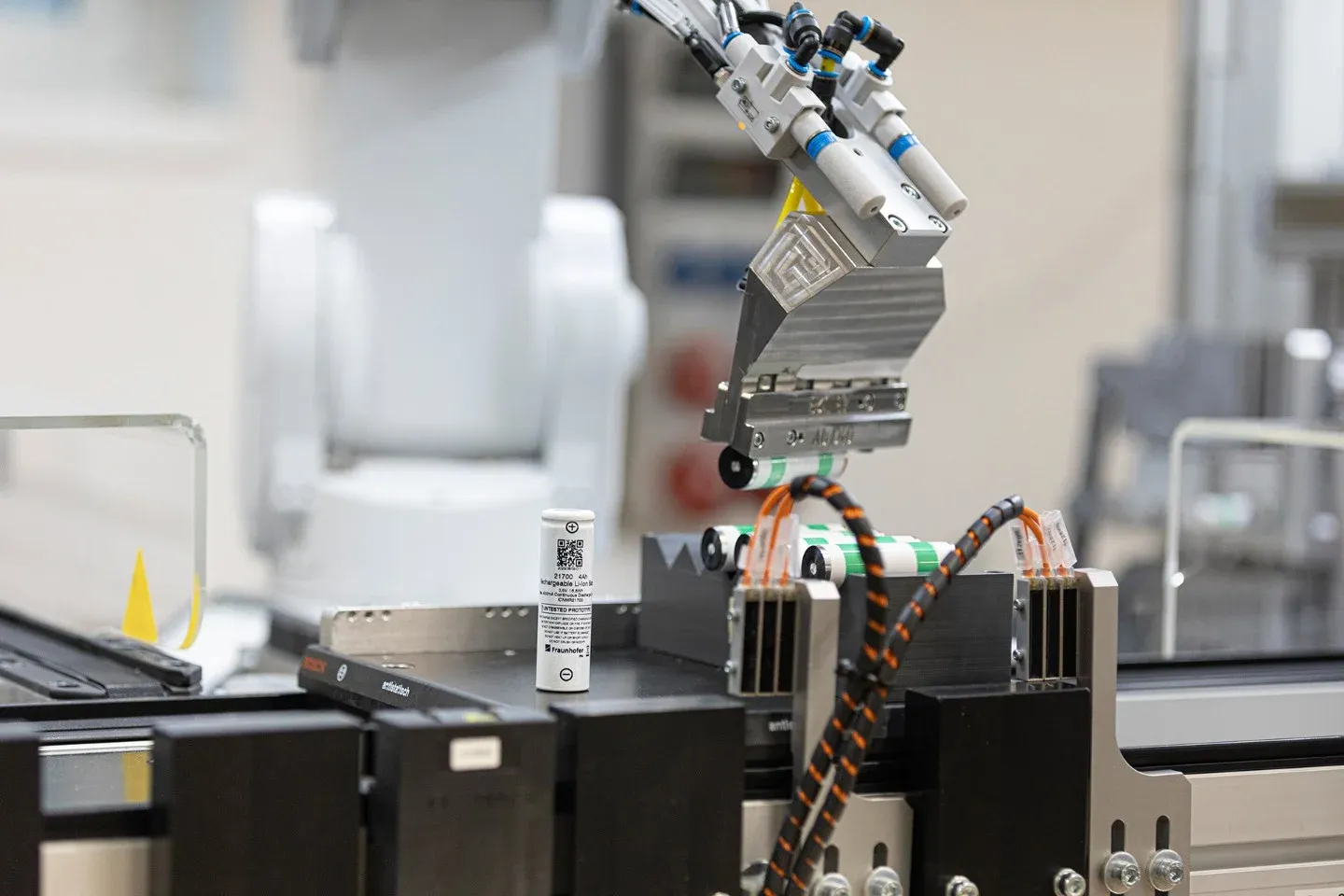
The Fraunhofer IPA and the University of Stuttgart have developed a new cell and electrode technology for aluminum anodes. It aims to control the previously problematic volume changes during charging and discharging, thereby making aluminum usable as an anode material for practical battery applications.
The aluminum foil serves as both the active material and the conductor.
Image: Fraunhofer IPA/Rainer Bez
Aluminum has long been considered a potential substitute for graphite or silicon in lithium-ion batteries. This material is relatively inexpensive, widely available, and capable of achieving high capacities. In practice, however, this approach has failed so far due to mechanical stress on the electrode: During charging and discharging, aluminum changes volume, which can lead to cracks, pores, and ultimately the pulverization of the electrode material. The result is capacity loss and a limited lifespan.
The Fraunhofer Institute for Production Technology and Automation IPA has now developed and patented a cell and electrode technology in collaboration with the University of Stuttgart’s Institute for Photovoltaics to address these aging processes. According to the researchers, this approach stabilizes the materials during operation and maintains electrical contact within the electrode over many charge and discharge cycles.
"We are making a long-known but previously difficult-to-control battery technology practically useful," says Kai Peter Birke, scientific director for battery and hydrogen systems and storage at Fraunhofer IPA.
This approach completely eliminates graphite and silicon in the anode. This could not only reduce the demand for graphite, which is considered a critical raw material for Europe’s battery industry, but also eliminate the problems associated with highly silicon-containing anodes caused by significant volume changes. Another difference lies in the structure of the electrode. A commercially available aluminum alloy foil is used as the starting material, serving both as the active material and the conductor. This eliminates the need for copper foil commonly used in conventional anodes.
Aluminum foil functions as both active material and conductor
A separate coating process, in which active material is applied to the current conductor, is also eliminated. This is intended to reduce both production costs and energy consumption in electrode manufacturing. The researchers mention lithium manganoxide, abbreviated as LMO, as a possible cathode. When combined with an aluminum anode, it is believed that a competitive energy density can be achieved. Additionally, the cell chemistry would be free of phosphates, making it a cost-effective alternative to lithium iron phosphate cells.
The aluminum anode can also be combined with electrolyte solvents with high flash points. Along with a fluoride-free LMO cathode, a fully fluoride- and thus PFAS-free cell structure is possible according to Fraunhofer. This would also help prevent the formation of hydrogen fluoride in the event of a battery fire.
Fraunhofer envisions initial applications primarily in areas where safety, robustness, and compact design are particularly important. Examples cited include air freight applications, tracking systems for transport containers, and specialized medical devices.
For future industrial use, it is important that the cell chemistry can be produced using existing manufacturing facilities. According to the institute, this means a complete overhaul of production infrastructure would not be necessary. Several prototypes have already been developed and are currently being tested at Fraunhofer IPA’s Center for Digitalized Battery Cell Production. The institute does not provide specific data on cycle counts or gravimetric or volumetric energy density in the current announcement.
Meanwhile, Fraunhofer is working on additional approaches to improve battery cells at the material and architecture levels. Just in September, Fraunhofer ISE introduced a cell architecture with significantly thicker electrodes. By reducing the proportion of current conductors, the energy density is expected to increase by 10 to 15 percent depending on the battery type and design. This approach is also still at the research stage and must first prove its industrial scalability.