
Europe is building the world’s longest underwater tunnel beneath the sea: 18 kilometers long with sections weighing 73,500 tons.
14/10/2026 13:00
Updated to
14/10/2026 13:00
Europe is building one of the most spectacular infrastructures in the world beneath the waters of the Baltic Sea. The Fehmarnbelt tunnel, which will connect Denmark and Germany, will be approximately 18 kilometers long and will become the longest underwater tunnel on Earth once it opens.
The project has just reached a new milestone. On September 28th, the fourth section of the tunnel was installed in the trench dug off Denmark’s island of Lolland, bringing the total length already constructed to nearly 900 meters and bringing the project closer to its full one-kilometer length.
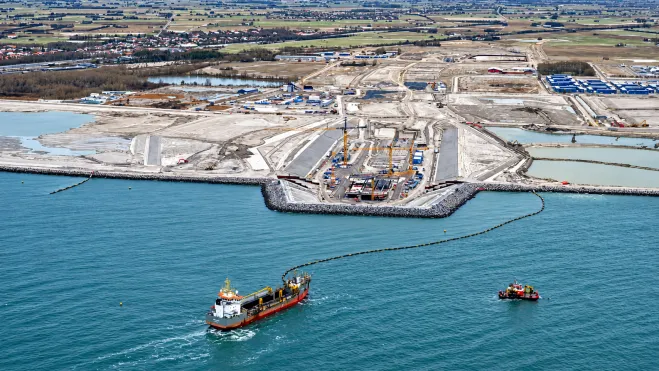
The most striking aspect is how it is being constructed. Instead of drilling directly beneath the seabed, the project uses enormous prefabricated concrete sections that are built on land, transported by sea, and then precisely sunk one after another to fit together.
Sections 217 meters long and over 73,500 tons
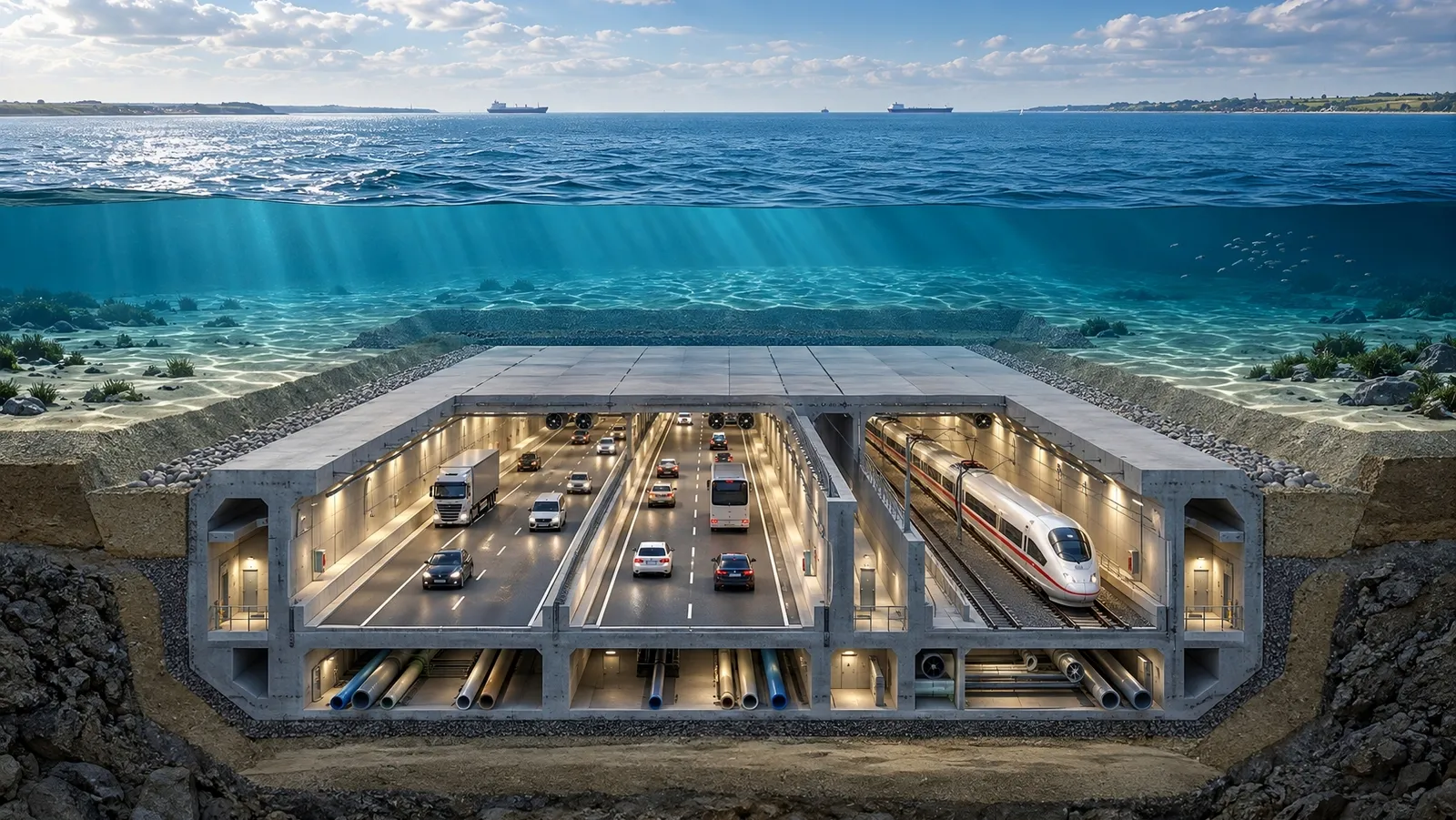
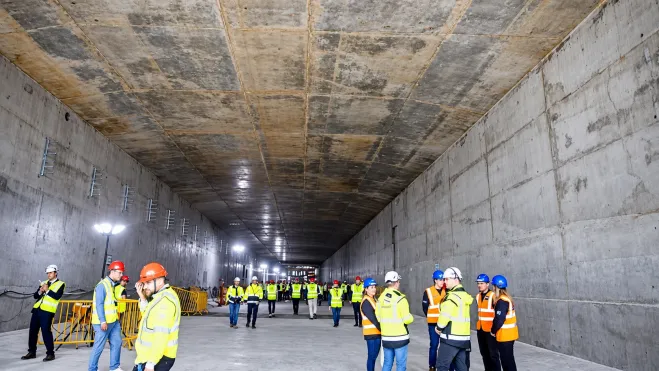
Each standard element is 217 meters long and weighs over 73,500 tons even before all the necessary work to submerge it is completed. They are giant hollow structures that will house future road and railway tunnels as well as technical facilities.
The modules are manufactured at a facility built specifically for the project in Rødbyhavn, Denmark. From there, they are towed to their exact placement site using several tugboats and the specialized vessel IVY, designed to oversee the entire sinking process.
Once positioned over the trench dug in the seabed, the elements are slowly lowered to their final location. They are then connected to the preceding section and secured with gravel, sand, and a layer of protective stone to ensure stability.
The tunnel will ultimately consist of 79 standard elements and 10 special elements, the latter being shorter and equipped with a lower level intended to house technical facilities. The first of these special modules will be roughly the size of a four-story building.
Four lanes and two railway tracks beneath the Baltic
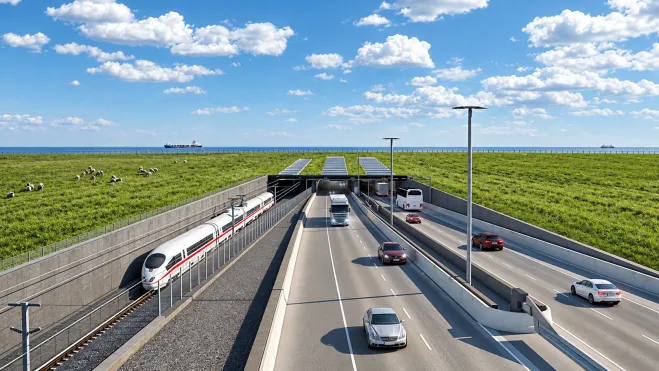
The Fehmarnbelt will not be just a road. The infrastructure will include four lanes of traffic, two in each direction, along with continuous shoulders and two electrified railway tracks within separate tubes. It will also have a separate tube designated for technical facilities and safety measures. The goal is to create a fixed connection between the Danish island of Lolland and the German island of Fehmarn, eliminating one of the main bottlenecks between Scandinavia and Central Europe.
Currently, crossing this section by ferry takes approximately 45 minutes, not including waiting and boarding times. Once the tunnel is completed, the journey between Rødbyhavn and Puttgarden will be reduced to about 10 minutes by car and seven minutes by train. The impact on rail travel will be even greater for longer distances. The project estimates that the train journey between Hamburg and Copenhagen could be shortened to around two and a half hours, compared to the current approximately five hours.
The construction of the tunnel began in 2020, and it has entered its most visible phase in recent months. The first segment was submerged in May 2026, the second arrived in June, the third in August, and now the fourth has enabled nearly 900 meters of continuous structure to be built under the sea.
The project has also required the digging of a massive underwater trench, with an average depth of about 12 meters and a width of nearly 100 meters. In total, around 15 million cubic meters of material have been removed to prepare the seabed on which the modules will be placed.
The European Commission considers this connection a priority infrastructure within the Scandinavia-Mediterranean corridor. Its goal is not only to reduce travel times but also to improve freight rail transport and strengthen links between northern and central Europe.
With the fourth element already in place and the first kilometer growing closer, the Fehmarnbelt is starting to move beyond being just a massive project on blueprints. Beneath the Baltic Sea, pieces weighing over 73,500 tons are being assembled one by one to eventually form an 18-kilometer tunnel connecting two countries.