
The EU project EV4EU promotes two-way charging.
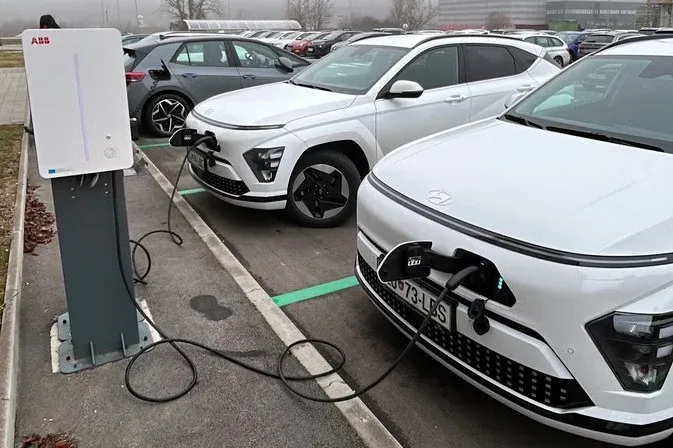
The EU project EV4EU focused on bidirectional charging has completed its work after four years. The partners developed, among other things, a bidirectional CCS charging prototype and open-source software for charging station operators. Four demonstration projects show how electric vehicles can contribute to making the power system more flexible.
Image: Gen-I
The European research project EV4EU has completed its work after four years of operation. Its goal was to develop and test solutions that would allow electric vehicles not only to draw power but also to function as flexible resources within the energy system. In other words, two-way charging. Among the key outcomes are a functional prototype of a two-way charging station based on CCS standards and software available for use by charging point operators. Funded by the EU with around nine million euros, the project was coordinated by the Portuguese research institute INESC-ID. A total of 16 project partners and six associated partners were involved.
The focus was on the Vehicle-to-Everything (V2X) concept. This umbrella term encompasses various ways to feed energy back from the vehicle battery or exchange it with other systems, such as Vehicle-to-Grid (V2G). In this case, the electric car feeds electricity back into the public grid. This can help alleviate peak loads or make use of excess electricity from renewable sources at a different time.
Vehicle-to-Home (V2H) refers to supplying energy to a home from the vehicle battery, such as when one’s own photovoltaic system produces little electricity. Vehicle-to-Building (V2B) applies to commercial or public buildings. Vehicle-to-Load (V2L), on the other hand, allows electrical devices to be powered directly from the vehicle—such as tools or camping equipment. V2L is also a form of energy exchange, but it does not necessarily serve grid stability.
CCS Prototype and Open Software
A key technical achievement of EV4EU is the development and successful testing of a fully functional prototype for bidirectional DC charging based on the Combined Charging System (CCS). This addresses an important component for broader adoption of the technology: power feedback through a standard DC charging interface. Additionally, the partners developed open-source tools for charging station operators to facilitate communication using standards for intelligent and bidirectional charging.
The management of available vehicle batteries also played a central role. EV4EU explored how a virtual power plant can aggregate and optimize various flexible resources to utilize them in energy markets. “This approach can lead to higher revenues while also bringing direct benefits to end users,” says project coordinator Hugo Morais. However, it requires that the vehicles be connected at the required time and that their owners allow sufficient flexibility during charging and discharging processes.
Four pilot projects in Europe
The project partners tested their approaches in Portugal, Slovenia, Greece, and Denmark. In Portugal, unidirectional and bidirectional charging stations were integrated into residential buildings and public facilities among other locations. The demonstration showed an average 8.6 percent reduction in charging costs for private households, as well as up to 21.9 percent higher integration of renewable energy.
In Slovenia, virtual power plants and local market platforms in office and school buildings were the focus. The trials confirmed the additional benefits of V2X compared to pure smart charging, which only controls the timing of electricity consumption. In Athens, Greece, partners tested flexible capacity contracts and dynamic pricing signals to limit overloads and high demand at public charging locations. The Danish demonstrator, on the other hand, controlled charging groups in parking lots. Control algorithms were intended to reduce phase asymmetries and improve local use of renewable energy.
User acceptance remains crucial
In addition to technical feasibility, EV4EU also examined business models, regulatory frameworks, and the needs of vehicle users. This is because two-way charging can function as a flexibility option only if users’ desired mobility is maintained and battery aging is taken into account. Appropriate control algorithms can optimize charging and discharging processes to limit additional stress on the battery.
The results show that V2X goes beyond individual vehicle and charging technologies: coordinated communication, appropriate market models, and incentives for stakeholders are required. The project provides proven technical approaches and practical insights for this purpose. The next step is to implement such solutions on a larger scale under the respective national network and market conditions.