
XPeng L03 Review: Is this new electric SUV the cheap XPeng we feared?
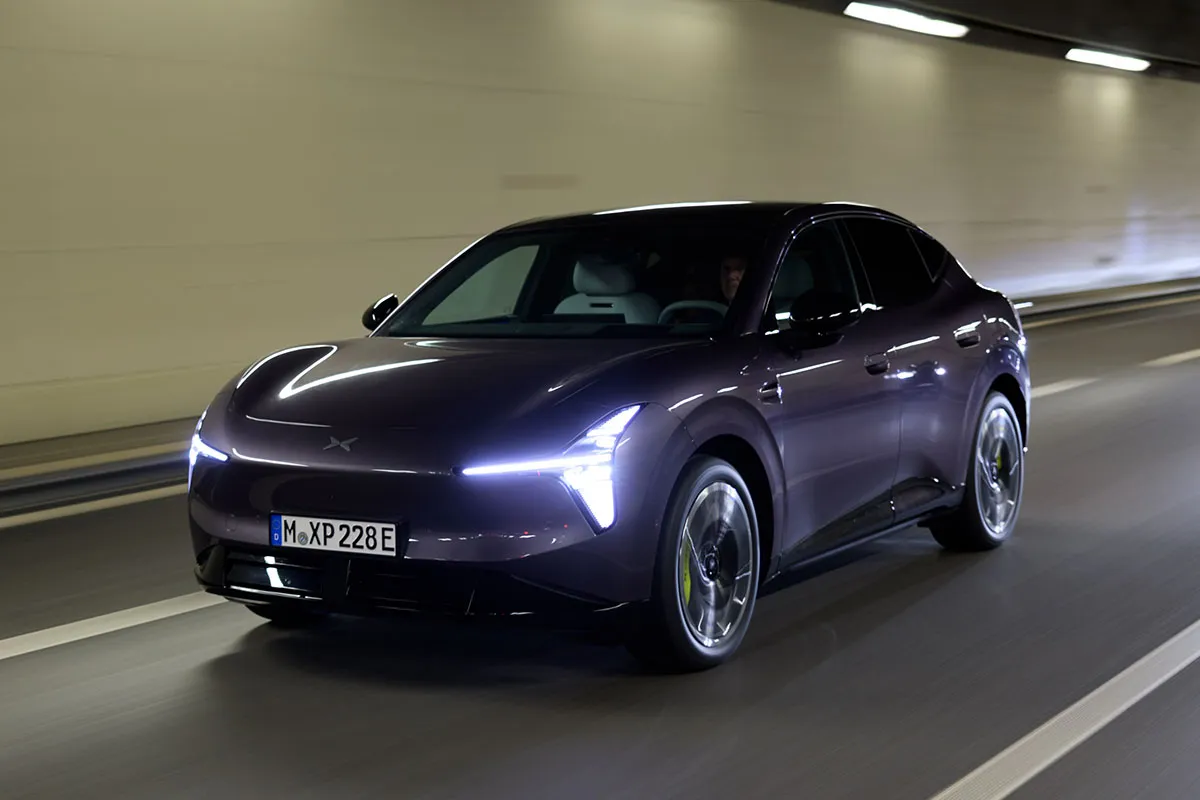
The XPeng L03 now opens up the Chinese manufacturer’s product lineup. Does this entry-level model have limited performance to keep its price low?
When entering our market, XPeng launched its best products first. Starting with the G6, a direct competitor to the Tesla Model Y, followed by the G9, a large luxury SUV capable of competing with the best in its class. More recently, the Guangzhou-based brand added the long sedan P7+ to its lineup. These vehicles offer satisfactory performance but come with cumbersome dimensions. XPeng now aims to fix this issue with the L03, a compact SUV (barely). However, this entry-level model must make some technical compromises.
Also read
Xpeng L03 or Tesla Model Y: the first showdown between the Chinese challenger and the benchmark in electric SUVs
A well-designed aerodynamics for this XPeng L03
Whether in photos or in reality, the XPeng L03 manages to effectively conceal its size. Its rounded lines and sloping roof clearly contribute to this impression. While it aims to be more compact, it doesn’t significantly outperform the slightly larger G6. With a total length of 4.65 meters, this new SUV falls into the family SUV category alongside models like the Citroën ë-C5 Aircross, Hyundai Ioniq 5, and Skoda Enyaq. The L03 is even a bit larger than the Nissan Ariya.
This silhouette allows the Chinese SUV to achieve a minimal Cx value of 0.228, which is an excellent figure for a vehicle of this type. It is comparable to that of the Tesla Model Y (0.23) or the Skoda Enyaq Coupé (0.224). Although the manufacturer does not disclose the SCx value, it is estimated to be slightly less than 0.60 m². This is a good figure that could, in theory, help control fuel consumption on the highway. We will return to this topic later.
Adequate interior space but a tiny trunk
Despite the sloping roof, the rear seating area is quite comfortable. The headroom is ample thanks to the panoramic glass roof, and the knee space is generous owing to the 2.85 m wheelbase. Additionally, the seating position is satisfactory: feet can be placed under the front seat, there’s enough headroom so knees don’t need to be bent, and the recline of the backrests allows for comfort. Passengers also have two air vents, but they’ll need to draw straws to decide who can use the single USB-C charging port.
Still, this spacious interior and SUV-style coupe design affect the trunk volume. Reported at 367 liters, it pales in comparison to competitors in this segment. A Skoda Enyaq of similar size promises 585 liters (570 liters in the Coupe version)! It remains to be seen how the manufacturer made its calculations. In reality, the trunk is nothing like that of a Cupra Born (385 liters). Indeed, it lacks height under the tray, and its sloping roof prevents loading large items behind the trunk threshold. However, it is fairly deep enough to hold plenty of flat luggage for those who don’t plan to take their entire home on vacation. The XPeng L03 offers a floor tray, but it serves only as a makeshift solution for storing cables or safety items. On the other hand, it makes up for this with a 75-liter space under the hood that can accommodate
a cabin-sized suitcase.An (overly) minimalist interior in the XPeng L03
At the front, there are plenty of storage options. The center console offers two phone holders (one with an inductive charger), a space under the central screen, as well as a lower storage compartment with a small additional tray. This last one is difficult to reach, but it’s still useful to have. Finally, there’s a pocket under the armrest.
The cockpit remains true to XPeng’s design philosophy, featuring a clean aesthetic and decent level of finish. It lacks the meticulous details found in the P7+, but overall it has no major flaws. The driver grips a new double-bump steering wheel inspired by that of the P7, which is not available in our market. The controls remain minimalist, but it’s much more comfortable and easier to hold than the brand’s previous steering wheels due to its thinner spokes. It is flanked by an 8.8-inch instrument cluster integrated into the steering column, which displays essential information. It’s a shame that the glossy finish hinders readability.
The same goes for the 15.6-inch central screen that provides access to all of the car’s controls. Fortunately, it proves to be easy to use and quite responsive. The system runs on the latest version of the brand’s custom operating software, featuring new graphics and functions. For tech enthusiasts, note that the entire system is powered by a MediaTek MT8676 processor along with three Turing AI chips that are a point of pride for the brand. However, these chips are only available in the Ultra trim of this test model.
Also read
XPeng G6 2025: What’s its real-world charging speed? Our test!
More advanced driving aids
These chips will be necessary for the level 2++ NGP VLA2 semi-autonomous driving system, which is equivalent to Tesla’s FSD. We have already tested this system in China, and it proves to be incredibly effective. For now, these sophisticated chips seem to enhance the reliability of the conventional system. During our brief test, the feature performed well on the highway. Of course, a longer test is needed, but we encountered no hesitation or suspicious reactions, such as the phantom braking issues frequently seen with other models in this range. It still exhibits typical behavior of electronic stabilizers, with constant beeps if the driver doesn’t bother to disable them one by one before driving off.
The XPeng L03 turns out to be a good companion for traveling, offering a decent level of comfort. This is certainly true on the highway, but less so on regular roads where better stability would be needed. The suspension’s flexibility fails to adequately control body movements, and the perfectly silent steering, as usual with XPeng, makes it impossible to tell where the wheels are. The sport mode setting on the steering column doesn’t change this either.
Also read
Supertest: XPeng P7+, charging times and range from our test
Average fuel consumption
The XPeng L03 is available with a battery of 58.3 kWh or 71.2 kWh in gross capacity. The latter is equipped in the performance test version. According to our calculations, it would offer 67.7 kWh of usable capacity across the entire range. In the best case, the SUV promises 520 km of WLTP range. However, in the performance version, the approved range is 440 km, with a WLTP fuel consumption including charging losses of 18.4 kWh/100 km.
In the real world, this SUV shows mixed results. For typical mixed-use driving, an energy consumption of around 18 to 19 kWh per 100 km can be expected, resulting in a range of 360 km. However, we were able to achieve 13.1 kWh per 100 km on purely urban routes, thanks to favorable driving conditions (few acceleration bursts where the vehicle’s 2,055 kg weight has an impact). Additionally, its aerodynamic performance helps control fuel consumption—everything is relative—bringing the figure to nearly 23.5 kWh per 100 km at a constant speed of 130 km/h. This should allow for a theoretical total range of around 300 km on highway driving, or 210 km when the battery is at 80 to 10% charge.
The best 400 V charging system on the market!
XPeng aims to become the first premium Chinese brand in Europe. To achieve this, the Guangzhou-based company initially did not plan to offer models with 400 V operating voltages. Yet that is exactly the case here, with a battery operating at around 450 V. Despite these technical specifications, the L03 stands out in its segment thanks to a rapid charging (DC) peak of 236 kW, enabling a 10-80% charge in just 20 minutes.
In reality, we were able to reach a peak power of 220 kW with a 10-80% charge completed in exactly 21 minutes and 30 seconds. Despite an irregular charging curve for this single charge (the endurance of charging cycles will need further analysis), the contract specifications are almost met. This results in an average power at the charger of 153 kW, which is the best value for a 400 V battery in our database. For perspective, the next Renault Scenic E-Tech 89 kWh model, which uses the battery from the Alpine A390 GT, will have an average power of 130 kW. A Skoda Elroq 85 (77 kWh) or a Tesla Model Y Propulsion (63 kWh) both have average powers around 125 kW. A BYD Atto 3 Evo, which promises a peak power of 230 kW, actually achieves an average power of 116 kW.
Based on our initial tests of actual consumption and range, the XPeng L03 Performance appears capable of adding 165 kilometers of highway range in 15 minutes and 250 kilometers in 30 minutes. This is the result we observed with a Tesla Model Y Propulsion. It means that, under strict conditions, the long-range version of the L03 could potentially match the performance levels recorded by us with the Tesla Model 3 Long Range Dual! Here is a chart showing how the L03 compares to its competitors. Of course, we are comparing 4×4 versions here with 4×2 versions, which were also tested under conditions different from those of a Supertest.
A G6 on sale at competitive prices
With the L03, XPeng aims to offer its most suitable electric vehicle model for the European market. Although its size is more manageable compared to other SUVs in its lineup, including the G6, the L03 remains a substantial SUV, though its sleek design helps to soften its bulk. It adheres to the standards of Chinese cars, offering interior space above average for its category, but its trunk capacity lags far behind that of its competitors. The same holds true for road performance—it’s not alarming, but it’s not as refined as European rivals or even the XPeng G6.
Finally, the L03 remains true to the brand’s other models, which offer some of the most economical cars in the Chinese market. While its 23 kWh/100 km figure on highways is average at best, a BYD Atto 3 Evo comes close to 25 kWh/100 km. Although the XPeng L03 could benefit from a slightly higher battery capacity to extend its range, it makes up for this, like all XPeng models, with outstanding fast-charging performance!
Like almost all cars from the Middle Kingdom, the XPeng L03 can also make its minor flaws forgettable when it comes to performance. The entry-level version starts at 34,990 €. With an upgrade raising the price to 37,990 €, customers can opt for the Long Range version with a WLTP range of 520 km. This is more affordable than a Tesla Model Y Propulsion (525 km WLTP), although the latter is significantly larger. At the top of the range is the Ultra trim, which adds further features at a price of 42,990 €. Finally, the high-performance all-wheel-drive version costs up to 46,990 €.
