
The new GAC AION UT Cross will arrive in Spain in 2027: 400 km of range and 440 liters of trunk space

The offensive by Chinese manufacturers in Europe continues to attract new players. One of those taking steps to establish a foothold in our market is GAC, an industry giant that is expanding its range of electric cars with models tailored to the tastes and needs of European drivers, many of which are even manufactured in our market. Its latest offering is a model designed to combine the space of an SUV with the comfort of a compact car and the aesthetic appeal of an SUV.
This is the GAC AION UT Cross, unveiled at the Paris Motor Show, with an expected arrival in Spain during the first quarter of 2027. This addition will broaden a range that already includes the AION UT and AION V, allowing the Chinese manufacturer to compete in one of the most demand-driven segments of the European market.
GAC AION UT Cross: an electric car designed for Europe

Aesthetically, the new AION UT Cross features a robust-looking body design with wheel arch guards, longitudinal bars on the roof, and a configuration aimed at offering greater versatility than that of a conventional sedan. It is not an SUV but rather an electric car designed primarily for paved roads, though it includes some elements that allow it to handle worse-condition paths and highways with more ease.
Although GAC has not yet disclosed all of its external dimensions, it has confirmed an axle distance of 2.75 meters, a figure that should allow for good utilization of the interior space. It also features a ground clearance of 147 millimeters even when the vehicle is fully loaded. Additionally, it comes with a chassis setup adapted for European roads and 225-millimeter-wide tires, designed to improve comfort and the ability to absorb road irregularities.
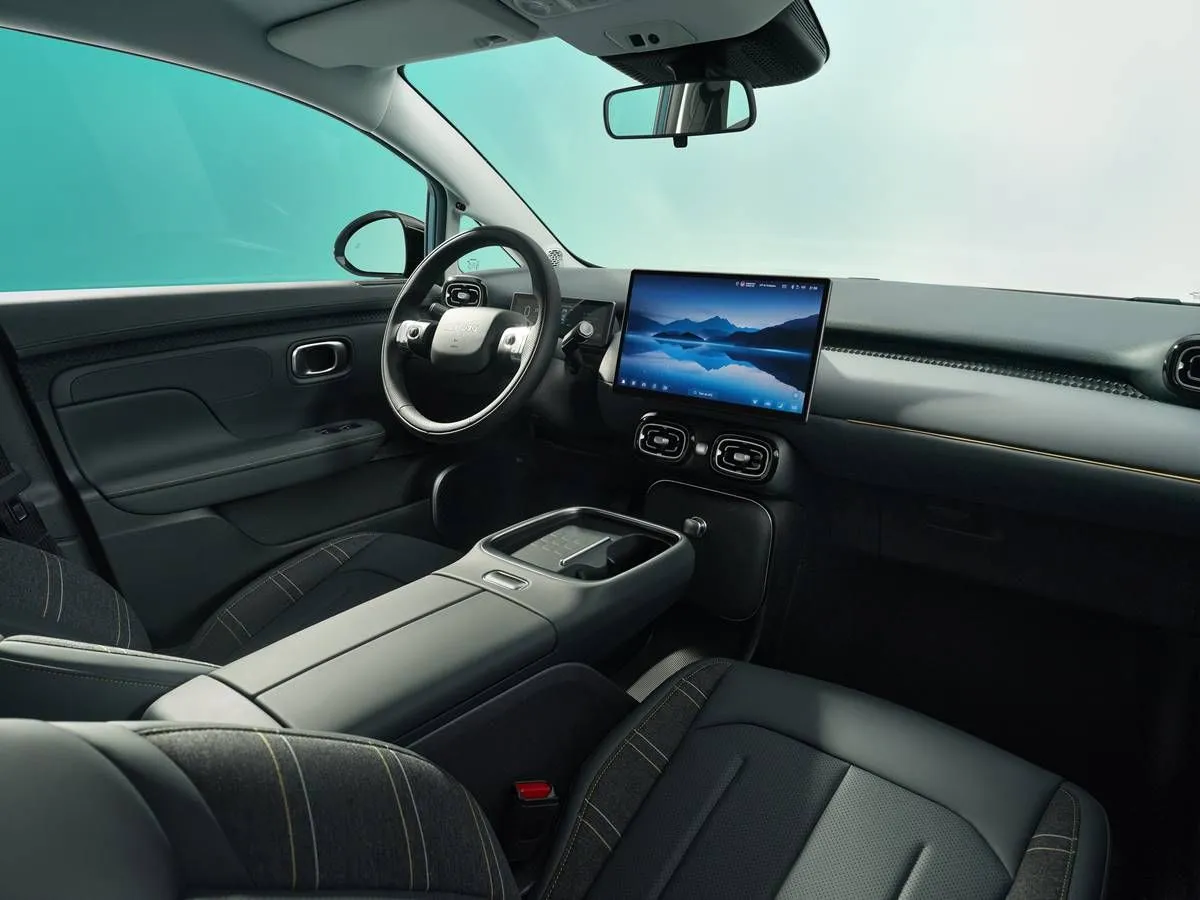
Inside, the manufacturer has opted for a simple and functional design, where available space plays a key role. The rear seats offer ample seating comfort, while the trunk has a capacity of 440 liters—a significant figure for a car intended for both daily commuting and family trips. Additionally, the rear seats can be folded down to create a flat loading surface, making it easier to transport bulky items.
Practicality is also reflected in the small details. GAC has installed up to 24 storage compartments throughout the cabin, ensuring passengers have space to keep their belongings. This solution, along with the spaciousness of the rear seats and the trunk capacity, contributes to one of the main selling points of this model: offering a versatile electric car without the need to opt for a large SUV.
In terms of mechanical specifications, GAC has not yet detailed the power of the electric motor or the performance features of the AION UT Cross. It also has not confirmed the capacity of its battery, although we do know it will feature the Magazine Battery technology developed by the Chinese group—a solution that places a strong emphasis on the safety of the energy storage system.
The manufacturer has announced an range of 400 kilometers according to the WLTP cycle. This figure positions it as an option for those who need an electric car for daily use but also want some flexibility for longer trips. We will have to wait to learn about its certified fuel consumption and see how far it can go under real-world conditions, especially on highways.
Regarding charging, GAC states that the AION UT Cross can go from 30% to 80% battery charge in 24 minutes. The maximum charging power and the time required to reach 10% charge, which is one of the most common benchmarks for comparing fast charging systems in electric vehicles, have not been disclosed yet.
Safety is another aspect the manufacturer wants to highlight. According to official data, 71% of the vehicle’s body structure is made of high-strength steel, and it is equipped with seven airbags. These include a V-shaped curtain airbag that is 2.1 meters long, designed to enhance protection for passengers in the event of an accident.
Finally, one of the factors that could determine its commercial success remains unknown: the price. GAC has not yet announced how much the AION UT Cross will cost in Spain, nor the trims and versions that will be available. This information is particularly important given the increasing competition between Chinese and European manufacturers in the segment of compact and family electric cars.
The proposal offers interesting arguments regarding its design, especially its interior space, practical approach, and autonomy that should be sufficient for many drivers. However, to truly assess its competitiveness, it will be necessary to know the battery capacity, charging power, and above all, the final price. With a launch scheduled for early 2027, GAC still has time to finalize the technical specifications, which will largely determine its appeal compared to competitors.
