
ADAC thoroughly tests Tesla’s FSD and discovers some limitations and flaws
Tesla has been using the name Full Self-Driving for years to describe its commitment to autonomous driving. Now, it has been slightly changed to “FSD Supervised,” and its rollout is underway in some European markets. It’s time to see its true capabilities.
The German automobile club ADAC was able to test the system in Denmark, one of the markets that has unilaterally approved it. The results are hard to summarize. On one hand, the system can accomplish many tasks with surprising ease. On the other hand, it still makes mistakes that remind us the driver remains essential.
The test lasted approximately two hours and allowed for an evaluation of both the strengths and limitations of the system installed in a Tesla Model 3. And it is here that one of the most interesting conclusions of the test emerges: the problem isn’t just that FSD can make mistakes, but also that it performs so well at times that it may cause the driver to become overly confident.
Tesla FSD Supervised works very well, until it stops working
Tesla is leveraging the opportunities offered by some European markets to expand FSD Supervised beyond highways. In Denmark, the Netherlands, Lithuania, Estonia, Belgium, Slovenia, and the Czech Republic, the feature is already allowed to be used, though always under the driver’s supervision. Tesla also makes it clear that the system does not turn the vehicle autonomous and that the person behind the wheel remains responsible.
The ADAC’s experience is particularly noteworthy because the Model 3 isn’t limited to keeping the car within a single lane. During testing, it was able to handle curves, intersections, roundabouts, lane changes, and various traffic situations with a driving style that was surprisingly natural at many moments. The car could follow the programmed route and make decisions without requiring constant intervention from the driver.
In narrow roads with oncoming traffic, it also performed convincingly. Even in a situation commonly seen on Danish roads, where certain lanes can be crossed to allow two vehicles to pass each other in a narrow road, the system was able to handle it properly. The results demonstrate a level of maturity that would have been hard to imagine in a system of this kind just a few years ago.
FSD is responsible for accelerating, braking, turning, changing lanes, and following the route, but Tesla insists that the driver must remain vigilant at all times. The company itself states that the functions currently available require active supervision and do not make the vehicle autonomous.
And that’s where the paradox lies. The smoother and more natural the car’s behavior, the easier it is for the driver to perceive it as something much closer to an autonomous system than it actually is. For a few minutes, it might seem sufficient to monitor it occasionally. But that can be a serious mistake.
The ADAC test provided several examples of why such supervision remains necessary. On one occasion, the Tesla chose the wrong lane. Another time, it took the wrong entrance to an highway and, while trying to correct its path, ended up crossing a solid line. It also used a lane reserved for buses incorrectly and even ran a red light.
According to ADAC, if the Tesla had had to take a German driving test during that trial, it would have failed three times. We are not talking here about minor behavioral details that might go unnoticed, but rather situations where human intervention is needed to prevent a violation or a potentially dangerous situation.
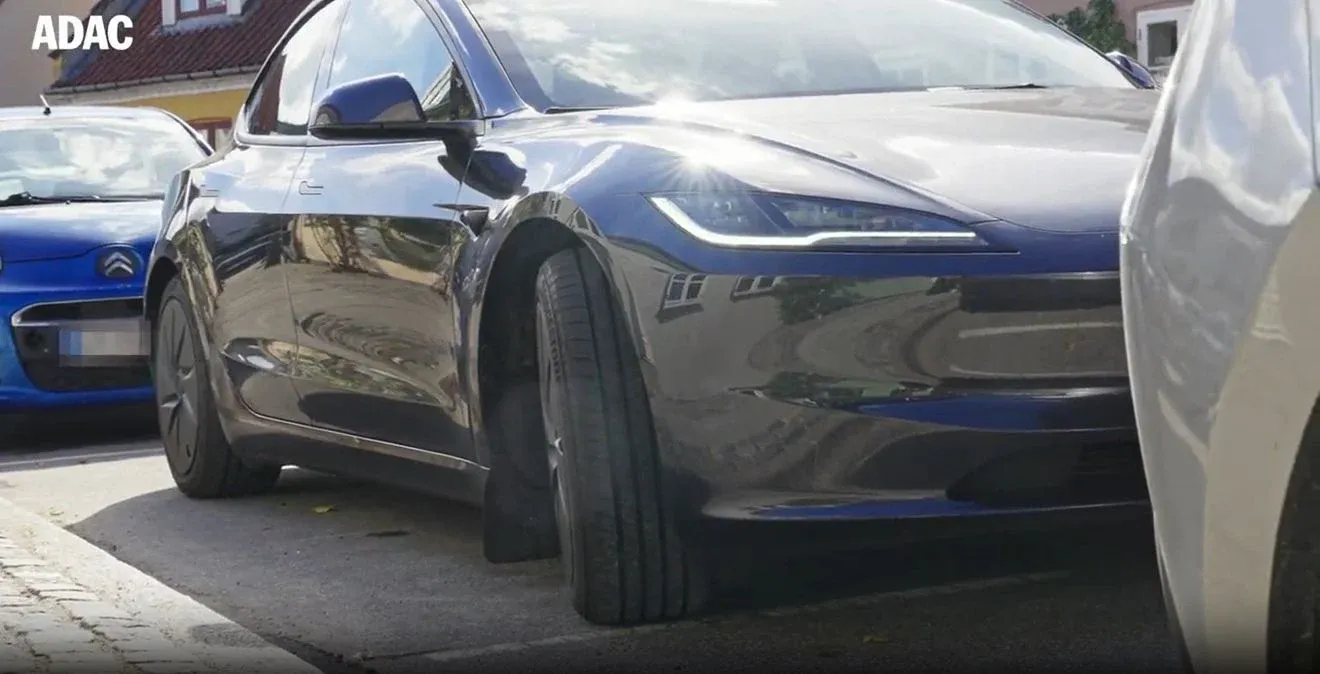
The autonomous parking test also revealed that the system still has a long way to go. In one of the scenarios tested, the Model 3 initially failed to find a suitable parking spot. When it finally located one, it required numerous attempts to park successfully and eventually gave up, with part of the car still on the road.
It is precisely this kind of behavior that makes the term Full Self-Driving problematic. A person might watch as the vehicle drives for miles, changes lanes, passes roundabouts, and navigates intersections without human intervention, leading them to believe the system can handle almost any situation. But a single unexpected error immediately shifts responsibility back to the driver.
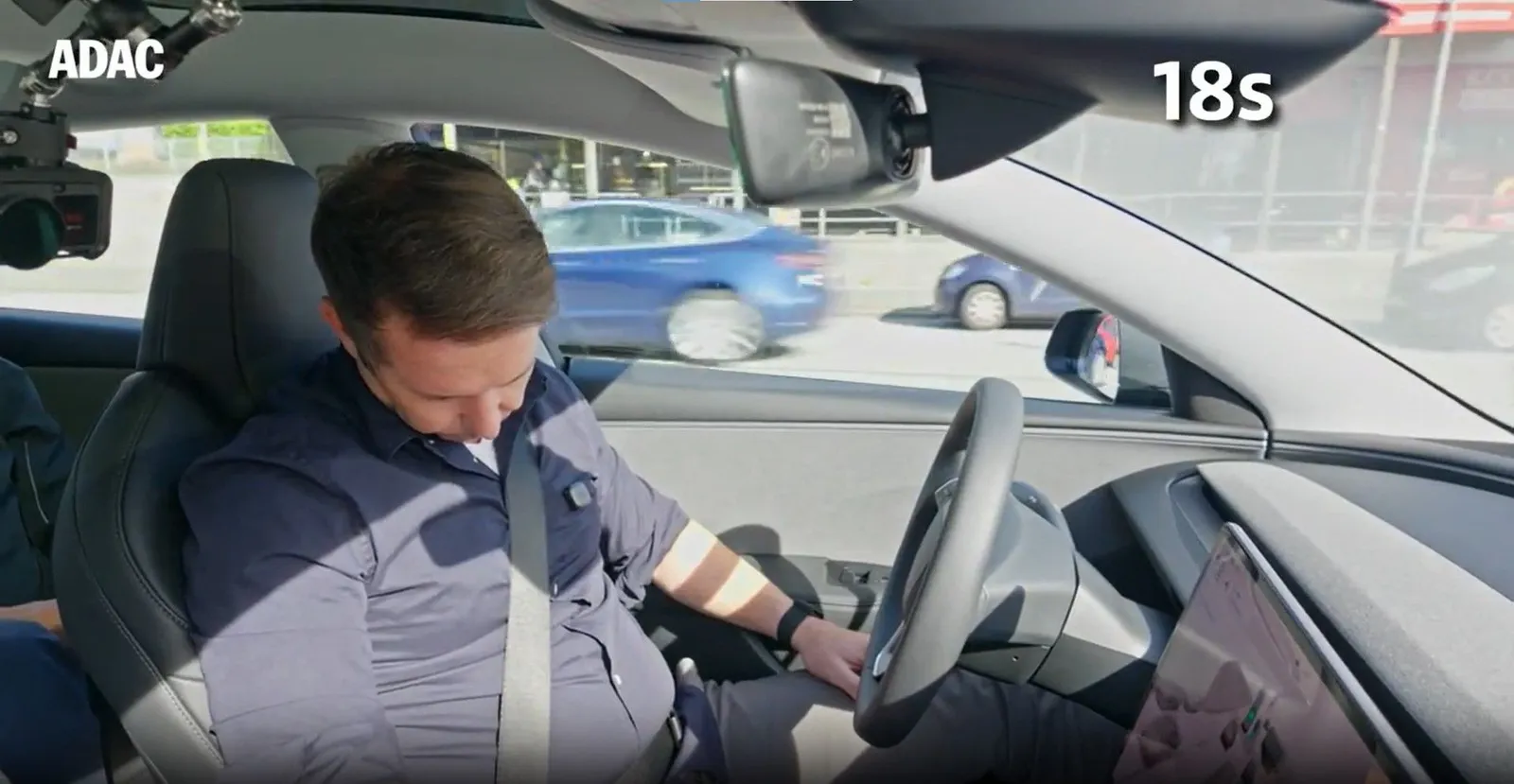
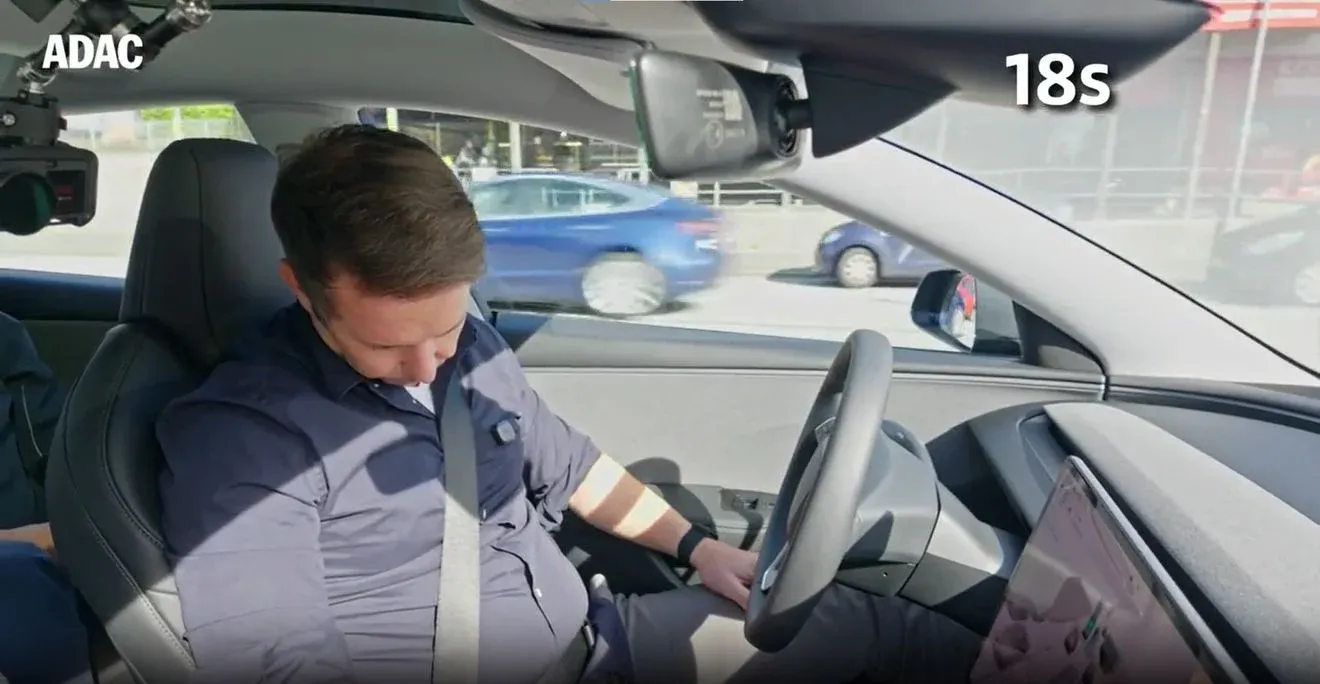
Driver monitoring is therefore essential. And here ADAC identified another weakness. The camera located in the cabin monitors the driver’s attention, but during testing the system took several seconds to detect when the driver’s gaze stopped being directed at the road.
Even more striking was the behavior with sunglasses featuring mirrored lenses. In that situation, the system failed to issue any warning, demonstrating that monitoring the driver is not foolproof either. In a system that relies on the driver being able to react at any moment, reliable detection of their attention is particularly important.
All of this does not mean that FSD Supervised is an underdeveloped technology. On the contrary, it is the opposite. The ADAC test demonstrates how far Tesla has advanced in driver assistance, especially when compared to traditional systems that merely keep the car within its lane or follow the vehicle ahead.
The problem lies in mistaking that capability for autonomous driving. FSD Supervised remains a driver assistance system. In the standard classification of automation levels, it falls under level 2, as the driver must continuously monitor driving and retain responsibility.
The ADAC report’s conclusion is likely more interesting than any spectacular demonstration of FSD. Tesla has managed to develop a system that can generate immense confidence in very little time, but that same confidence can become its biggest problem if the driver assumes they can relax now.
Opinion
The other conclusion is that everyone agrees FSD significantly improves road safety, though it performs best when the driver remains attentive to what’s happening. And that’s the key point. A notable increase in safety that Europe is blocking, using rather absurd excuses such as the car potentially exceeding legal speed limits in certain situations. Something related to safety, like an unexpected obstacle while overtaking.
All of this is driven by Brussels’ effort to protect traditional manufacturers that are far behind Tesla in terms of technology.
