
Driving the Leapmotor B03X reveals a spacious electric car that lacks polish
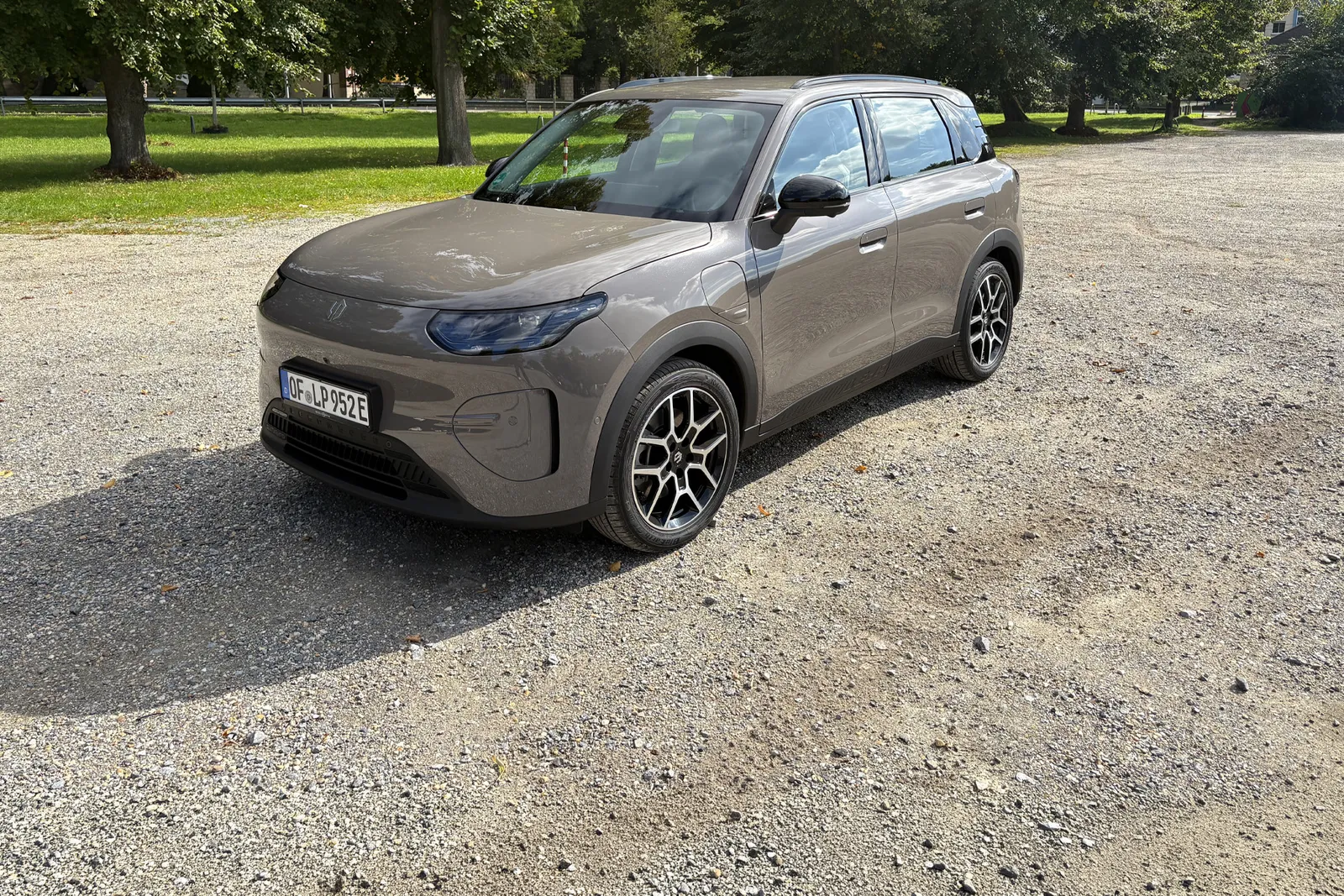
Leapmotor has only been active in Europe for two years, but the brand is gaining significant momentum. In Germany, 12,558 all-electric Leapmotor vehicles were registered from January to August 2026 — already more than double the figure for the entire previous year. In terms of distribution, the manufacturer benefits from the Stellantis dealer network. Dedicated showrooms at selected partners, such as Fiat, Opel or Peugeot, have helped Leapmotor expand to over 1,020 locations across 36 European countries.
The model range is also growing. In addition to the T03 and C10, the compact SUV B10 (our driving report here) and the electric fastback saloon B05 have joined the line-up. The B03X now fills the gap between the T03 city car and the two larger B models. Pre-sales began in July. During national test drives around Düsseldorf, I was able to test two examples, both equipped with the larger battery.
Powerful motor, light steering
Both versions of the B03X are powered by a permanently excited synchronous motor on the front axle, delivering 200 Nm of torque. Both batteries use LFP cells integrated directly into the vehicle structure using the cell-to-chassis principle. Leapmotor calls this CTC 2.0 Plus. The Pro, with a 39.8 kWh energy capacity, delivers 130 kW, while the ProMax, with 53 kWh, provides 145 kW.
On paper, the two variants remain closely related. Both accelerate from 0 to 100 km/h in 8.6 seconds and are limited to 160 km/h. Up to 50 km/h, the lighter Pro (1,525 kg) even edges ahead slightly, reaching the mark in 3.8 seconds compared to the ProMax’s 3.9 seconds. The ProMax weighs in at 1,625 kg.
For responsiveness, the B03X offers three acceleration modes. According to the manual, the drivetrain responds gently in Comfort mode, linearly in Standard, and most strongly in Sport. Activating Sport mode also greets the driver with a short sound reminiscent of starting a combustion engine. But is this really necessary?
I mostly drove in Standard mode. Even then, the ProMax’s 145 kW was more than sufficient. During spirited acceleration, the front wheels’ grip even reached its limits. I wasn’t able to test the Pro, but since Leapmotor states it accelerates to 100 km/h just as quickly, its 130 kW should also be adequate for everyday use.
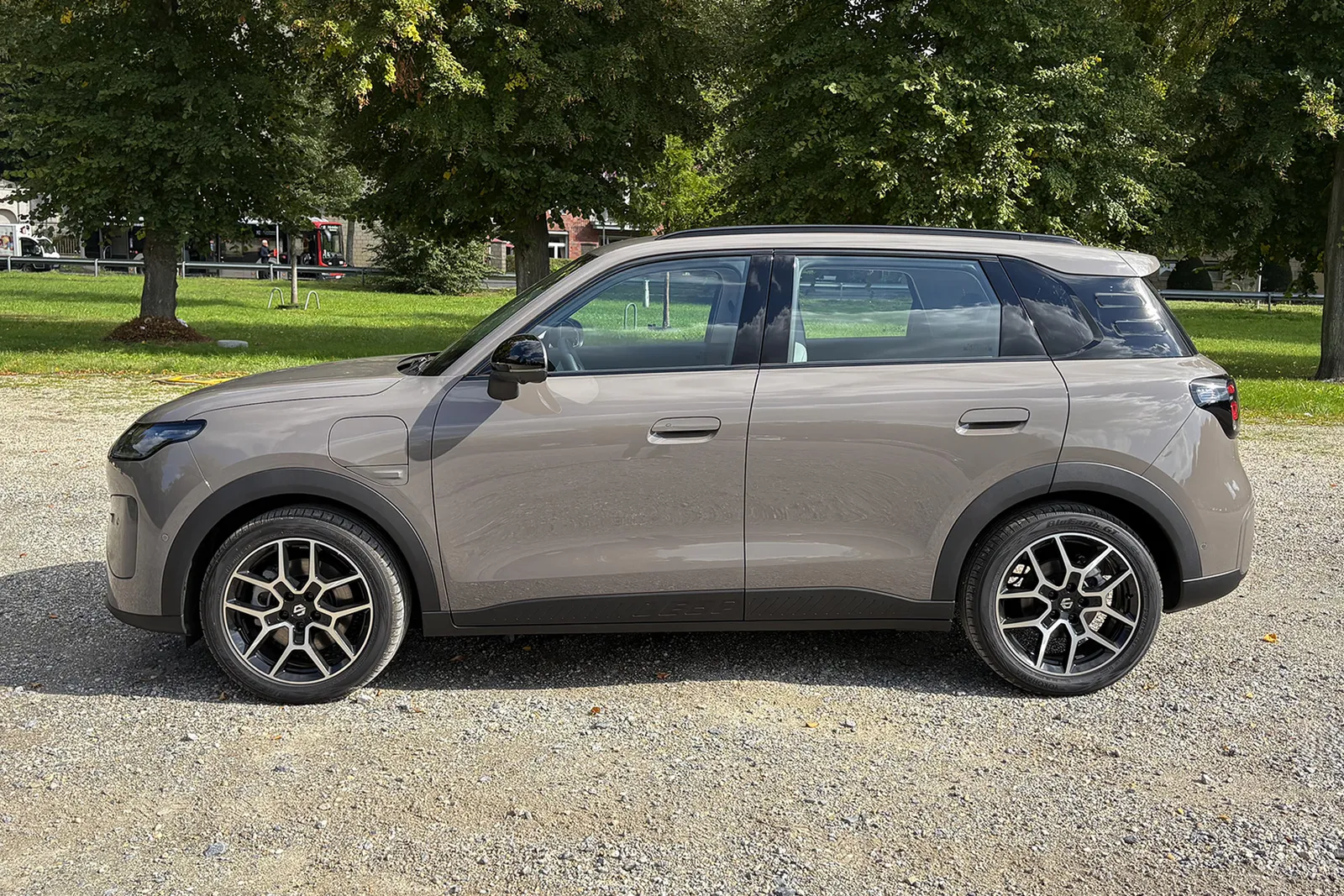
Image: Daniel Bönnighausen
- 1/7
- 2/7
- 3/7
- 4/7
- 5/7
- 6/7
- 7/7
The steering and regeneration can each be adjusted in three levels, independently of the driving mode. In Comfort mode, the steering is too light, while Standard adds barely any resistance. This still feels insufficient to me, especially since there’s almost no feedback from the road through the steering wheel. It’s only in Sport mode that the steering feels roughly how I’d expect it to in Standard mode.
The suspension, with MacPherson struts at the front and a multi-link axle at the rear, doesn’t smooth out every bump, but it does a decent job in the city and on country roads. The tuning, on the other hand, really isn’t sporty. Even at normal motorway speeds, the body doesn’t feel particularly stable. And during brisk cornering, the body leans noticeably to the side, and the front axle pushes outward over the front wheels.
Acoustically, the impression is similar. Up to around 100 km/h, the cabin remains pleasantly quiet, but from approximately 110 to 115 km/h, wind noise becomes more noticeable. Conversations are still easy, though the B03X could benefit from better sound insulation at higher speeds.
Consumption and range
Leapmotor states a WLTP range of up to 292 kilometres for the Pro with 39.8 kWh and up to 382 kilometres for the ProMax with 53 kWh. This places the B03X behind several competitors. The VW ID. Cross achieves up to 427 kilometres with 52 kWh, while the Škoda Epiq, with the same battery size, manages up to 441 kilometres. The Ford Puma Gen-E reaches up to 417 kilometres with 46.8 kWh, and the Peugeot e-2008 achieves up to 405 kilometres with 51 kWh. Even with smaller batteries, some rivals perform better: the Kia EV2 offers up to 317 kilometres with 42.2 kWh, and the Škoda Epiq 40 delivers up to 310 kilometres with 37 kWh.
VW, Škoda, Ford and Peugeot specify the usable energy content, while Leapmotor and Kia provide the gross value. Leapmotor does not disclose how much of the 53 kWh in the ProMax is actually usable. This doesn’t change the range gap, but it does make it harder to assess how efficiently the B03X uses its energy.
There’s no doubt that my test drives around Düsseldorf took place under favourable conditions, with plenty of sunshine and temperatures around 21°C. After a route through the city and on country roads with only a small motorway portion, the ProMax’s onboard computer showed 13 kWh/100 km. Those who drive only in the city and on country roads may achieve even better figures. On two routes with mostly motorway driving, consumption was around 17 kWh/100 km. Under these conditions, ranges between 300 and 380 kilometres are possible. More precise assessments will require a comprehensive test.
Fast charging, cumbersome planning
On paper, the B03X performs well in charging. The Pro accepts up to 100 kW at a fast charger, while the ProMax supports up to 133 kW. Both batteries are said to charge from 10 to 80 per cent in 21 minutes. While the maximum charging power is merely average, the charging times are not.
The VW ID. Cross takes 24 minutes for 10 to 80 per cent, according to the manufacturer, while the Ford Puma Gen-E requires 26 minutes. For the Peugeot e-2008, the charging process from 20 to 80 per cent alone takes 35 minutes. By comparison, the B03X is therefore well-positioned based on the manufacturer’s figures.
At an AC charging station, the B03X charges as standard with three-phase 11 kW. Charging from 30 to 80 per cent takes around two and a half hours with the smaller battery and just over three hours with the larger one. A heat pump and V2L function are also standard, which is not a given in this price range.
The route to the fast charger is less convincing. The navigation system currently does not offer intelligent charging planning that automatically integrates necessary stops into a route. It only indicates where the battery would theoretically be empty and where a charging stop would make sense. The driver must then select the appropriate station themselves.
On my test route, the system presented a list of charging stations along the way. At least it can be filtered to show CCS charging points with over 100 kW, but the filter must be reset for each new route planning, and there are no further options. After adding a stop, the navigation displays the remaining range upon arrival in kilometres without showing the percentage charge level prediction.
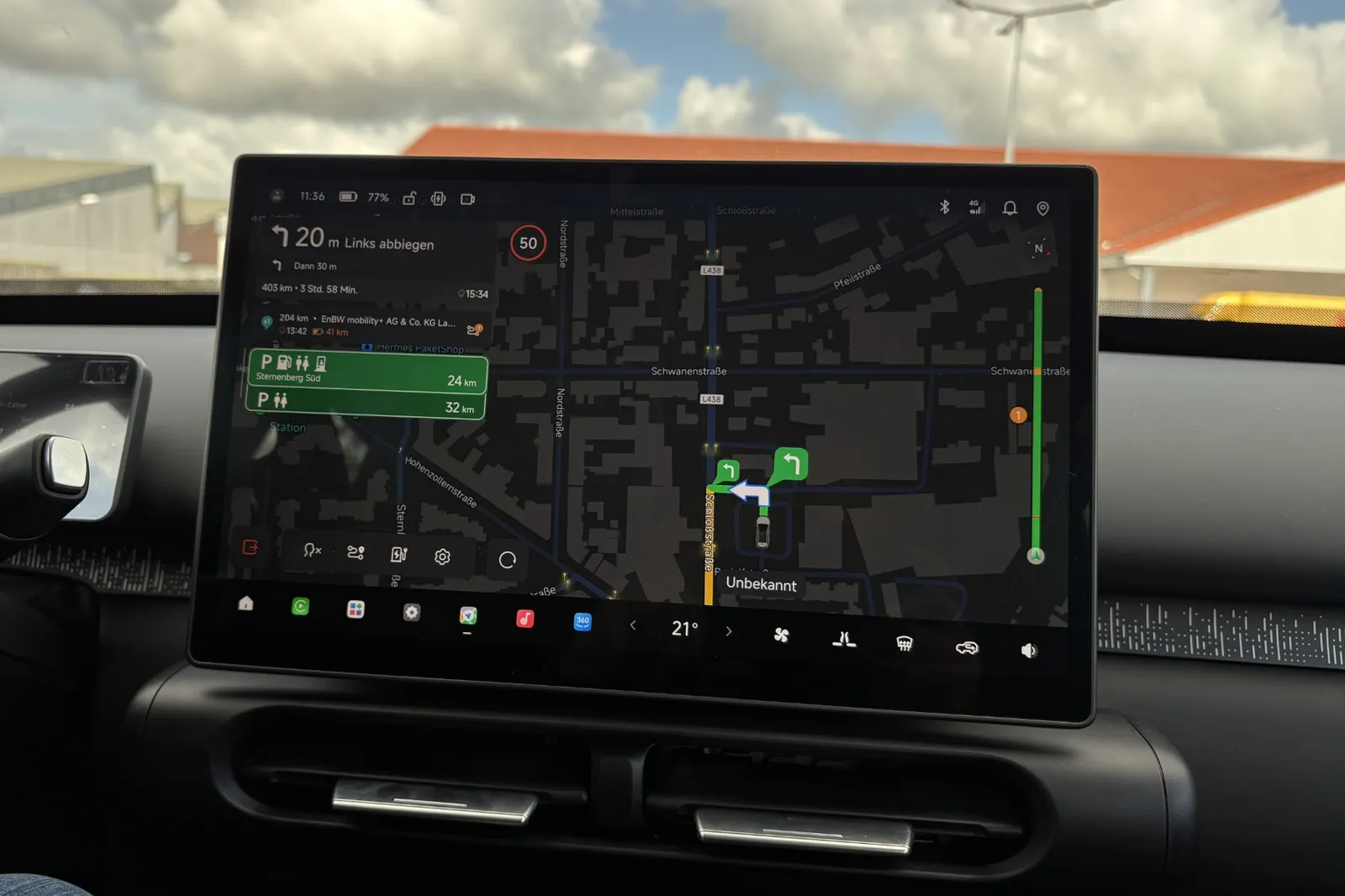
Image: Daniel Bönnighausen
- 1/8
- 2/8
- 3/8
- 4/8
- 5/8
- 6/8
- 7/8
- 8/8
Pre-conditioning also requires manual effort. While the battery can be prepared for fast charging via the app and infotainment system, the vehicle does not automatically do this before a charging stop selected in the navigation—whether as a main or intermediate destination — according to Leapmotor.
Those missing a full-fledged charging planner can turn to their smartphone. Apple CarPlay and Android Auto are standard in both trim levels and work wirelessly. Using the appropriate apps, routes including charging stops can be planned more effectively, even if the apps usually do not automatically know the B03X’s current charge level.
Digital cockpit with quirks
Apple CarPlay and Android Auto are displayed on the 14.6-inch touchscreen that dominates the cockpit. There’s also an 8.8-inch driver information display. Both are pin-sharp, but the range of functions remains limited.
The 360-degree camera, standard on the ProMax, is also impressive. It can render the vehicle transparent down to the wheels, and, together with the tight turning circle of 10 metres, makes manoeuvring easier. Less successful are the small rotary wheels on the steering wheel, which must also be operated sideways for some functions. This isn’t immediately intuitive. The same applies to the window lift switches, whose operation logic sometimes works in the opposite direction to what you’d expect.
The B03X is generously equipped with driver assistance systems. Even the base version includes 21 systems, from adaptive cruise control with lane centring and a traffic jam assistant to fatigue detection. In everyday use, however, these systems often make their presence known acoustically, and it’s not always immediately clear what the car is objecting to. That said, you’re not entirely at the mercy of the warning tones. A quick-access bar at the top of the screen allows you to disable speed or distraction warnings with a tap, and a freely assignable steering wheel button bundles driving mode, regeneration and assistance systems in one menu.
Ample space for passengers
One of the B03X’s greatest strengths is its spaciousness. This isn’t so much due to its length—at 4,270 mm, the B03X is only 12 cm longer than the VW ID. Cross, and both have almost identical wheelbases (2,605 mm and 2,601 mm). The Peugeot e-2008 shares the same wheelbase and, at 4.30 metres, is only about 3 cm longer. However, the B03X is significantly taller and slightly wider than both.
Passengers benefit the most from this spaciousness. Up front, there’s plenty of comfort and space on both sides, for the legs and above the head. The rear is even more surprising. Despite being 1.90 metres tall, I still had space for my knees and head when I tried out the back seats, and my feet fit comfortably under the front seats. While there are three seats, the rear bench is realistically better suited for two adults and one child.
The so-called Leap Flex Seats (previously known as Magic Seats) enhance everyday practicality: the rear seat bases can be folded upwards like in a cinema, creating space behind the front seats for tall or bulky items.
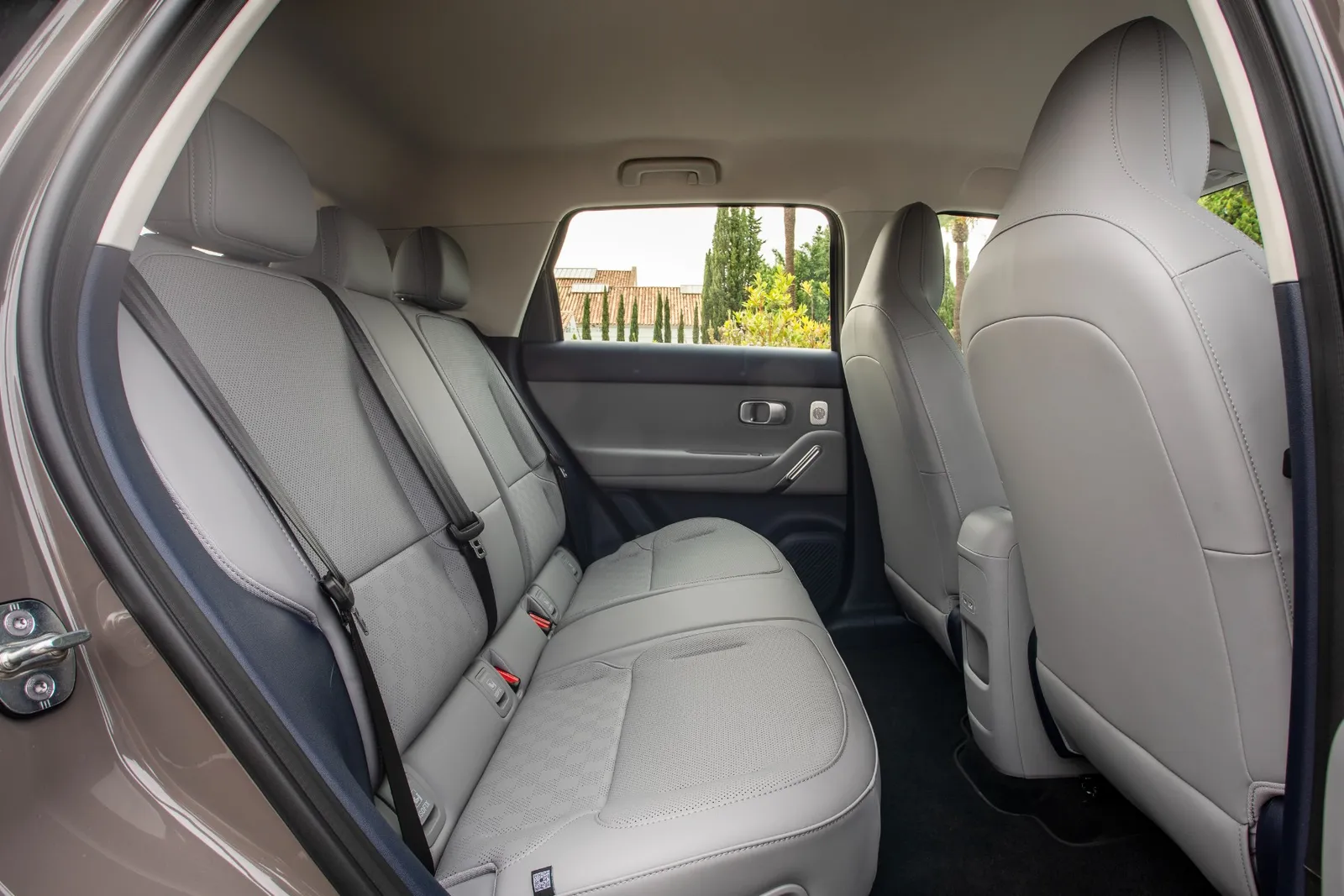
Image: Leapmotor
- 1/7
- 2/7
- 3/7
- 4/7
- 5/7
- 6/7
- 7/7
The generous space is mostly trimmed with plastic. While many areas have a thin, softer surface layer, there’s little in the way of proper padding. The visual impression also depends heavily on the interior trim, and the two-tone, light interior of my second test car looked far more appealing than the all-black version of the first. Still, this doesn’t change much about the material quality.
The boot, on the other hand, only benefits from the dimensions to a limited extent. At 407 litres, it’s not small, and with the rear seatbacks folded down, it offers up to 1,358 litres to the roof. Both figures already include the so-called Leap Box. It used to be called the Giga Box — and the name was fitting: lifting the load floor, which can be locked at two heights, reveals a 105-litre washable compartment. Still, competitors offer more: the shorter ID. Cross provides 475 litres, the e-2008 offers 434 litres, and the Ford Puma Gen-E, including its underfloor compartment, delivers 523 litres.
There’s no frunk, and Leapmotor has not yet specified a towing capacity — only plans for a coupling for a bike rack. The competition is already ahead here, as the VW ID. Cross and Škoda Epiq can tow up to 1.2 tonnes when braked, while the Ford Puma Gen-E and Kia EV2 manage 750 kg, with the Kia even achieving this with the smaller battery.
Extensive standard equipment, minimal surcharges
Leapmotor offers the B03X in two fixed configurations. The Pro Life with the smaller battery costs €25,400, while the ProMax Design with the larger battery is priced at €29,900. The only extra-cost option is a metallic paint finish for €650.
Some competitors have list prices only slightly higher, but the difference lies in the details. Many features that come as standard in the B03X cost extra elsewhere or aren’t available at all. For the Škoda Epiq 35, priced at €25,900, the heat pump costs an additional €950. The Kia EV2, starting at €26,600, is not available with a heat pump or V2L function in its base version and only has four seats.
The VW ID. Cross and Ford Puma Gen-E are significantly more expensive. The slightly shorter ID. Cross currently has a regular price of €36,525 with the larger battery. The similarly sized Puma Gen-E starts at a minimum of €36,900. Even with the larger battery, the Epiq starts at a minimum of €32,100, which is above the B03X ProMax Design.
The Geely E2 (our driving report here) is noticeably cheaper. With a 35.4 kWh battery, it costs €19,990 and offers a WLTP range of 252 kilometres; with a 47.1 kWh battery, it’s €23,990 and achieves 345 kilometres. Even the larger version is thus cheaper than the B03X Pro, which, with 39.8 kWh, manages 292 kilometres. However, the E2 only delivers 60 kW or 85 kW and charges at a maximum of 60 kW or 80 kW. Leapmotor’s actual response to the E2 is yet to come: in China, the A05 fastback saloon competes against it, and it is expected to launch in Europe as the B03. When this will happen is not yet confirmed.
| | B03X Life | B03X Design |
| --- | --- | --- |
| Drive | FWD | FWD |
| Power | 130 kW | 145 kW |
| Torque | 200 Nm | 200 Nm |
| Acceleration | 8.6 s | 8.6 s |
| Top Speed | 160 km/h | 160 km/h |
| WLTP Range | 292 km | 382 km |
| Battery Capacity | 39.8 kWh | 53 kWh |
| DC Charging Power | 100 kW | 133 kW |
| DC Charging Time 10-80% | 21 min | 21 min |
| AC Charging Power | 11 kW | 11 kW |
| AC Charging Time 30-100% | 2:30 h | 3:10 h |
| Price | €25,400 | €29,900 |
The comparison with the Opel Frontera Electric is particularly interesting. At 4.39 metres, it is about 11 cm longer but fits well within the B03X’s battery and space offerings. With the smaller battery, it starts at €29,340, and with the larger one, at €33,040. The base version only includes a manual air-conditioning system, and a heat pump isn’t even listed in the price list. Since Leapmotor uses the Stellantis dealer network, both models will often be found in the same dealership. The same applies to the Peugeot e-2008, which starts at €40,700.
The closest competition comes from within Leapmotor’s own line-up. The B10, which is about 25 cm longer, costs €30,400 with a 56.2 kWh battery, delivers 160 kW and charges at up to 140 kW. So, for those looking to spend around €30,000, there are at least two models to choose from within the brand—for now.
Conclusion
The Leapmotor B03X is, above all, a pragmatic electric car. For €25,400 or €29,900, it offers its passengers an unusually large amount of space for its vehicle class, along with comprehensive standard equipment. Practical features like the Leap Flex Seats and the large Leap Box, a more than adequately powerful drivetrain, and decent consumption further enhance its appeal. Whether the manufacturer’s claimed short charging times hold up in practice remains to be seen in a comprehensive test.
On the downside, there’s a limited range and a lack of refinement. The steering is too light in Comfort and Standard modes, the charging planning requires a lot of manual effort, the frequent warning tones can be annoying, and the materials reflect the price point. Some issues can be mitigated, such as by using the Sport steering setting and the quick-access bar for warnings.
The B03X shines where space, everyday practicality and a low price are more important than high-quality materials or convenient charging planning. This applies to families as well as fleets. Those who frequently drive long distances, however, should take a closer look. So, while it offers plenty of space, Leapmotor still has room for improvement when it comes to refinement.
