
Daimler Buses edges closer to the battery-electric coach with its ELCH Project
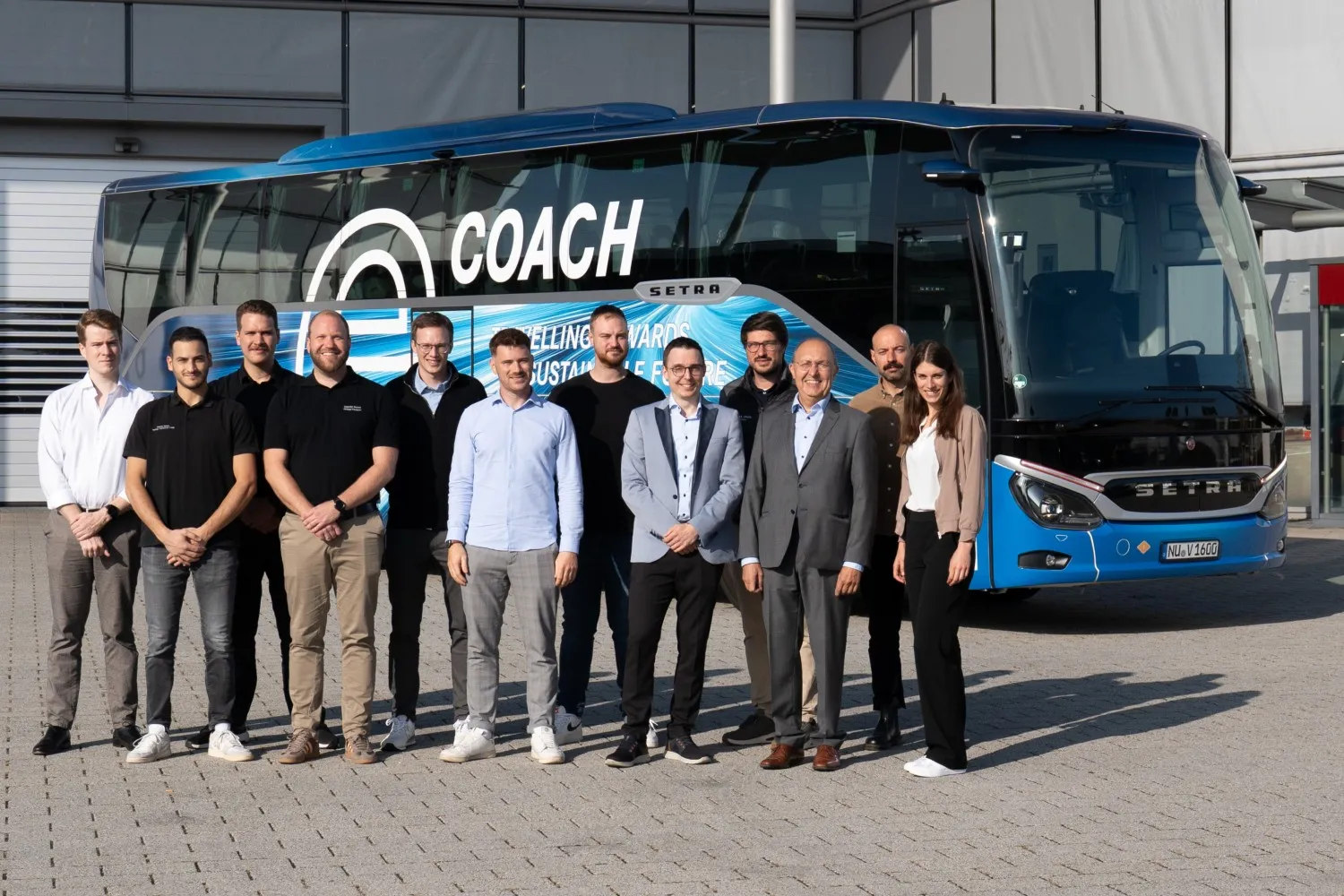
The partners in the Electrified Coach (ELCH) funding project have reached a milestone: When the team led by Daimler Buses met in the German district of Neu-Ulm, they conducted a test drive with the jointly developed technology demonstrator that can travel more than 500 kilometers. The funding project will continue until the end of 2026.
Image: Daimler Truck
In a few years, Daimler Buses aims to offer fully battery-electric coaches under its Mercedes-Benz and Setra brands. To accelerate development, Daimler Buses joined forces with research institutes and industry practitioners in 2022 to form the Electrified Coach project, commonly abbreviated as ELCH. From the outset, the goal of this government-funded project has been to develop a modular powertrain. The insights gained from building the analogue demonstration vehicles should provide the foundation for future series-production electric coaches.
In its latest announcement, Daimler Buses confirms that with its project partners, it has advanced the development and validation of a market-ready battery-electric coach concept. “In addition to the powertrain and battery, we are also focusing on topics such as energy consumption, aerodynamics, lightweight design, economic viability, and practical usability in long-distance travel,” states the Stuttgart-based company. “The project’s findings provide an important basis for the further electrification of the coach segment at Daimler Buses.”
The joint test drive in Neu-Ulm served to test and validate the technical concepts under real-world conditions. Furthermore, the project partners used the meeting to discuss the progress made so far and coordinate the next steps toward the project’s conclusion.
Daimler Buses is coordinating the funded project with renowned research and industry partners. The consortium includes the Karlsruhe Institute of Technology (KIT, Institute ITIV), the University of Mannheim (MISES), the Rhineland-Palatinate Technical University of Kaiserslautern-Landau (RPTU) with its institutes iMAD and SAM, and Flix SE.
KIT contributes its expertise in vehicle data analysis and processing to the project, working on optimising the operating strategy for the electric coach. Researchers at RPTU are exploring potential improvements in lightweight design and aerodynamics to further enhance energy efficiency and range. MISES primarily assesses the economic viability of battery-electric coach concepts for various use cases and analyses their competitiveness. Flix, for its part, provides real-world operational and usage data from long-distance bus services and supports the development of practical application and driving cycles.
Daimler Truck says the project makes an important contribution to Daimler Buses’ electrification strategy. The goal is to offer battery-electric coaches by the end of the decade. The truck and bus maker says the findings from the project provide an important foundation for the further development of corresponding vehicle concepts and technologies.