
BYD has announced a battery submerged in liquid. It is an energy storage device, not a car
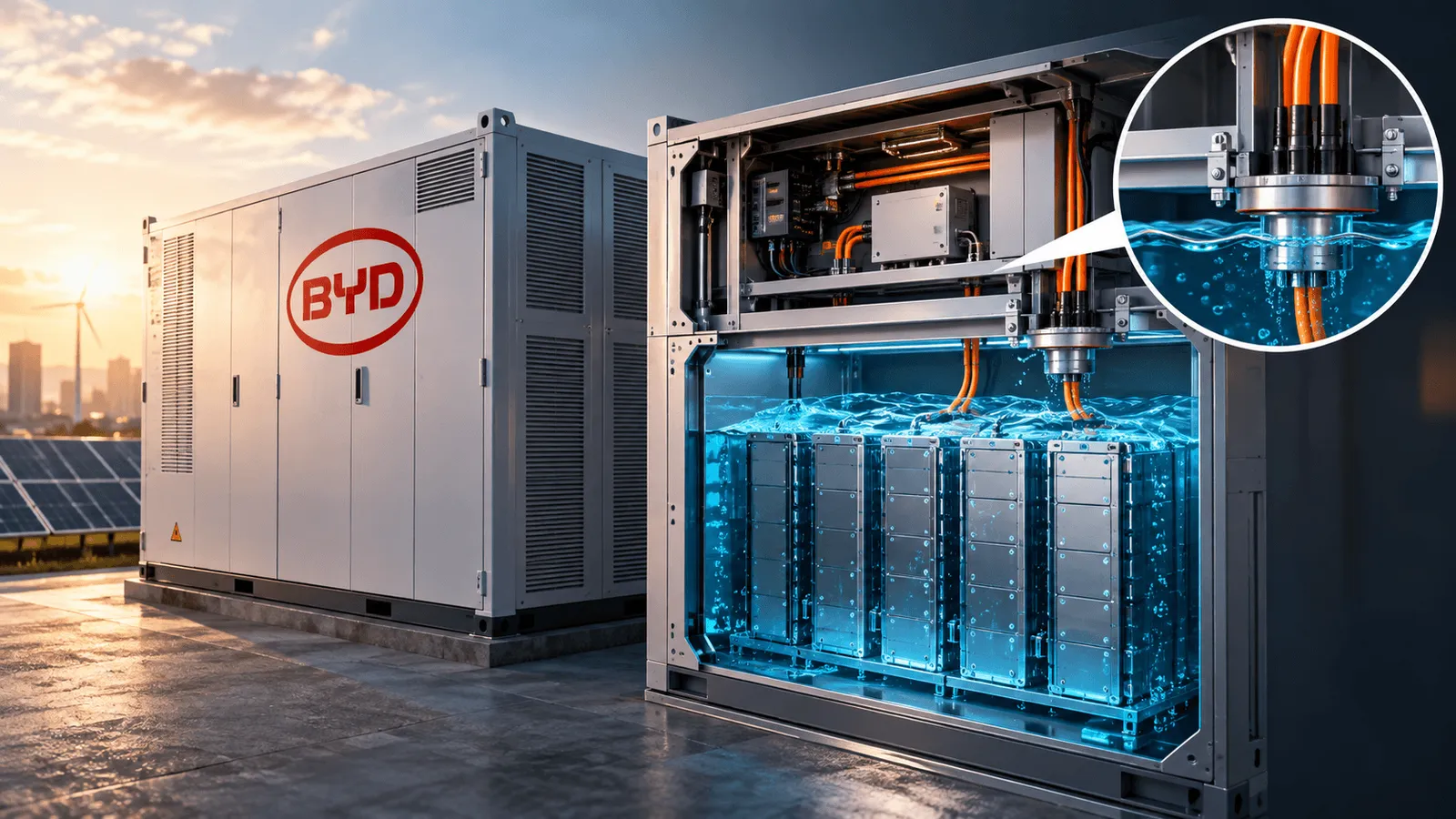
The Chinese patent office CNIPA published BYD’s application on October 5, 2026, regarding a battery cabinet with modules immersed in a dielectric fluid. Document CN 122868832 A describes two separate chambers and the method for routing wires between the wet and dry sections.
The application was filed in March 2025. It pertains not to a new power battery for passenger cars but to a stationary energy storage system.
Battery modules operating directly in fluid
In a typical liquid cooling system, the fluid flows through aluminum plates placed next to the modules. Heat must pass through the cell casing, intermediate materials, before reaching the coolant.
BYD proposes immersion cooling. The modules are placed directly in a non-conductive dielectric fluid that can flow over their surfaces. The document mentions fluids based on hydrocarbons or esters. This shortens the path from the heat source to the coolant, but another issue arises: how to remove electrical and signal wires from the flooded chamber without compromising sealing.
The solution is a housing divided into two parts. The upper, dry chamber contains the electrical components. The lower part holds the battery modules submerged in the fluid. The connections do not pass through the floor or the lower part of the side walls but are directed upward toward the dry chamber before leading to the dry section.
This placement of the seal is not arbitrary. Hydrostatic pressure increases with depth, so a fitting located higher experiences less pressure than an identical connection at the bottom of the tank. The patent focuses on this boundary between fluid and electronics, rather than just heat removal.
Today’s BYD and CATL systems cool batteries indirectly
The solution described differs from the designs already offered by China’s leading manufacturers. BYD’s MC Cube energy storage system uses Blade batteries and a cell-to-system architecture, while the MC Cube-T variant features liquid cooling. However, the fluid does not directly surround entire modules.
The CATL EnerOne and EnerC systems look similar, with cooling plates located outside the modules. The CATL Qilin automotive battery uses a different arrangement. The cooling plate is part of a multifunctional layer placed between adjacent cells. It remains a controlled cooling channel rather than the battery being submerged in fluid.
The announcement does not confirm production has begun. The document is undergoing technical review, and BYD has not announced plans to commercialize this design. There is also no information about its use in vehicles. For now, it is an idea for an energy storage cabinet and a specific solution to one of the most challenging issues in submerged cooling.
LovEV Newsletter
Want more content like this?
Sign up — we’ll send you a weekly summary once the newsletter starts.
