
BVG relies on the depot management system from IVU Traffic Technologies.
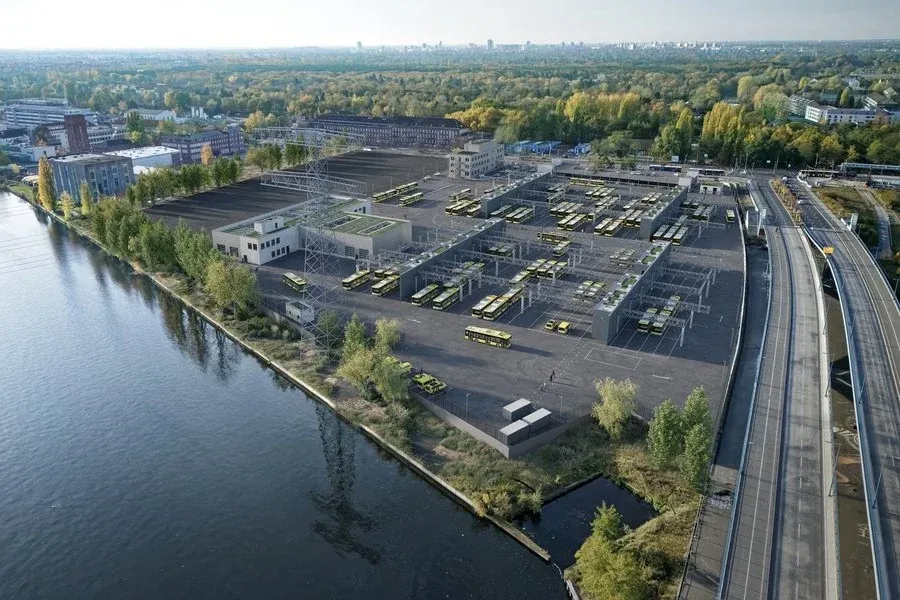
The Berliner Verkehrsbetriebe (BVG) is using a management system from IVU Traffic Technologies to operate its new electric bus depots in Marienfelde and Treptow-Köpenick. Both depots are scheduled to open in 2027 and will accommodate a total of 440 electric buses.
The future electric bus depot in Treptow-Köpenick.
Image: BVG
IVU Traffic Technologies states in a release that it will assist BVG in digitizing its future electric bus depots in Marienfelde and Treptow-Köpenick. The corresponding contract for the future control system was awarded recently. The agreement covers the use of the IVU.suite software solution for depot management, enabling BVG to digitize and control its operations—including charging and load management for the entire bus fleet.
The goal is to implement an automated system that optimizes vehicle deployment and scheduling, charging processes, and maintenance intervals. The solution is also intended to create a unified data platform for communication among dispatchers, mechanics, and drivers.
"We are very pleased to continue our long-standing cooperation with BVG in managing the depots for the new locations as well," says Dr. Hanna Schachel, head of Public Transport at IVU Traffic Technologies. "With these new electric bus depots, BVG is creating a solid foundation to reliably expand electric bus services in Berlin. Our system helps ensure that vehicles, charging infrastructure, and operational processes are seamlessly integrated at the new depots."
Background: Berlin’s transportation authorities are simultaneously building two new electric bus depots. The depot on Säntisstraße in Marienfelde held its foundation-laying ceremony in March, while the second construction project in Treptow reached this same stage three months earlier.
In Marienfelde, the depot is being built starting from summer 2025 on a site covering approximately 6.6 hectares. This project involves a facility designed entirely for electric bus operations, where around 220 electric buses are set to be stationed soon. Completion is planned for next year, as is the opening of Berlin’s second new electric bus depot on the Spree River in Treptow. With these two new depots, BVG will create the necessary capacity for the southern and southeastern parts of the city. Together, both locations will provide space for around 440 electric vehicles—nearly a third of the future electric bus fleet.
Alongside the construction of two new depots, BVG is also advancing the development of bus charging infrastructure within the city area—primarily through pantograph charging stations at up to 20 terminal stops. The idea behind this is simple: buses can charge there during regular service without having to return to the depot for charging. While most routes can operate daily without intermediate charging, as the number of battery packs in the buses (and thus their range) is typically adjusted to match the planned routes, situations may arise during service where the battery level drops below expectations. In such cases, the charging stations at terminal stops can help replenish sufficient power during the time the bus is there. For some particularly long routes, charging stops are also planned from the start—these too could become unnecessary in the future.
will take place along the route.Meanwhile, the electrification of BVG’s fleet is progressing as well: As an intermediate step, the operator aims to have around 500 electric buses in service by 2027. BVG has since relaxed its originally set goal of complete electrification by 2030; officials have been referring to the 2030s for some time now, and HVO is also planned to be used as a fuel temporarily. BVG CEO Falk specifically expects battery-electric buses to account for 80 or 90 percent of the Berlin transportation system by 2035, with HVO100 made from waste and residual materials seen as an option for the remaining 10 to 20 percent. This marks a shift away from BVG’s earlier, more ambitious goals. A similar relaxation of electric bus targets—at least in terms of timing—has also occurred in Hamburg recently.