
Charging stations: only 29% of French people consider the network sufficient
France now has over 200,000 charging stations open to the public. Yet, according to a new survey conducted by YouGov for Alphabet France, only 29% of French people believe that current infrastructure allows for 100% electric mobility. Confidence is growing, but disparities between generations and regions remain significant.
The French charging network has never been more developed. Charging stations are increasing, fast-charging hubs are becoming common along major roads, and electric vehicles are growing in number on our highways.
Only 29% of French People Convinced
Yet a significant portion of the French population continues to doubt whether infrastructure can meet their needs. This is what a new survey conducted by YouGov for Alphabet France among 1,001 people on September 17 and 18, 2026, reveals. The first finding of this study is that only 29% of French people believe the charging infrastructure currently in place allows for fully electric mobility. In other words, 71% of those surveyed disagree with this statement.
Looking at the bigger picture, it can still be said that things are moving in the right direction. This proportion was 23% in 2024 and rose to 25% in 2025. Thus, confidence has increased by six points over two years. This is an encouraging trend, but it remains relatively modest compared to the development of infrastructure.
As of the end of August 2026, France had 200,926 public charging points according to Avere-France figures, an increase of 13% from the previous year. These numbers show that deployment is continuing. Yet they clearly aren’t enough to reassure everyone. It should be noted that the presence of a charging station doesn’t necessarily guarantee a reliable charging experience suitable for all types of trips.
Youngers are much more confident than older adults
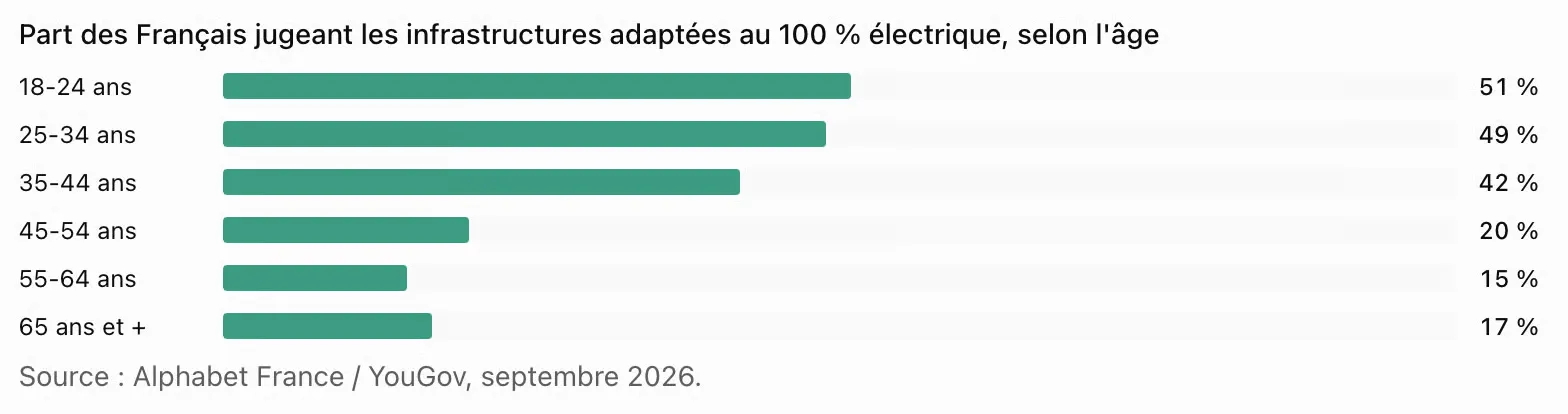
The study also highlights a significant generational gap. Among those aged 18–24, 51% of respondents believe the charging network makes it possible to drive exclusively on electricity. This figure drops to 49% among those aged 25–34 and 42% among those aged 35–44.
Also read
This small French town became the hub for fast charging this summer
After 45 years, confidence plummets. It drops to 20% among those aged 45–54, and further to just 15% among those aged 55–64. People over 65 are only slightly more optimistic, with 17% holding favorable views. How can such a gap be explained? The study’s authors cite, among other factors, younger generations’ greater familiarity with new technologies and emerging mobility trends. This is a plausible hypothesis, though the survey does not allow for pinpointing the exact reasons behind these differences.
Men are surprisingly more confident than women. 35% of men and 24% of women consider the network to be suitable. Nevertheless, progress is evident in both groups compared to 2025.
Charging: A Matter of Region?
The size of the urban area also plays an important role. In cities with more than 100,000 inhabitants, 37% of respondents believe the infrastructure is sufficient for a fully electric transition. This figure drops to 28% in urban areas with 20,000 to 100,000 inhabitants and to 20% in those with fewer than 20,000 inhabitants. A 17-point gap that illustrates the differences in perception across regions. The good news is that confidence is rising everywhere. It increased by five points in one year in urban areas with fewer than 20,000 inhabitants, compared to two points in larger cities.
This survey is interesting, but it only measures French people’s perceptions, not the actual capacity of the network to meet their needs. It also does not distinguish between drivers who have home charging solutions and those who rely on public chargers. In short, the challenge is no longer just about installing more charging points. It is also necessary to make the network clearer, more accessible, and more reliable in order to convince drivers who are still hesitant to give up internal combustion engines.