
Plugless electric buses: their tires handle recharging them during the journey
11/10/2026 09:00
Updated to
11/10/2026 09:00
A Swiss company founded by ETH Zürich is developing an unconventional method for charging electric buses: transferring electricity from a plate installed on the road surface to coils built into specially designed tires. Winduction claims to have achieved a transfer efficiency of over 90% and aims to use the regular stops along a route to conduct small charges during service. The outcome could be particularly interesting: using much smaller batteries, reducing weight, and lowering both the cost of purchasing buses and the power requirements in depots.
The idea stems from a well-known issue in urban electric transportation. Many buses require high-capacity batteries because they must store almost all the energy they will use during the day overnight.
This results in more weight, higher costs, and high-power chargers that concentrate electrical demand in bus depots.
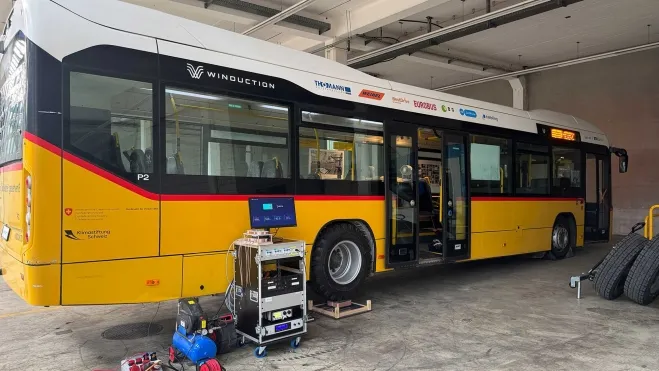
Winduction proposes spreading charging out throughout the day.
The distance between the road and the bus is the problem. Wireless induction charging is not new; it typically uses a coil buried in the ground and another installed under the vehicle.
The problem is the separation between the two. The greater the distance, the more difficult it is to transfer energy efficiently.
Winduction’s engineers found a seemingly simple solution: the part of the vehicle that is always in contact with the ground is the wheel.
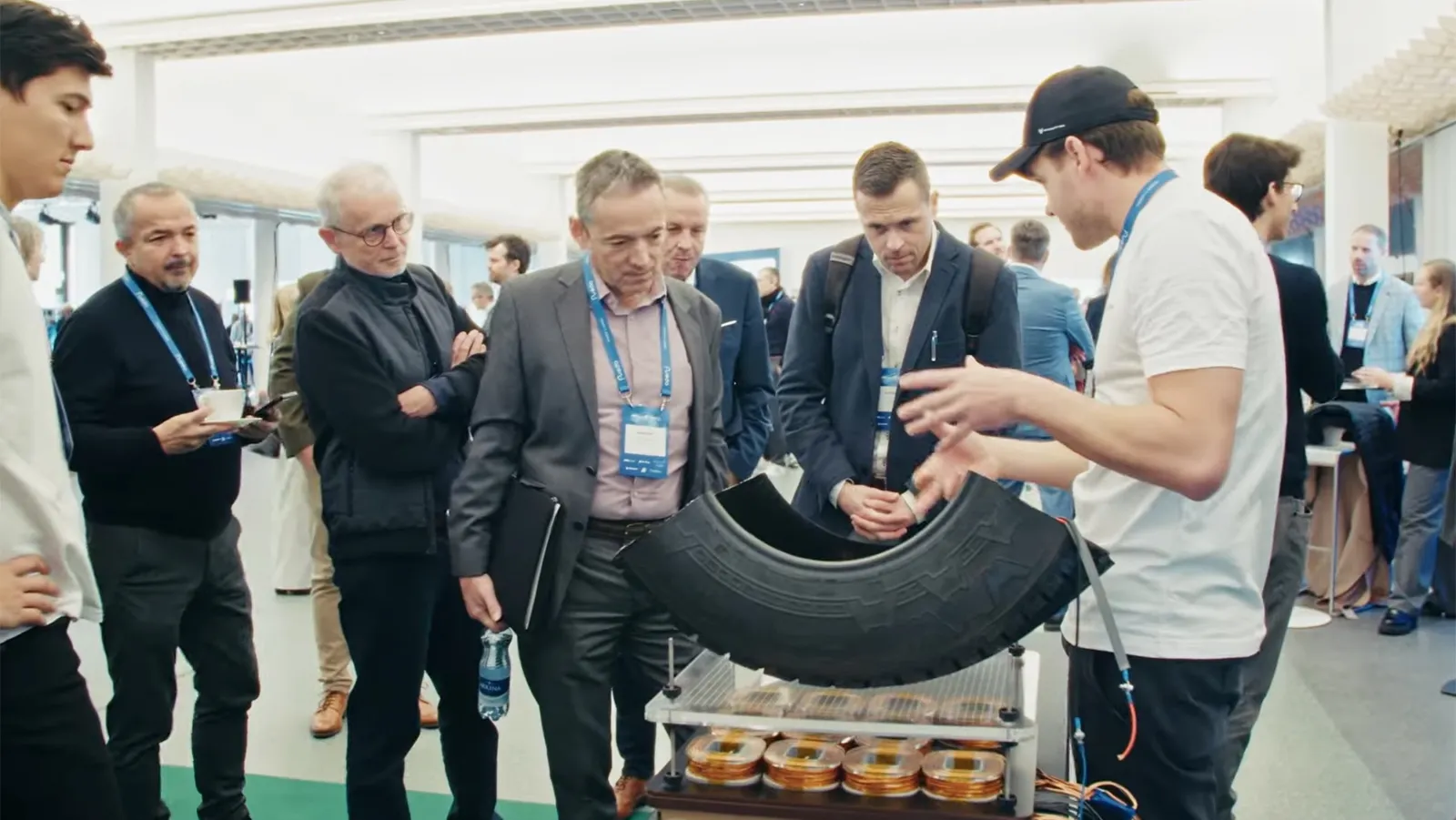
Their system installs the transmitting coils on a plate integrated into the road surface and places the receivers inside a specially designed tire. When the bus stops on the plate, the magnetic field allows electricity to be transferred to the vehicle and ultimately to its battery.
The company claims that the efficiency from the ground to the vehicle exceeds 90%, meaning less than 10% of the input energy is lost during transfer.
They even had to reinvent the tire
However, there is an unexpected challenge. Conventional bus tires use steel belts to provide structural strength. This metal would react with the magnetic field and convert a significant portion of the energy into heat.
That’s why Winduction is working with its partners on a steel-free tire specifically designed for this system.
This is one of the elements that still needs to prove durability, safety, and economic viability before considering large-scale commercial use.
Smaller batteries because the bus charges while in operation
The real advantage lies in daily operation.
Winduction has studied a route between Zurich Airport and Oerlikon as an example. According to its calculations, it would only be necessary to install panels at two of the 24 stops, accumulating about three hours of charging over a 16-hour day.
Instead of waiting until night to charge a large battery, the bus would replenish energy at specific points along the route.
This would allow for the use of less battery, reduced weight, and a more even distribution of electrical demand throughout the day. It could also decrease the need to keep backup vehicles idle while others are charging.
The first test with passengers is set for 2028
For now, this is still a developing technology, not a commercially deployed system.
Winduction is building testing facilities in Winterthur and working to integrate all components into a fully transformed bus.
The goal is to carry out the first pilot project under real conditions by 2028, likely in the area around Zurich Airport, transporting passengers.
The proposal offers an interesting possibility for electric transportation: perhaps the solution to increasing a bus’s range isn’t to install more batteries, but to enable it to recover energy while making exactly the same stops it used to make.