
“Auto-Paket”: France is likely to follow Germany in relaxing CO2 targets
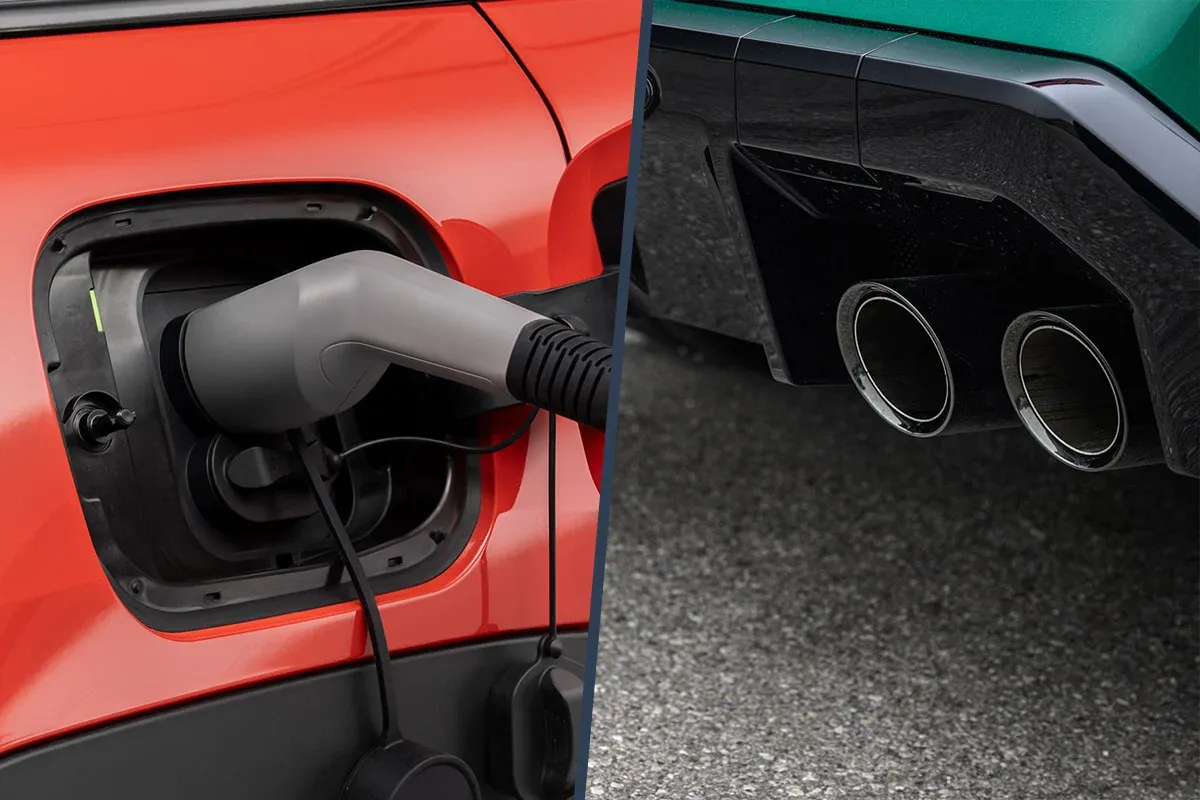
Germany’s Chancellor Friedrich Merz and France’s President Emmanuel Macron appear to have agreed on a position that could soften the EU’s phase-out of internal combustion engines. In return, Germany would accommodate France on the so-called “Buy European” requirements.
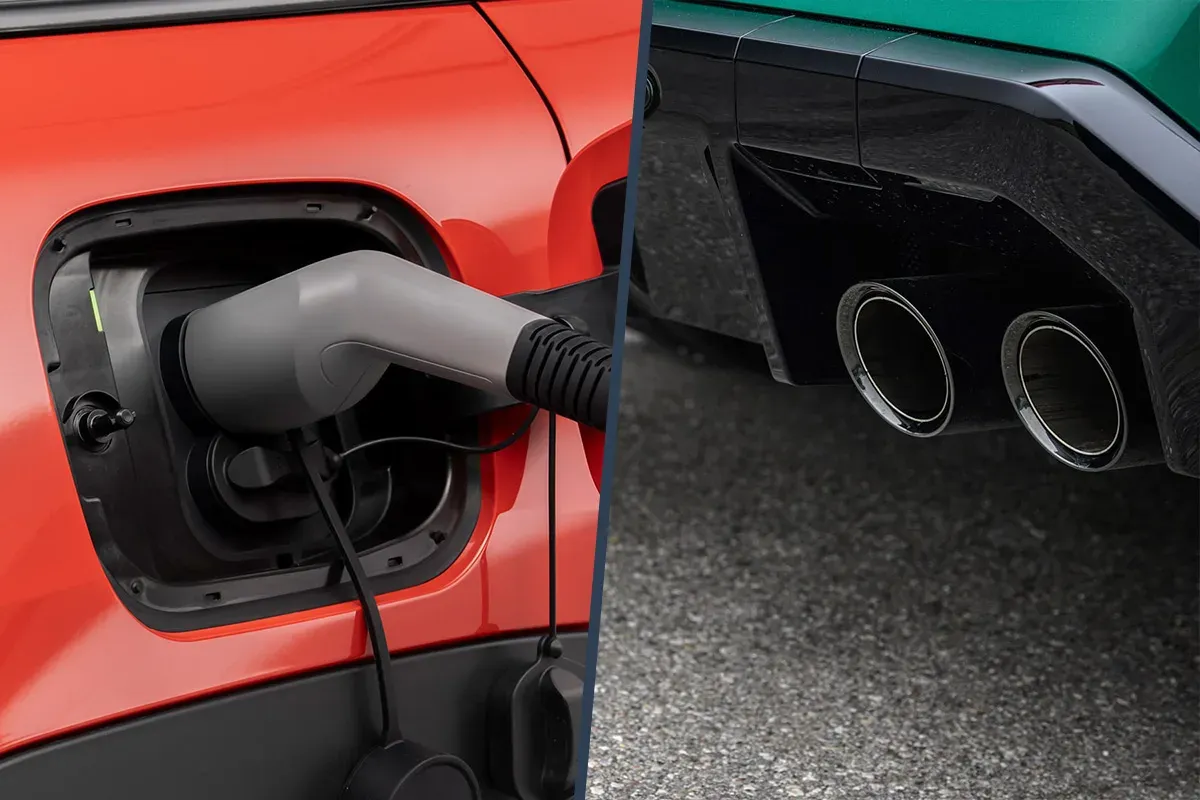
Images: BMW / Editing: electrive
The FAZ and Handelsblatt report this in agreement. Macron is reportedly giving up his resistance to relaxing EU fleet size limits for cars. In return, Merz is shifting from his previously defensive stance against overly strict “Made in EU” requirements. They have reached an agreement on the general outlines, but further details are still under negotiation, according to EU diplomats.
To provide context: The EU Commission responded to warnings from the automotive industry at the end of 2025 with its “Auto Package,” stating that sticking to a de facto ban on new gasoline vehicles by 2035 would exacerbate the industry’s crisis. This move was also made under pressure from Germany. The Commission’s proposal sets a new CO2 fleet target of a 90 percent reduction compared to 2021, which equates to an CO2 emissions level of 11 grams per kilometer—instead of zero grams. The Commission no longer specifies a date for the 100 percent target, assuming this means that after 2035, 27 to 29 percent of new registrations will still have internal combustion engines.
Important: The focus of legislation is always on the CO2 fleet average, which refers to the average CO2 emissions in grams per kilometer that newly registered vehicles from a manufacturer in the EU must not exceed on average. If OEMs fail to meet these increasingly stringent requirements, they face fines. The Commission’s draft is set to be approved by the European Parliament soon.
A classic compromise: give and take
France and Germany have previously held different positions on key aspects of the “Auto Package” – but now seem to have moved closer at the highest level. Chancellor Merz and President Macron each concede on one main issue in exchange for support on another core concern. France is said to be willing to help relax CO2 fleet limits even beyond what the Commission has proposed. In return, Germany agrees to compromise on the planned Industrial Accelerator Act (IAA) and support stricter “Made-in-Europe” rules than originally intended.
The “Handelsblatt” also provides clues about how far the two countries intend to go: “Germany and France are calling for an additional reduction of ten percentage points without compensation. With compensation options, the reduction could theoretically reach at least 80 percent. Automakers would have more flexibility: they would be able to sell significantly more vehicles with internal combustion engines than under the current Brussels plans.”
This position goes beyond the Commission’s proposal.
The background is that while the commission wants to allow manufacturers to reduce CO2 emissions by only 90 percent by 2035, according to the current draft, they would need to make up for the remaining 10 percent through low-CO2 European steel, as well as e-fuels and biofuels. This is where it becomes clear how much further Merz’s and Macron’s positions diverge.
In addition, the interim target for 2030 is also set to be part of the alleged German-French agreement. Under current EU law, new cars must reduce their CO2 emissions by 55% by 2030 compared to 2021 levels. The Commission aims to allow greater flexibility while not undermining the goal entirely. Merz and Macron now want to further extend this flexibility, changing the proposed period from three years to five years between 2028 and 2032, in order to avoid heavy fines.
France is now likely to receive German support in exchange for strict “Made in EU” requirements for the automotive industry. To date, Berlin has adopted a more moderate approach that aimed to include trading partners such as Turkey, Vietnam, and Morocco. However, Paris wants the new industry rules to be strict, though an exception might be made for the United Kingdom.
Voting in Parliament is Approaching
If the deal between the two largest economies is finalized, it could significantly influence further proceedings in relevant bodies. Just last week, the Transport Committee of the European Parliament postponed a key vote on the “Auto Package.” The voting was originally scheduled for October 5. However, Der Spiegel reported, citing the office of MEP Jens Gieseke (CDU) and a spokesperson for the largest group, the EVP, that this date has been delayed—by roughly two weeks. The reason is said to be that parties within the so-called Center Platform apparently still need time to reach an agreement. A plenary vote is currently planned for November.
To pass the package, the European Parliament must approve it first (where the EPP is the largest faction), and the member states in the EU Council must also give their approval. A simple majority is sufficient in the European Parliament, but a so-called “qualified majority” is required in the EU Council. Therefore, approval from at least 15 countries that together account for at least 65 percent of the EU’s population is needed.
During the consultation process, various interest groups may attempt to modify the draft in their favor. Against this backdrop, the “auto package” was intended by the Commission to be broad from the outset, so as to offer benefits to as many countries as possible. As is known, in addition to Germany, six other EU countries (all with a relatively low share of electric vehicles among their new registrations) advocated for weakening the CO2 targets and supporting internal combustion engines. However, it now appears that France, a previous opponent of this policy, has switched sides.
Let’s take another look at the “Auto-Paket” in its basic form as presented at the end of 2025: The Commission’s approach is to slightly relax the CO2 targets as described above, thereby allowing not only the sale of plug-in hybrids and vehicles with range extenders beyond 2035 but also that of mild hybrids and conventional internal combustion engines. However, there’s a major caveat right away: The Commission ties this relaxation to certain conditions.
Firstly: According to the commissioners, the CO2 emissions still produced by new internal combustion engines after 2035 must be offset as mentioned above. A credit system is planned, under which manufacturers must balance out the internal combustion engines, plug-in hybrids, and range extenders they sell after 2035—through things like green steel from the European Union in their vehicles or climate-neutral fuels such as biofuels or the controversial e-fuels. Up to three percent of the 2021 reference target (or in other words, 30 percent of the emissions still allowed) can be credited through clean fuels, while for green steel it is 7 percent of the reference target or 70 percent of the emissions still allowed.
It is unclear, however, exactly how strict these requirements will be in practice. Whether an automaker can actually use green steel in its cars and power them with E-fuels by 2035 depends heavily on the availability of green steel and those clean fuels in 2035, as well as their costs. And on who can afford such vehicles after 2035.
Small electric cars will be favored
The details become clearer on other points: So-called “Super Credits” are intended to give special support to small and affordable electric vehicles. Electric cars shorter than 4.20 meters should therefore carry more weight in calculating a manufacturer’s fleet emissions. In practical terms, a sold ID. Polo would not count as one vehicle in VW’s fleet emissions calculation but rather as 1.3 vehicles. “This will create incentives for the introduction of more small electric vehicle models,” the commission said in December. This proposal is thought to originate from Spain and France. Both countries had already advocated in the fall for maintaining the 2035 CO2 target with only slight additional flexibility and prefer to promote electric vehicles through measures like Super Credits.
As with the CO2 regulation starting in 2025, the path toward the adjusted 2035 target is also being made somewhat more flexible. Specifically, this refers to the previously fixed interim target for 2030, which is likely to be extended similar to the current regulation from 2025 to 2027. Instead of meeting fixed annual targets, manufacturers must achieve these interim goals over the period from 2030 to 2032 – if they still exceed them by 2030, it will not immediately result in penalty payments. There is also the option to offset any shortfall by making greater savings in subsequent years. Additionally, “extra flexibility will be granted to the truck segment, where acceptance of electric vehicles has been structurally more difficult, with the 2030 CO2 target being reduced from 50% to 40%,” according to the commission.
A new development is that the EU Commission intends to set specific requirements for the electrification of business vehicles for member states starting in 2030 – with different requirements for each country. Brussels wants to leave it up to the member states to determine how they implement these requirements. However, Belgium’s successful corporate vehicle taxation system serves as a model, having led to a sharp increase in electric car sales there.
New CO2 regulations also for electric trucks
The EU Commission also plans to allocate 1.5 billion euros for a “Battery Booster” aimed at accelerating the development of a “completely EU-made battery value chain.” A corresponding call for proposals was launched in July. The measures include interest-free loans for cell manufacturers and supportive policy actions. Not only in the battery sector but also across the entire automotive industry, bureaucratic requirements are set to be adjusted. This is intended to reduce administrative burdens on companies, with the Commission estimating annual savings of 706 million euros.
The commission also proposes a targeted amendment to the CO2 emission standards for heavy commercial vehicles, which would make it more flexible to meet the 2030 targets – though no specific figures have been given yet. “The targeted amendment allows manufacturers to accumulate more emission credits in the years leading up to 2030 than under the current regulations. While current rules only permit manufacturers to receive credits if their CO2 emissions are below a linear reduction pathway, the proposal would allow them to generate credits as soon as their CO2 emissions fall below their annual target,” the commission states in its draft.
“The future is electric.”
The background to all these adjustments and regulations is clear: the European automotive industry faces not only a major technological shift but also fierce competition of “unprecedented speed and scale,” as the EU states. “Therefore, it is extremely important to ensure the industry’s competitiveness and support it in transitioning to clean mobility and decarbonizing road transport.” The EU’s strategic dialogue with the automotive sector last year gave companies the opportunity to clarify their positions and needs in Brussels. As a result, the Commission has advanced the already agreed-upon review of the regulations by one year, offering the industry more flexibility. The Commission is deviating from its previous approach—but only slightly.
The package of measures is also referred to by the Commission as “the first industrial strategy for the automotive industry.” “It ensures climate, industrial, and economic coherence. It includes elements and prerequisites for a future-proof, clean, and competitive automotive sector and encourages manufacturers to continue investing in zero-emission vehicles,” reads a Q&A on the “Auto Package.” “It provides greater flexibility and technology neutrality regarding CO2 standards for passenger cars and light commercial vehicles, as well as targeted flexibility for heavy commercial vehicles to help us achieve our climate goals, and it supports the introduction of zero-emission and low-emission vehicles into company fleets. The future is electric.”
