
FSD becomes Tesla Assisted Driving: New name aims to enable EU approval
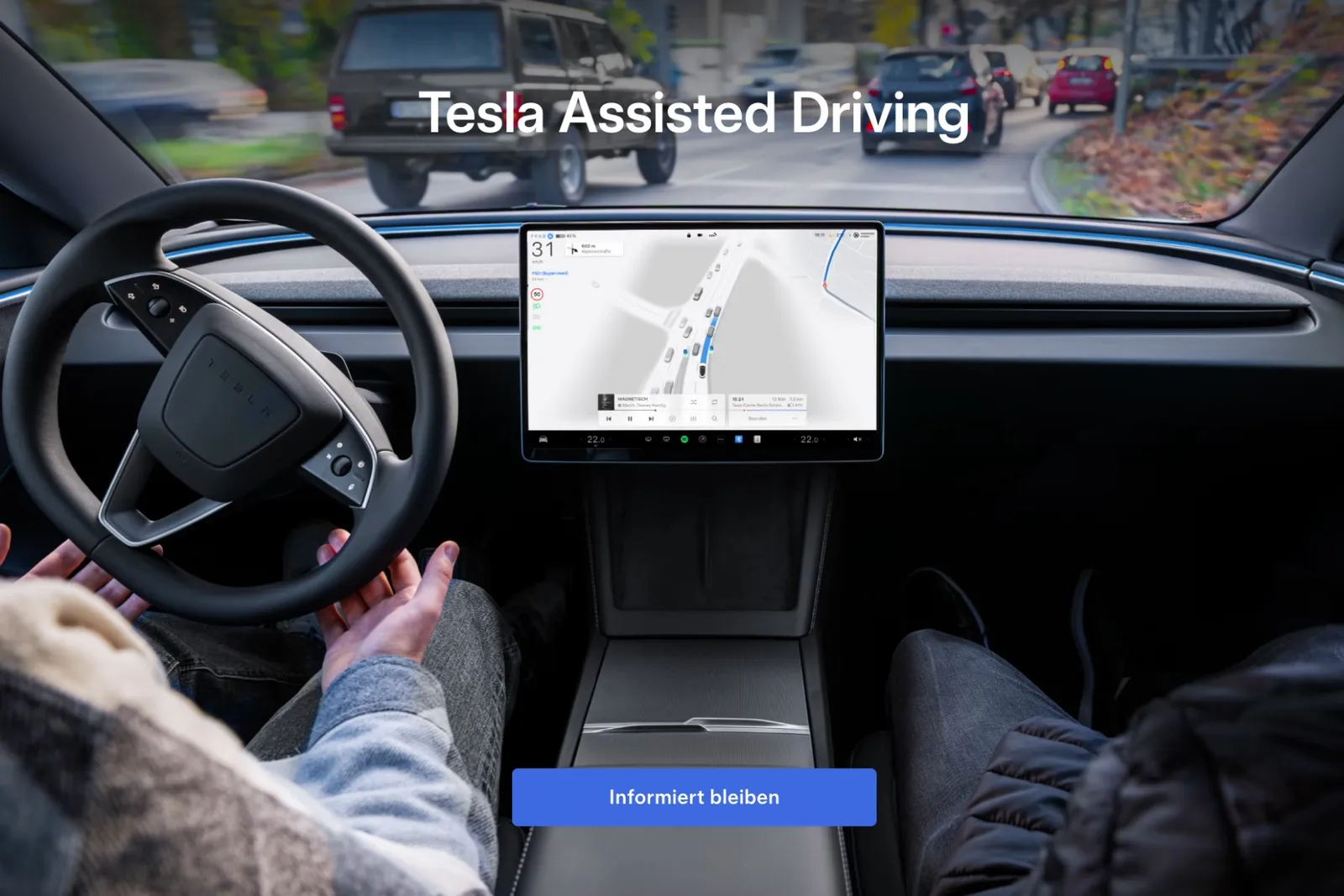
In its efforts to secure EU-wide approval for its Full Self Drive (Supervised) driver assistance system, also referred to as FSD (Supervised), Tesla has complied with a request by the German federal government: the system will now be renamed Tesla Assisted Driving. Transport Minister Steffen Bilger (CDU) had described the previous name as "misleading."
Image: Tesla
As is well known, Tesla has been striving for a pan-European approval for FSD (Supervised) for a long time. This system enables door-to-door autonomous driving, but the driver must remain ready to take control at any time. After FSD has been approved in North America, Australia, New Zealand, and South Korea for some time now, the first EU countries have also joined this list this year: the Netherlands took the lead in April, followed by Lithuania, Estonia, Denmark, Belgium, Slovenia, Czechia, and Croatia — and Slovakia has just announced its approval as well.
Currently, it is not a regular EU type approval but rather a provisional EU type approval under Article 39 of EU Regulation 2018/858, issued by the Dutch transportation authority RDW. This has been gradually recognized by the other mentioned countries as well.
Tesla, however, aims to obtain a pan-EU approval as soon as possible and does not want to seek recognition of the Dutch approval from each of the 27 member states individually. Therefore, a vote is expected in the EU’s Technical Committee on Motor Vehicles (TCMV) at the earliest opportunity — though it has already been postponed several times, most recently to December.
German Transport Minister as Catalyst
The reason for delaying the vote was the concerns of several countries that have not yet approved FSD — including Germany. In a notable move, however, Federal Transport Minister Steffen Bilger (CDU) spoke publicly about the matter last week.
Bilger said, “Currently, discussions are taking place at the European level regarding the approval of Tesla’s assistance system. Many technical issues need to be resolved, as well as questions related to liability. I discussed this with Tesla in September. We quickly reached a mutual understanding and arrived at a constructive agreement. Based on this, I will now work to ensure that the system is approved across Europe as soon as possible. My goal is to enable Tesla drivers to utilize the benefits of assisted driving throughout the EU at the earliest opportunity.”
The term “FSD” is misleading
One of Bilger’s conditions was to rename the driver assistance system, as the current name “FSD” is misleading. “It’s not a system that takes over all driving tasks. In fact, it’s a driver assistance system that can assist with certain driving functions such as accelerating, braking, and steering. The driver must remain vigilant at all times,” said the Ministry of Transport.
According to Bilger, Tesla offered to rename the system “Tesla Assisted Driving” and has now taken this step in Europe, though not worldwide. The Tesla website in Germany and many other European countries now uses this new name instead of FSD.
Large EU countries must agree
Since a qualified majority of at least 15 out of the 27 member states, representing at least 65 percent of the European Union’s population, is required for EU-wide approval, Germany’s support as the largest EU member state is extremely important to Tesla. The ties between the two parties have long been strong, as Tesla operates its only factory on European soil in Grünheide near Berlin, where it produces the Model Y, which comes equipped with Tesla Assisted Driving or features aimed at preparing for it.
Germany’s support for “Tesla Assisted Driving” could pave the way for the other three major EU countries—France, Italy, and Spain—to also agree to it. France had recently expressed criticism toward the system. However, if France continues to refuse its approval, Tesla will need to convince almost all other EU countries to support it.