
ACC announces five million battery cells ‘Made in France’
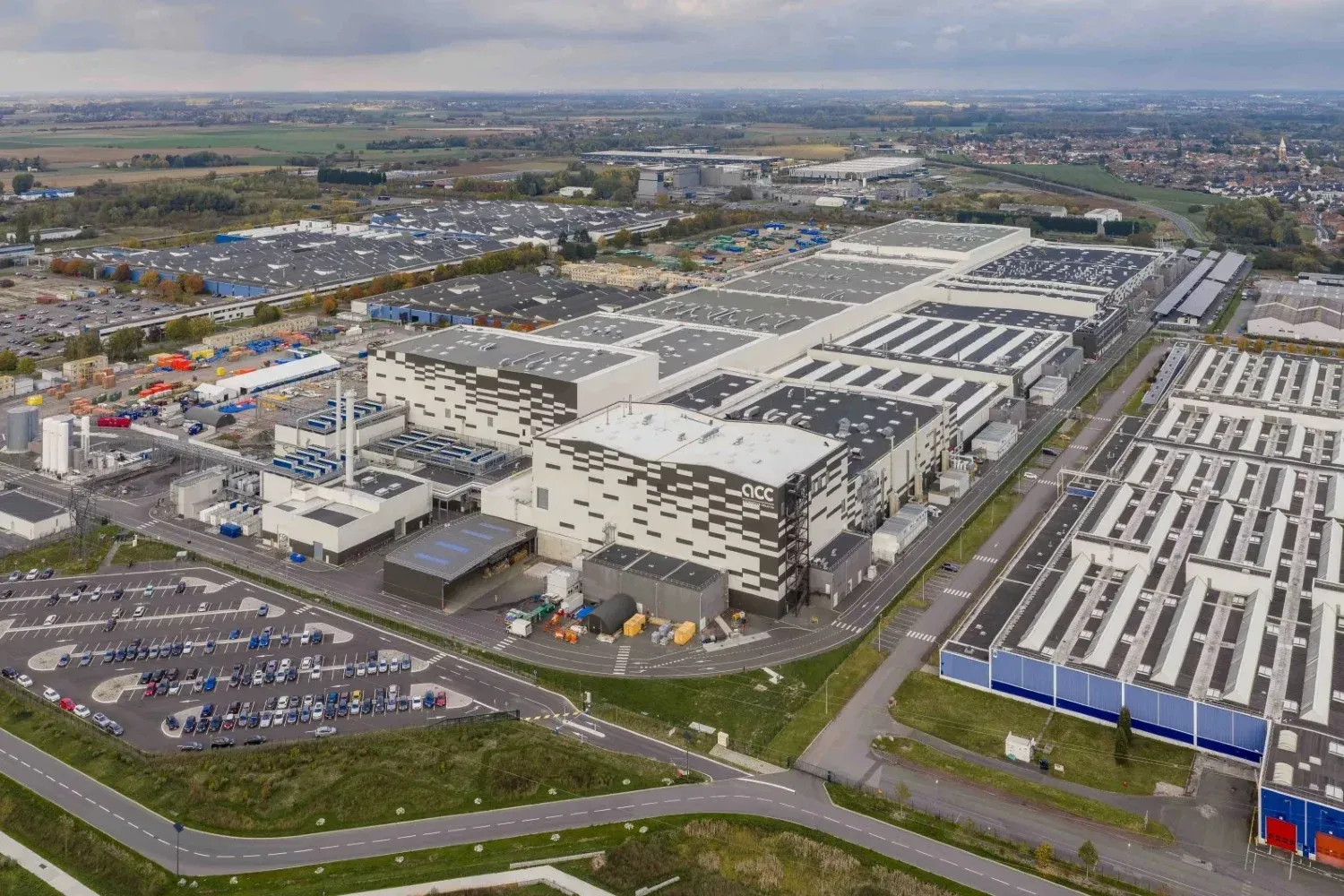
The Automotive Cells Company (ACC) battery joint venture between Stellantis, Mercedes, and TotalEnergies has announced producing its five-millionth cell at its factory in France. The plant's second production block, with a capacity of 12.9 GWh, is set to begin production in 2027.
Image: ACC
At the Paris Motor Show, ACC announced that its current cell output at the Douvrin site is enough to equip nearly 40,000 vehicles with its own battery cells. The joint venture also revealed plans to commission the second production block at the plant next year to manufacture batteries for Mercedes-Benz electric vehicles. This will increase the site’s capacity by 12.9 GWh from next year, bringing the total to just under 26 GWh. The final expansion stage currently envisages three production blocks with a combined manufacturing capacity of around 40 GWh.
Automotive Cells Company (ACC) is one of the few European manufacturers of battery cells and modules for electric vehicles. Founded in 2020, the company develops and produces batteries based on NMC chemistry. Its shareholders are Stellantis, Mercedes-Benz, and Saft, a subsidiary of TotalEnergies. ACC currently employs around 2,500 people in France, at its research and development centre and pilot plant in Nouvelle-Aquitaine, and in the Hauts-de-France metropolitan region where its gigafactory in Douvrin is located.
ACC batteries now in eight Stellantis EVs
Management emphasises that ACC has “grown significantly and its industrial maturity has evolved considerably” since the last motor show two years ago. The company’s cells and modules are now installed in eight premium electric car models, all marketed by the Stellantis Group. These include the Peugeot E-3008 and E-5008, Jeep Compass, Lancia Gamma, DS N° 7 and N° 8, Citroën C5 Aircross, and the Opel Grandland.
Allan Swan, CEO of ACC since May 2026, said: “Reaching 5 million cells produced in France is an important milestone for ACC and a clear demonstration of the progress achieved by our teams over the past years. It shows that Europe can develop and industrialise advanced battery technologies at scale.” Nevertheless, the challenge of competitiveness remains: “Europe must now ensure that its industrial ambitions are supported by a framework that enables battery manufacturing to compete on a level playing field. Only a competitive European offering will be able to meet the demand for ‘Made in the EU’ production,” Swan noted.
“Defect rates are approaching target levels”
This comes against the backdrop of the EU’s debated draft of the Industrial Accelerator Act (IAA)and its “Made in Europe” aspirations. Swan hopes for swift implementation of the IAA, which would “provide the necessary support to boost demand for batteries manufactured in Europe.” However, there are also voices expressing concerns that the EU industry may not even be able to meet its own battery demand.
Regardless of industrial policy guidelines, ACC still faces its own challenges, primarily the high defect rate in cell and module production. The company’s interim report states: “Defect rates are steadily approaching target levels.” It also notes: “ACC is successfully supplying Stellantis in accordance with the agreed production schedules.”
Stellantis struggles with battery shortages
This contrasts with reports from around two weeks ago, when _Reuters_ and the German trade publication _Handelsblatt_ reported at the end of September that Stellantis would temporarily halt production at its French plants in Sochaux, Rennes, and Mulhouse for at least one week each. In two cases, this was due to shortages in the supply of EV batteries from ACC.
However, the pause is only indirectly related to the shortage of ACC’s large nickel-based batteries. Stellantis primarily aims to avoid producing too many other vehicles “to prevent building up inventories that do not match customer demand,” as the company explained. After all, demand is particularly high for the long-range electric models (equipped with ACC batteries) for which customers currently face very long waiting periods.
The Sochaux plant in eastern France, which produces models such as the Peugeot 3008 and Peugeot 5008, is set to pause operations from 23 to 30 October. The Rennes factory, which manufactures the Citroën C5 Aircross among others, will close from 22 to 30 October. The previously announced production halt in Mulhouse from 15 to 30 October is said to have other reasons unrelated to battery shortages.
ACC’s supplies have been experiencing a tight bottleneck for Stellantis production for some time now. The joint venture originally planned to build three plants in France, Germany, and Italy but is now focusing on ramping up its only cell factory in Douvrin, France. The other two major projects were scrapped.
Ramp-up has proven challenging
As _Bloomberg_ reported in February, citing internal sources, operations in Douvrin have also faced difficulties. At the beginning of the year, ACC was reportedly only able to equip around 1,000 cars per month with long-range batteries, far below its original target. The joint venture is said to have subsequently brought in a team of experts from China to boost production and reduce high defect rates. In February, ACC also acknowledged fundamental issues: ACC Secretary-General Matthieu Hubert told _Bloomberg_ at the time that the ramp-up was proving challenging.
Stellantis uses the battery cells from ACC’s Douvrin plant in the aforementioned EVs based on the STLA Medium platform. For these vehicles with ACC cells, _Bloomberg_ already reported delivery delays of up to eight months in February.
Long-range models face very long delivery times
In April, a report by the German automotive trade publication _Automobilwoche_ followed, stating that private customers in particular are facing very long waits for their long-range models, specifically focusing on the Opel Grandland, Peugeot E-3008, and E-5008. A Stellantis dealer told the trade journal at the time that deliveries had been pushed back to the first or second quarter of 2027. Other dealers reportedly received no binding delivery dates at all.
The situation remains delicate for Stellantis brands. After all, it only affects customers willing to pay nearly €5,000 more for a larger battery with 97 kWh instead of 73 kWh capacity and the corresponding range increase, compared to the same model with a smaller battery.
Meanwhile, ACC is said to have reduced defect rates and further stabilised production. However, a Stellantis spokesperson told _Reuters_ that they are still not receiving enough batteries, even though ACC has made significant progress in production, in the context of the announced plant pauses. Demand for long-range models, particularly from fleet customers, remains high and continues to exceed current supply.