
500,000 tests and not a single bad battery. Aviloo shatters the biggest myth about “electricians”
In short:
Aviloo released the largest independent battery condition report in history for used vehicles
The analysis covered over 500,000 individual tests conducted between 2022 and 2026 across four continents
Contrary to popular belief, there are no “bad” batteries — according to this diagnostic company’s study
You’re buying cell chemistry and thermal management systems, not a logo on the hood — emphasizes Aviloo
The Hyundai Ioniq 5 with a 72.7 kWh battery performed best in the comparison
The model with this battery produced between 2021 and 2022 retained 97.26% SoH after 50,000 km
Aviloo: the technology works
According to Aviloo, the median state of health (SoH) for 20 popular models is 94.74% after 50,000 km and still around 91% after 150,000 km. These are figures that are hard to ignore, especially in light of the upcoming Euro 7 regulations. As the company notes, “the average shows that the technology works,” but it says nothing about a specific vehicle — which is why Aviloo emphasizes that an individual test remains “the cheapest form of due diligence in the used car market.”
Hyundai performs best in this comparison. The Ioniq 5 with a 72.7 kWh battery — analyzed in the version sold only from 2021 to 2022 — maintains 97.26% SoH after 50,000 km, 95.14% after 100,000 km, and 93.37% after 150,000 km. In practice, this means a drop in range from 335 km to just 327 km after another 50,000 km. It’s a result that’s hard to call degradation, right?
Volkswagen ID.4 and Tesla Model Y – two global bestsellers – complete their tests with almost identical results. The ID.4 with a 77 kWh battery achieves 95.41% after 50,000 km and 90.09% after 150,000 km, while the Model Y Long Range (78.8 kWh) reaches 94.54% and 90.05% respectively. As Aviloo points out, “different cells, different production continents, yet only a quarter-of-a-percentage difference.”
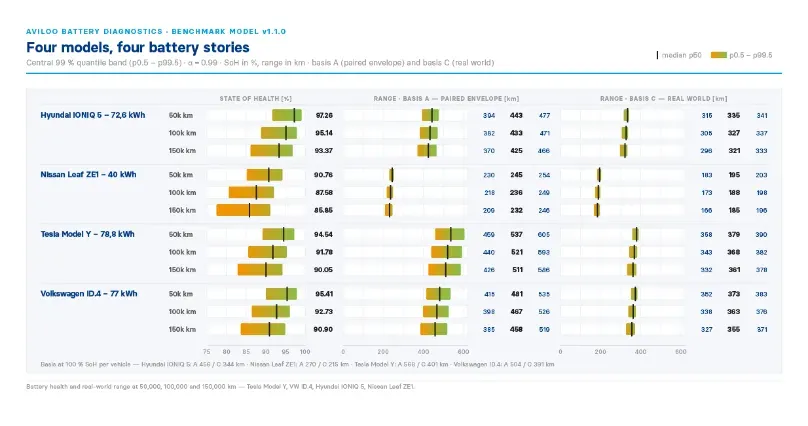
The only clear deviation from the norm is the Nissan Leaf ZE1 with an air-cooled 40 kWh battery. The SoH median drops from around 90 percent after 50,000 km to 85 percent after 150,000 km. Aviloo explains this as follows: “A smaller battery requires more full charge cycles, and the lack of liquid cooling accelerates degradation.” The range decreases from 196 km to 185 km. Similar trends are seen in the Renault Zoe and Mini Cooper SE—older models with smaller battery packs.
Brand doesn’t matter
The most interesting conclusion for buyers of used electric vehicles, however, is less dramatic: brand doesn’t matter. The Cupra Born performs identically to the Volkswagen ID.3, the ID.4 groups with the Audi Q4 e‑tron and Škoda Enyaq, while the Opel Corsa‑e is in the same category as the Peugeot e‑208. “You’re buying the cell chemistry and thermal management system, not the logo on the hood,” emphasizes Aviloo.
The report also shows that the industry already meets future Euro 7 requirements. The regulations set to take effect on November 29, 2026, require 80% of capacity to be maintained after 100,000 km and 72% after 160,000 km. Meanwhile, the worst-performing model in the study, the Leaf, is 13 points above this threshold, even with 10,000 km less mileage than specified by the regulations. “Euro 7 is not a standard the industry must reach – it describes where it already was in 2022,” reads the report.
However, something else is crucial: differences between units of the same model can reach 13.5 percentage points in SoH, which translates to as much as a 29 km difference in range. Therefore, Aviloo urges: “Don’t assume the condition of your battery – test it independently.”
Flash Aviloo Test
The company emphasizes that its three-minute FLASH test does not rely on reading data from the BMS (battery management system – note by editor), but rather on statistical analysis based on hundreds of thousands of real cases. “To provide the market with an honest, independent, and global view of how these batteries age,” says Marcus Berger, CEO of Aviloo. “Averages hide a lot.”
In 2026, Aviloo expanded its services to include battery warranties for used cars, based solely on independent diagnostic data. If a battery drops below the specified SoH threshold within one year and 20,000 kilometers, the customer receives up to 3,000 euros in compensation. The program is already operational in 12 European countries and is supported by major dealer groups as well as brands such as Mercedes-Benz, Volvo, and Porsche Holding.
Oskar Włostowski