
Infineon to invest €1.1 billion in Villach
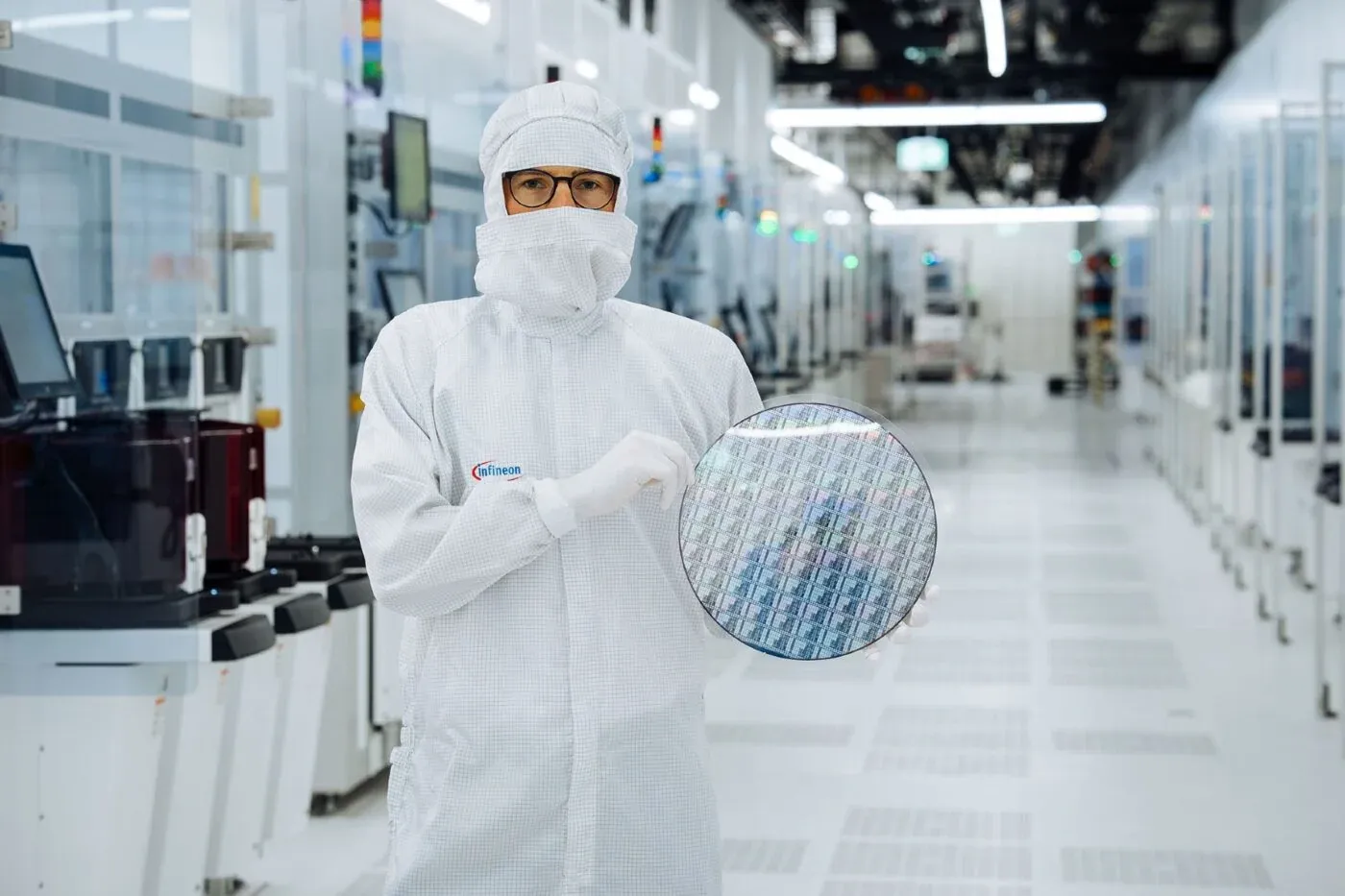
Villach, Austria is one of the most important locations for Infineon. The market leader in chip manufacturing has now established the world's first high-volume production of GaN power semiconductors on larger 300-mm wafers at its Austrian location. Production is set to start in 2027. By 2034, around 1.1 billion euros are expected to flow into the existing infrastructure in Villach.
Image: Infineon
Infineon, one of the world’s leading microchip manufacturers, achieved a breakthrough in the production of gallium nitride (GaN) power semiconductors in 2024. The German company’s success in transitioning GaN semiconductors from 200- to 300-millimetre wafers boosted its production volume by a factor of 2.3 and made it possible to establish high-volume manufacturing.
As a result, Infineon plans to invest around €1.1 billion in its Villach site in Austria by 2034. Utilising and modernising the existing cleanroom facilities that are essential for chip production will make the expansion of manufacturing capacities particularly efficient and cost-effective. Infineon Austria currently employs around 5,800 people, approximately 4,800 of whom work at the plant.
“This substantial investment shows our clear commitment to strengthening the European semiconductor ecosystem and Europe’s technological sovereignty. By establishing high-volume manufacturing on 300-millimetre wafers, we will be the first company in the world to bring gallium nitride power electronics into volume production,” said Jochen Hanebeck, CEO of Infineon Technologies AG.
Enormous market potential for GaN chips
The launch of high-volume production for next-generation gallium nitride (GaN) power semiconductors on 300-millimetre wafers is scheduled for the end of 2027. This will enable Infineon to meet the growing demand for energy-efficient components in future-oriented fields such as AI data centres, electric vehicles, renewable energy, robotics and consumer electronics.
The market potential is enormous. Industry analysts forecast an annual growth rate of around 35% for GaN power semiconductors between 2025 and 2031, reaching approximately US$3.5 billion. Gallium nitride switches and converts electricity far more efficiently than conventional silicon, making it possible to produce smaller, higher-performance systems with minimal energy losses and reduced heat generation.
Austrian Chancellor Christian Stocker said, “With Infineon’s billion-euro investment, we are witnessing one of the largest single investments in the history of Austria’s high-tech industry. This is not only a strong commitment to Austria as a business location but also helps ensure that the future of the semiconductor industry will not be shaped solely in Asia or the United States, but also in Austria and Europe.”
EU funding gives the project a boost
The project is supported by the European Chips Act. The European Commission has already approved state aid totalling €319 million. Formal funding approval from the Austrian Ministry of Economic Affairs is expected to follow on schedule.
The Austrian Economic Minister Wolfgang Hattmannsdorfer emphasised the project’s macroeconomic benefits: “Austria is already a leader in energy-efficient chips. Relative to our population, we rank first in the EU in business R&D spending in the semiconductor sector. With our industrial strategy, we intend to build on this lead and not only research new technologies but also manufacture them on an industrial scale. This benefits the entire economy: Statistically, every job in the chip industry can provide six additional jobs across the broader economy.”
Sabine Herlitschka, CEO of Infineon Technologies Austria AG, highlighted the importance of linking research and industry: “Competitiveness and technological sovereignty emerge where excellent research is translated into industrial value creation. This is precisely where our flagship project comes in: From Austria, we are bringing innovation into industrial application, strengthening our technological leadership and securing highly skilled jobs. Microelectronics is a key industry with enormous leverage for the economy and society. The entire Austrian semiconductor ecosystem benefits – from research organisations and universities to industrial partners. We are thus sustainably strengthening Europe’s competitiveness and strategic autonomy in microelectronics.”