
Second phase of electric mobility: Will the power grid become a bottleneck?
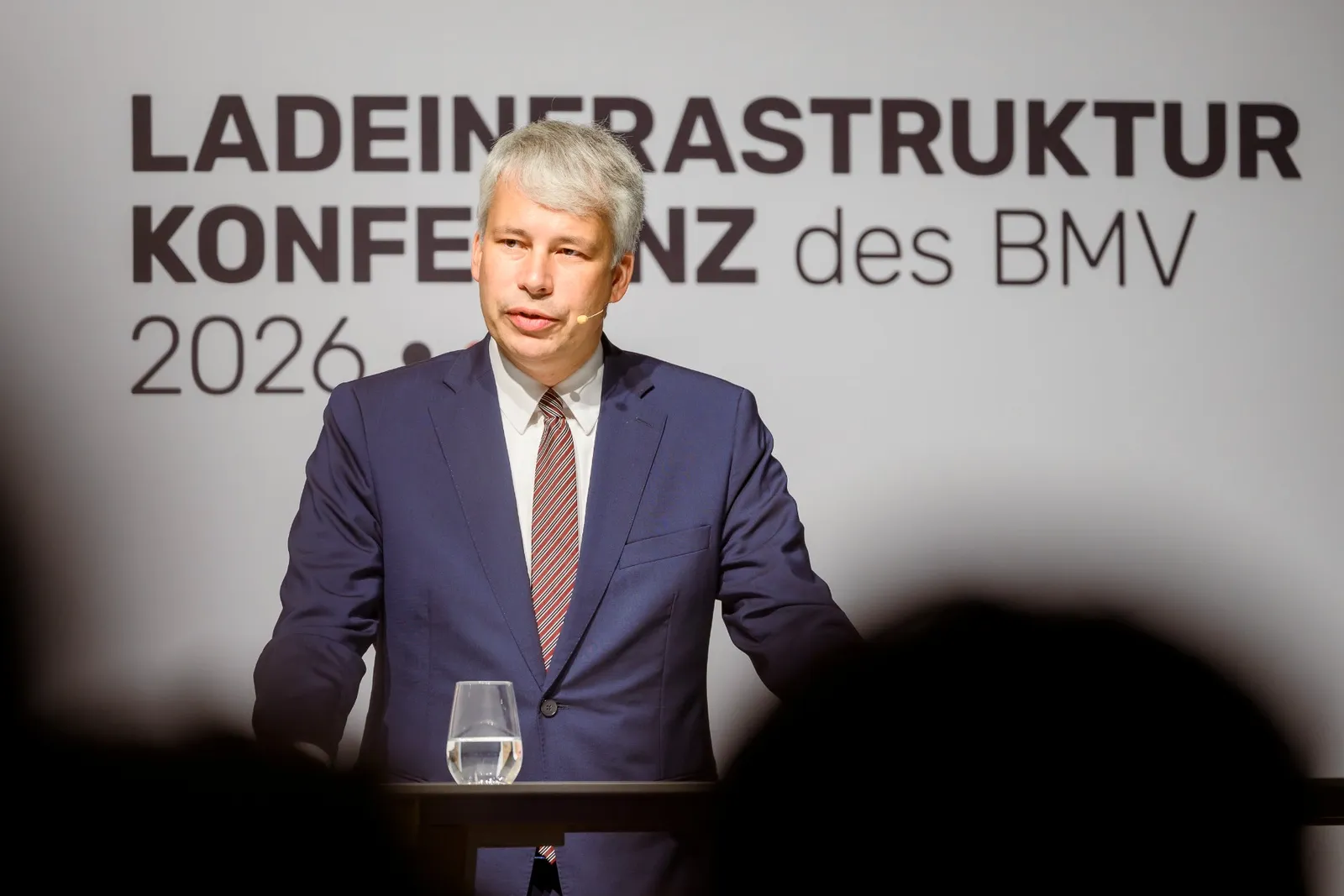
Steffen Bilger wanted to make one thing clear that morning: electric mobility works. The new Federal Transport Minister, who had already delivered his first speech on this topic in the Bundestag as a regular lawmaker in 2010, looked back far at the charging infrastructure conference held by his ministry in Berlin — to concerns about range, political debates over a million electric cars, and also to his own early experiences with an electric Fiat 500, which once failed to outperform even a Porsche in Zuffenhausen.
It was a full-blown charm offensive for electric mobility. Bilger cited 3.6 million electric cars to date, around 210,000 publicly accessible charging stations, and an average of another 60 added daily according to him. Just a few days earlier, he had opened the hundredth highway charging site in Germany’s network at an unstaffed rest area on the A81.
Yet his presentation had a small flaw: As Bilger admitted at the host’s request, he and his family do not yet drive an electric car personally—instead, they still use a gasoline vehicle. This made his political declaration all the more forceful. “The skeptics were wrong, and the pioneers were right,” the minister said at the end of his speech—adding immediately a heartfelt thank you to everyone who contributed to it.
The real message of his speech was hidden elsewhere. Bilger declared the first phase of charging infrastructure development largely complete. “We’re no longer just talking about how many charging stations will be built or have been built,” he said. The focus now is on “how we can create a coordinated overall system.” This was the underlying theme of the conference.
The second phase: Quality over quantity
Professor Stefan Bratzel from the Center of Automotive Management summarized this shift in simple terms: “We are entering a new phase of electromobility, moving away from niche products toward mass-market items.”
For Bratzel, this mainly means that the previous success metrics are losing their significance. Germany has made significant progress in expanding charging infrastructure quantitatively. However, sheer quantity is no longer enough. “The second phase must shift from quantity to quality.”
Quality, in his view, refers to availability, reliability, performance, the right location, understandable prices, and easy operation. Simply knowing whether a charging station exists is no longer sufficient in the mass market. What matters most is whether it functions reliably in everyday use. Bratzel also questions the traditional metric of maximum charging power. “The key question is how many kilometers of range I can get in my battery within five or ten minutes,” said the automotive expert.
This fundamentally changes the perspective. Charging infrastructure is no longer primarily about hardware. It becomes a product — and that product is the entire charging experience. Bratzel spoke of a “Charging Journey” that must function smoothly from plugging in to payment without any friction. In the mass market, convenience becomes the key differentiator.
His perhaps strongest statement came at the very end: “The first phase of electrification was competition for the best electric car. The next phase will be competition for the best electric ecosystem.” He meant the combination of vehicle, battery, charging infrastructure, software, electricity pricing, smart meters, and power grid. The electric car itself will increasingly become less of a bottleneck. Mobility, energy, and data now need to be considered together.
But it is precisely at this intersection that the second major topic of the conference begins — and thus perhaps the biggest problem in the industry as well.
The new bottleneck lies behind the charging station
Bilger himself provided the starting point for this: “The foundation for truck fast-charging networks and any charging infrastructure are efficient energy grids.” What sounded like a political task description from the minister became even more urgent in the speeches of other speakers.
Linda Boll, Fastned’s Germany head and also chairman of e-Mobility Deutschland e.V., brought this issue to the forefront the night before during a parliamentary event organized by her association. Her concise formula is: “No power connection, no charging station. That’s as simple as it is.”
The association now views timely access to grid capacity as a “critical bottleneck” for the implementation and profitability of charging stations. According to Boll, there is no shortage of technology, capital, or willingness to invest. The problem lies rather in the procedures.
The association is particularly critical of the regional models being developed to allocate scarce grid capacity. Some distribution network operators are replacing the existing priority system with deadlines and point systems. Charging station operators are sometimes required to already have construction permits or highly advanced hardware orders, even before they know whether they will receive the necessary grid capacity.
"If operators have to submit construction permits or hardware purchase contracts just to get a basic network commitment, it reverses the logical order of construction," Boll criticizes. Instead, he calls for "uniform, reliable standards nationwide rather than a bureaucratic patchwork."
According to calculations by the association, such procedures can delay new projects by one and a half to two years. The federal government’s network connection package, designed to reorganize these processes, is currently under parliamentary review. For the charging industry, it will be crucial how the rules are ultimately formulated.
Boll advocates for uniform national regulations, more frequent bidding rounds, and a phased approach that prevents project developers from making large upfront investments before receiving their first capacity commitment.
"The power grid is full."
The extent to which this challenge is now recognized was illustrated by Johannes Pallasch from the National Charging Infrastructure Control Center.
His focus is less on today’s charging infrastructure and more on users of the future. Current electric vehicle drivers are disproportionately often people who own property, a parking space, and their own charging station. The situation will be different in the mass market. Then there will be significantly more renters, residents of densely populated urban areas, and people without their own charging point.
Pallasch refers to this as a “held-back majority”: people who can generally imagine driving electric vehicles, but for whom the necessary conditions are still lacking. This next group of users faces an infrastructure development process whose requirements become increasingly stringent. Pallasch put it bluntly at the conference: “The power grid is full.” In the coming years, there will be “intense debates” about how additional charging infrastructure can even be integrated into the grids.
His perhaps most important message, however, was not a warning but an appeal to take advantage of the current window of opportunity. During preparations for the next phase of market growth, a phrase was uttered within the management team: “We will never again have as much time as we do now.”
This is perhaps the key insight from this fifth edition of the federal charging infrastructure conference: the mass market has not yet fully arrived. That is precisely why there is now an opportunity to prepare power connections, municipal planning, land allocation, and charging services for it. It could become much more difficult later on.
It’s not a shortage of charging stations, but a coordination problem
This also shifts the political challenge. Of course, Germany still needs additional charging infrastructure. But the question is no longer simply: How many charging stations are missing? What matters more is whether the right charging stations are built in the right locations, whether there is sufficient grid capacity available, whether permits are obtained in time, and whether charging works just as easily and cost-effectively for people without their own home chargers as it does for homeowners.
Automotive expert Stefan Bratzel previously summarized this problem in a remarkably simple formula: “I don’t think we have a real knowledge problem. But we do have an implementation problem.”
And it is precisely in this regard that the different perspectives of this conference converge: The transport minister celebrates the successes of past years. Scientists call for a shift from quantity to quality. Operators warn about the connection procedures. And the national coordination center urges making use of the remaining time before the mass market truly arrives.
The first phase of electromobility involved bringing vehicles and charging stations onto the roads. The second phase now focuses on creating a functional ecosystem. And the bottleneck of this system might just lie where it is not visible at the charging station: in the power grid behind it.
Perhaps the Federal Ministry of Transport should have organized a shuttle service between its charging infrastructure conference and the BDEW’s Netze meeting point. While industry leaders in Berlin-Moabit struggle to gain access to the grid for electric mobility, utility operators are holding conferences in Alt-Treptow. There are nearly eight kilometers between the two events. Bringing these two worlds together would be an important task for the second phase of eMobility — and for the BMV.
